Free Shipping Over$200

- Products
- Marking
- Alternative

Building a Supply Plan for a Long-Life IoT Device
A long-life IoT device can be designed correctly, certified correctly, and still fail commercially because one ordinary part disappears in year three. Teams often discover that too late. The prototype works, the pilot ships, the dashboard is live, and the product manager starts talking about a seven-year install base as if seven years were just a longer version of launch month. Supply does not behave that way. The bill of materials that looks harmless at EVT can become the part of the product that ages fastest, because radios, PMICs, memories, crystals, regulators, connectors and passives do not all share the same commercial lifespan, distributor pattern or warning rhythm.
P3.20 is about that slower clock. A connected device placed into meters, building controls, asset trackers, agricultural gateways or factory nodes usually stays in service longer than the consumer electronics cycle that surrounds many of its semiconductors. The product is expected to hold firmware support, spare stock, repairability and certification continuity across several hardware purchasing seasons. That means supply planning is not procurement work bolted onto engineering at the end. It is part of the architecture. A device with no second-source path, no lifecycle map, no stocking policy and no early-warning habit may ship once and then spend the rest of its life being defended.
The first supply decision is whether the device architecture can survive the day a wireless module goes away
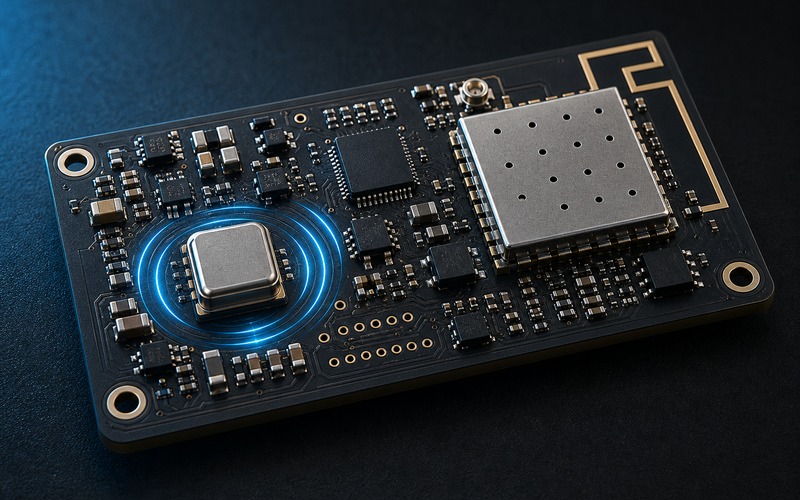
Migrating smoothly when a wireless module goes end of life matters because modules sit at a dangerous intersection of convenience and dependency. They save RF design time, shrink certification uncertainty and let a team ship faster when wireless expertise is shallow. Those are real benefits. The trap is that the module wraps radio silicon, firmware assumptions, matching, antenna rules, approval evidence and pin mapping into one purchased boundary. When that boundary disappears, the product is not replacing one line in the BOM. It may be replacing a regulatory path, a software abstraction and a mechanical keep-out all at once.
That is why the earliest supply review should ask whether the host board has been laid out to tolerate a module migration. Is there enough placement room around the module for a pin-compatible family change. Are the supply rails and wake lines generic enough that another vendor module can fit without pulling the whole power tree apart. Has firmware isolated the modem or radio control layer behind an interface that can survive command-set drift. Have antenna constraints been documented in a way a future layout team can follow without reverse engineering the first program. A module that shortens launch time may still be the right decision, but only if the product leaves itself room to stop being married to one exact module forever.
The hardest part is psychological. A team that selected a module to reduce risk tends to think of it as the safe component in the design. In lifecycle terms, it can be the sharpest concentrated risk on the board. Vendors merge, regional approvals shift, chipsets under the module are respun, and distribution dries up in layers. The migration path should be drawn when the original module is still healthy, because the day the product-change notice arrives is the worst time to begin discussing which MCU pins were assumed, which enclosure plastics were tuned around one antenna shape, and whether the old approval evidence was quietly doing more work than anyone wrote down.
A module strategy is durable only when the exit strategy is visible while no one needs it yet.
A chip shortage is not solved by asking which substitute is cheapest. It is solved by asking what else the original part was secretly doing for the system
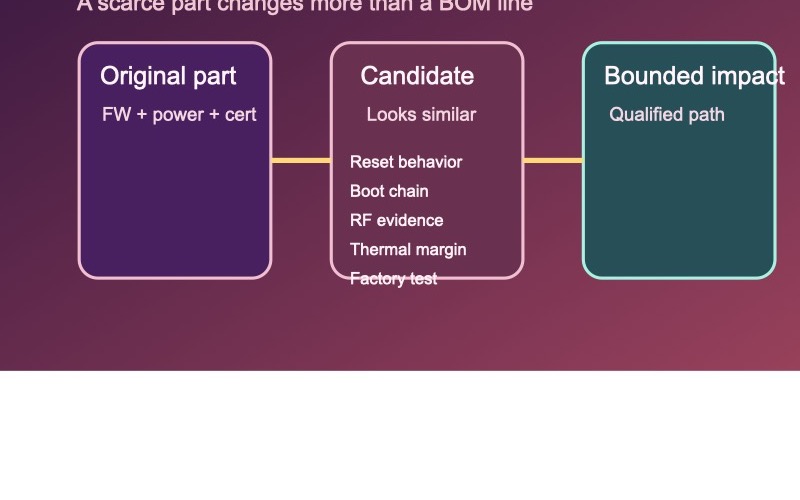
Evaluating a substitute when an IoT chip goes scarce sounds like a sourcing question, yet the real work starts in systems engineering. A scarce IoT processor, radio MCU, PMIC or interface chip carries more than its headline function. It may define sleep current, startup timing, brownout behavior, package heat path, boot ROM behavior, flash toolchain, certification references, manufacturing test coverage and years of accumulated firmware assumptions. A substitute that shares only the broad category can still force retesting across the entire product.
Teams get trapped when they compare replacements through the lens of catalog filters. Same core count. Similar RAM. Close package. Comparable interface list. Those are necessary checks and weak checks. The deeper question is what the part was buying the product architecturally. Was the original MCU surviving a harsh supply rail because of its reset behavior. Was the radio chip already integrated into an approval story the sales plan depended on. Was the processor supported by field-upgrade code that had never been ported elsewhere. Was the PMIC sequencing rails in an order the rest of the board had come to rely on. A substitute can look clean in procurement and still open three hidden redesigns at once.
A disciplined shortage response maps the component's responsibilities in layers. Electrical: voltage, current, clocks, thermal envelope, I/O thresholds, analog performance. Firmware: drivers, BSP maturity, boot control, watchdog behavior, OTA path, manufacturing programming. Commercial: supplier health, distributor reach, lead-time volatility, package continuity, geographic exposure. Compliance: whether a change touches EMC behavior, radio evidence, safety spacing or region-specific declarations. Only after those layers are visible should price and stock snapshots start to dominate the conversation. Otherwise the team is paying attention to what is easiest to compare instead of what is hardest to recover.
The product that survives scarcity is usually the one that has already separated essential behavior from vendor convenience. Then a substitute review becomes a bounded exercise rather than a controlled panic.
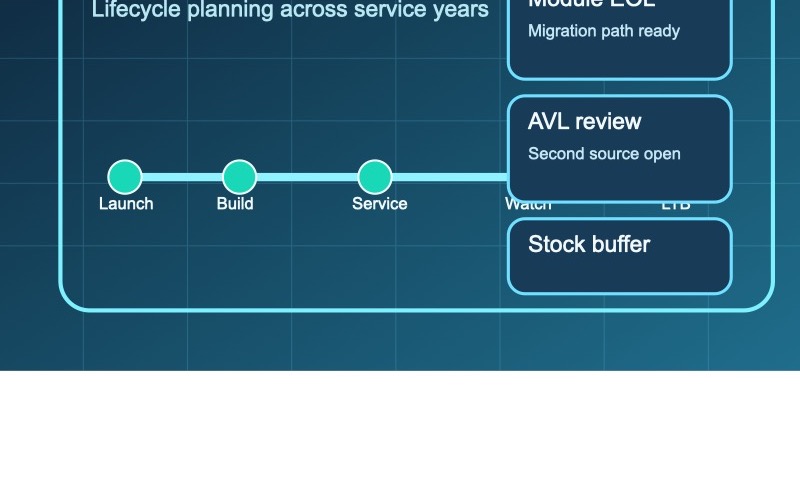
A long-life device needs a supply plan drawn across service years, not only across the first production batch
Planning supply for a long life IoT device is where the branch becomes architectural. Plenty of teams say they want a product to last seven or ten years. Far fewer define what that claim means in operational terms. How many years of uninterrupted factory build are required. Whether field spares must remain interchangeable with the original hardware revision. Whether an approved second source can enter without changing firmware certification or service manuals. Whether a board spin in year four is acceptable if installed units remain supportable. Supply planning starts by making those promises explicit, because each promise changes the stocking and qualification strategy behind it.
There are usually three clocks to reconcile. The deployment clock measures how long customers expect installed devices to remain serviceable. The component clock measures how fast semiconductors and electromechanical parts move from launch to maturity to last-time-buy. The cash clock measures how much inventory the company can afford to hold without turning the warehouse into a graveyard. A supply plan is the negotiated truce between those clocks. Ignore any one of them and the product becomes unstable in a different way. Ignore the deployment clock and the service organization inherits redesign chaos. Ignore the component clock and purchasing gets surprised by notices it should have anticipated. Ignore the cash clock and finance will reject the exact buffer policy engineering asked for.
The practical structure is boring and powerful. Classify parts by supply criticality, not just by cost. The radio, host processor, PMIC, memory and key connectors often sit in the top tier because they are hard to replace without validation pain. Mid-tier parts may still deserve approved alternates if they are single-sourced packages with uncertain lifecycle signals. Low-tier passives can often be handled by package and specification families, yet even there, odd dielectric, tolerance or automotive-screened variants can create unnecessary brittleness if the AVL is too narrow. Then place each tier on a refresh rhythm: quarterly distributor review for fragile semiconductors, semiannual AVL expansion for interface and power parts, annual packaging and commodity review for passives and mechanicals. The point is not to create paperwork. The point is to stop the BOM from becoming static while the market around it keeps moving.
A serious long-life plan also reserves design margin for future substitutions. Extra GPIO escape where a nearby pin-compatible part might differ. Flash headroom for a driver stack that may grow. Power-tree margin when a future module draws a different burst current. Mechanical space around a connector family that may need a more available shell or latch. Those margins never feel urgent during first release. They become the cheapest design choices on the whole project once the first lifecycle shock hits.
The mega mistake is to confuse a stable product with a frozen BOM. A product meant to live a long time should expect controlled change and design itself so that change arrives through known doors rather than through emergency wall-breaking.
Small-quantity buying is where many counterfeit and gray-market risks first enter the wireless BOM
Sourcing genuine wireless chips in small quantities becomes important when a team is prototyping, supporting low-volume variants or bridging a short service gap after the mainstream channel dries up. Small orders tempt people into the wrong confidence model. The amount is small, so the risk feels small. In reality, low-volume urgent buying is where traceability weakens, substitution pressure rises and visual inspection is mistaken for procurement control. Wireless chips, modules, crystals and power parts are especially exposed because a remarked or mishandled part can still power up, only to drift later under RF, thermal or sleep-current conditions that incoming inspection never reproduced.
The safe small-quantity process is less about heroics and more about discipline. Prefer authorized channels even when price is irritating. If an independent distributor is unavoidable, demand traceability evidence, date-code consistency, packaging photos, and explicit acceptance criteria before the purchase lands. Keep suspect bridge stock physically and digitally separated from approved mainstream stock. Run receiving checks that match the part's failure mode: current draw, RF link behavior, startup repeatability, oscillator accuracy, temperature drift, not only pin-one orientation and top marking. A chip that passes a smoke test can still poison a field batch if its leakage, tuning margin or memory retention is off spec.
There is also a support angle. Small-quantity emergency buys often create silent BOM splits. One repair lot uses the normal PMIC, the next uses a broker-sourced part, a service depot swaps a module revision, and six months later engineering is asked why only some units fail to reconnect after a cold morning reboot. If the purchase route changed, the configuration record should change with it. Field support cannot debug what manufacturing never wrote down. That is another reason long-life products need supply process to be treated as product behavior, not back-office detail.
A real supply plan does not wait for scarcity to define how emergency purchases are controlled. It defines that path before anyone is desperate enough to use it badly.
The best EOL notice is the one the team has already rehearsed for before the official letter arrives
Catching an end of life notice early sounds like a monitoring trick. It is an organizational habit. Manufacturers rarely wake up one morning and surprise the market without leaving smaller signals first. Product-change notices start to mention die migrations. Lead times widen with no clear recovery. Distributor availability becomes patchy by region. The sales contact grows vague about long-term allocation. Package options quietly narrow. Software support moves toward maintenance mode. None of those clues alone proves an EOL event is imminent. Together they tell a patient team that a dependency deserves attention before the formal last-time-buy window compresses every decision into the same quarter.
The monitoring system should be multi-source because every single source has blind spots. Manufacturer lifecycle dashboards are authoritative when they are updated and incomplete when they are not. Distributor stock history exposes friction but not the reason. FAE conversations surface roadmap hints yet depend on the honesty of the account relationship. Internal buyers notice price steps and MOQ changes earlier than design engineers do. Repair and service teams may be the first to see that certain revisions are getting harder to replenish. A resilient company lets those signals converge into one lifecycle review instead of leaving them trapped in separate inboxes.
Early warning only matters if it triggers predefined responses. Tier-one component enters watch state: validate alternates, expand buffer forecast, snapshot firmware branch compatibility, refresh test fixtures. Tier-two component enters watch state: check AVL breadth, confirm package options, estimate requalification effort. Vendor acquisition rumor appears around a strategic module: ask for roadmap clarity, review stocking horizon, verify whether the approval path depends on a soon-to-be-obsolete module family. These are not complicated actions. They become difficult only when the team waits for certainty. By the time certainty arrives, the calendar is usually worse than the engineering problem.
A good organization treats lifecycle notice like weather radar. The goal is not to predict the exact storm minute. The goal is to stop acting surprised when clouds have been visible for weeks.
Long-life supply planning is product design carried forward into the years after launch
P3.20 is a reminder that connected hardware lives on a supply curve as much as it lives on a schematic. A wireless module migration path should exist before the original module is threatened. A substitute review should expose system responsibilities before procurement compares unit price. A long-life product promise should be translated into tiered inventory, qualification rhythm and design margin before customers install the first fleet. Small-quantity buys should be controlled as if they were configuration changes, because often they are. End-of-life monitoring should gather weak signals early enough that an official notice feels like confirmation, not discovery.
The teams that manage this well do not eliminate change. They make change legible. Their BOM has escape routes. Their firmware has boundaries. Their mechanical choices leave room for part-family drift. Their purchasing records talk to engineering records. Their service organization can tell which hardware variant is in the field and why. That is what a supply plan buys when it is done seriously. Not only stock. It buys time, options and fewer moments where the company learns too late that a cheap-looking part had been carrying an expensive promise.