Free Shipping Over$200

- Products
- Marking
- Alternative

Clearing Wireless Approvals Before a Device Ships Abroad
A radio can work well on the bench and still be unshippable. Teams often discover this late, after the enclosure is frozen, after the antenna has been squeezed beside a battery, and after sales has already started talking about Europe, North America and China as if they were one lane. Approval work then feels like a paperwork tax. It is not. Approval work is the public record of whether the radio design, clocking, shielding, firmware behavior, labeling and production discipline match the market you want to enter.
P3.19 sits at an awkward point in an IoT build. The product already looks close to finished, so nobody wants a compliance discussion to move layout, firmware settings or the bill of materials. Yet that is exactly when the hard questions appear. Which markets matter first. Whether the radio path is built from a module or a bare transceiver. Whether the software can lock transmit power, channel plan and duty cycle in production. Whether the enclosure plastic shifts antenna behavior enough to change the test result. A wireless approval plan is not written after the device is done. It is one of the things that decides what "done" even means.
The first approval question is not which logo goes on the label, but which radio behavior you are taking legal responsibility for
Which approvals a wireless device needs to ship abroad starts with scope. A battery sensor sold only in one domestic market does not face the same stack as a gateway that must enter the United States, the European Union and mainland China in the same year. Even within one product family, an NB IoT meter, a 2.4 GHz handheld tool and a Sub GHz monitoring node can fall into different regulatory paths because their transmit bands, host interfaces and deployment environments are different.
The mistake is to treat approval as one item in a launch checklist. In practice, it is a chain of obligations. Radio emissions, immunity expectations, labeling, technical file retention, user documentation, approved antenna combinations, software control over the RF path, and the identity of the responsible economic operator can all matter. Some obligations live in the lab result. Some live in the declaration paperwork. Some live in the production line because the certified sample must still resemble what will later leave the warehouse. If those links are not owned early, the product gets trapped in a cycle of "small" engineering changes that keep resetting confidence.
A better way to frame the work is to ask what the market will hold you accountable for. Is the team claiming conformity for a finished end product. Is it integrating a radio module under defined host conditions. Is it shipping a development board that will never be the final commercial form. Each path changes how much RF responsibility sits on your shoulders and how much evidence you must keep close when questions arrive later.
The approval map is part technical boundary, part business boundary, and part record-keeping boundary.
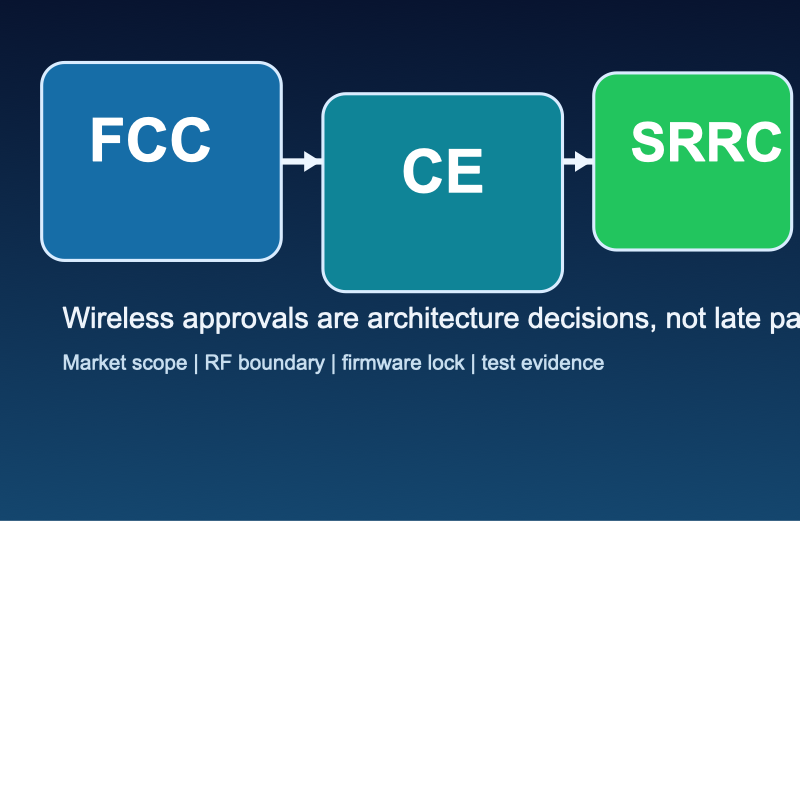
FCC and CE do not ask the same question, even when they are both looking at the same product
How FCC and CE differ for a wireless device is not a debate over which regime is harder. It is a reminder that different markets package responsibility in different ways. In the United States, teams often think first about the radio authorization path, the granted configuration and the exact conditions attached to that approval. In the European Union, engineers also need to think about the conformity route for the whole product, the supporting technical file, and whether the declarations, test evidence and user instructions line up with the real configuration being sold.
That difference changes engineering behavior. A board designer working toward one FCC filing may focus on keeping the antenna path, transmit settings and module conditions fixed enough to preserve the approved case. A designer working toward CE also has to think about how the assembled product behaves as a market-ready device, what documentation accompanies it, and whether accessories, power adapters or enclosure options create a different compliance story. The radio is still the center of gravity, yet the finished product context matters in a different way.
This is where late surprises are born. An enclosure revision that looks harmless to mechanical engineering can detune an antenna. A firmware update that exposes another region setting can weaken the argument that the shipped configuration is controlled. A second source antenna with a close paper spec can still alter radiated behavior enough to force extra work. Compliance labs do not test the product the team intended. They test the product that is in front of them, with the enabled modes, accessories and host conditions that can be shown.
The practical lesson is to freeze the compliance-relevant variables in plain language. Which antenna part numbers are valid. Which cable lengths are part of the approved setup. Which radios can transmit together. Which region settings are exposed to the customer. Which firmware build was used in the evidence pack. Without that discipline, "same product" becomes a dangerous phrase.
A precertified module does not erase compliance work, but it can move the work to a boundary your team can manage
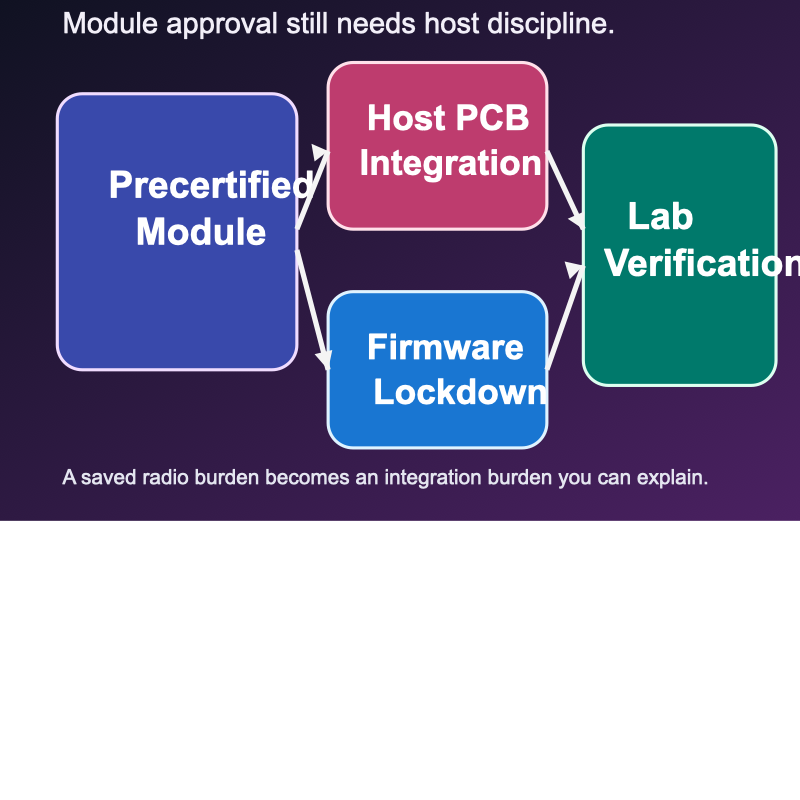
The certification work a precertified module saves is often described too loosely. A module does not let a team ignore the law. What it can do is reduce how much of the RF design is being proven from scratch. If the module vendor has already carried the radio core, firmware conditions and approved antenna combinations through a defined authorization path, the product team may inherit a tighter and more understandable boundary. That can shorten the schedule and cut risk for a small team that is stronger in application hardware than in RF debugging.
The savings are real when the host design respects the module assumptions. Keep the approved antenna or stay inside the stated antenna class. Follow the layout guidance around the keep-out, ground reference and feed structure. Avoid exposing software modes that the module evidence never covered. Preserve labeling rules and user instructions. When those conditions are honored, a module can turn a messy radio program into an integration program. That is often a better match for industrial IoT companies that need to ship a reliable product without building a deep RF certification bench inside the company.
The trap is believing that the module certificate transfers automatically to any host. It does not. The host still has its own power noise, enclosure geometry, battery placement, display cable routing and coexistence issues. The product may still need its own checks, declarations and records. In some markets, the end product obligations still remain even when the transmitter core came from an approved module. A module is not a free pass. It is a decision to buy a tested RF boundary instead of inventing one.
That purchase can be wise for another reason. It narrows change control. When a bare-chip radio design slips, the fix may sit in matching, stack-up, shielding, software timing or power rail noise. When a module-based design slips, the problem is more often in integration around the module boundary. That is still painful, yet the search space is smaller and the handoff to the lab is easier to explain.
SRRC work is not just a local paperwork variant. It pushes teams to be explicit about the domestic radio configuration they are selling
What SRRC approval asks of a domestic device matters for teams that plan to serve the China market with their own branded wireless hardware. Too many export-first product teams treat domestic approval as something to "add later" once the overseas version is stable. That split often breaks down because radio parameters, band choices, labeling, test samples and product records do not stay cleanly separated when one platform is shared across markets.
SRRC forces a direct conversation about which radio configuration the domestic product is claiming. If the device can operate across multiple bands, regions or firmware personalities, the team has to decide what is in scope for the local market version and how that scope is controlled in production. That reaches into firmware locks, manufacturing settings, model naming and after-sales support. A radio that can be reconfigured casually in the field is harder to defend than one whose approved operating envelope is plain and disciplined.
This is also where documentation habits matter. Engineers like to think that the hard work is inside the RF chain. Many later delays come from weaker habits around sample traceability, version naming, host configuration records and what the user manual promises. If the domestic unit shares hardware with an export unit, the file pack must still explain what distinguishes the Chinese commercial version from the others. If a module is used, the integration argument still has to stay coherent. If an external antenna is offered, the approved combinations and installation conditions need to stay under control.
None of this is glamorous. It is careful boundary work. Yet boundary work is what keeps a radio product from becoming an argument between engineering, sales, the test house and the future support team.
That discipline also protects schedule promises. When a sales team asks whether one platform can ship to three regions in one quarter, the right answer does not come from optimism. It comes from knowing which hardware is shared, which firmware branches are locked, which labels differ, which antenna options stay valid, and which evidence pack belongs to each commercial version. A team that can answer those points calmly is usually closer to shipment than a team that says certification will be handled "near the end."
The compliance plan should shape architecture choices while the product is still easy to move
P3.19 is not telling teams to fear certification. It is telling them to place certification where design choices are still cheap. Market scope should be set before the antenna path is boxed in. FCC and CE differences should be understood before the company talks as if one test package answers every jurisdiction. A module should be chosen when its tested boundary matches the team's real skill set and schedule, not as a panic purchase after the RF layout drifts. SRRC should be included when the domestic product is still a product definition, not a pile of half-shared assumptions.
A wireless device ships abroad only when the radio behavior, labeling, firmware control and product records all point in the same direction. When they do, approval work feels orderly. When they do not, the lab becomes the first place the organization discovers what product it was building. That is an expensive place to learn something that architecture and change control could have settled months earlier.