Free Shipping Over$200

- Products
- Marking
- Alternative

800V Data Center Power: Component Selection Guide for AI Racks
800V Data Center Power: Component Selection Guide for AI Racks
Quick Summary
If an AI rack moves toward higher-voltage power distribution, the component problem changes fast. The design is no longer only about choosing a bigger power supply. Engineers need to review the whole power path: switching devices, busbars, connectors, protection, current sensing, isolation, capacitors, and thermal hardware.
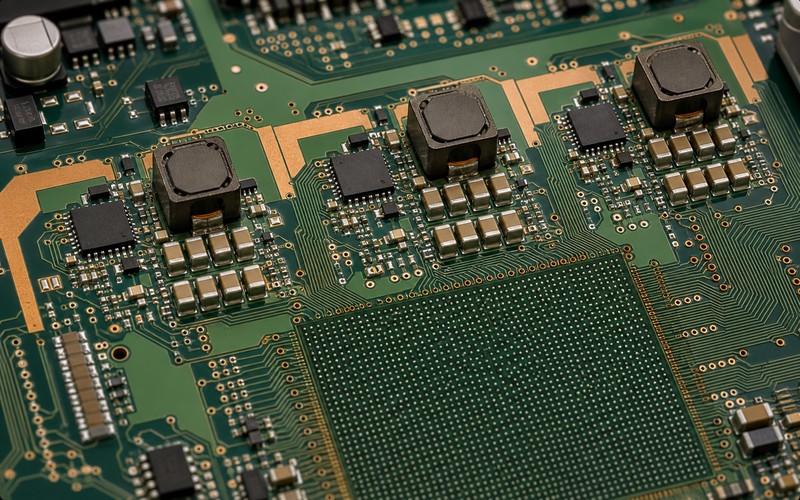
The short answer: 800V-style data center power can reduce current for a given power level, but it raises the bar for insulation, fault handling, service safety, and component qualification. That tradeoff is the real story for buyers and engineers.
This is not a simple replacement of 48V with 800V. Real data center power systems will probably mix several voltage domains for a long time. Some equipment will stay with familiar 48V distribution. Some power shelves and sidecar cabinets will move higher. Some conversion stages will sit closer to the load. The important question for engineers and buyers is narrower: which components become harder to choose when rack power density rises?
The answer starts with the power path. Busbars, connectors, DC/DC converters, protection devices, current sensors, isolation parts, gate drivers, DC-link capacitors, thermal interface materials, and wide-bandgap switches all move closer to the center of the design review. A part that was once selected late in the project can become a system constraint.
What Happened
AI infrastructure has made rack-level power distribution more visible. A dense accelerator rack can no longer be treated as a normal server rack with larger power supplies. The electrical path from the facility feed to the accelerator board now affects efficiency, thermal design, serviceability, and safety.
Higher-voltage DC distribution is getting attention because it attacks one of the most obvious pain points: current. When voltage rises, current falls for the same power level. That can reduce copper loss and make the mechanical power path more manageable. But higher voltage creates new work in insulation, creepage, clearance, fault isolation, service procedures, and component qualification.
At the same time, cooling is expanding beyond chips. Power conversion modules, busbars, connectors, and protection devices can all become heat sources in a dense rack. A power path that is electrically efficient may still be hard to package if the heat has no clean path out.
The useful question is how higher rack power changes the parts that engineers specify and buyers source.
Component-Level Impact
| Component area | What changes in a high-power AI rack |
|---|---|
| SiC, GaN, high-voltage MOSFETs | Voltage rating, switching loss, gate drive, package inductance, and thermal path become selection filters. |
| Protection devices | DC fault energy, interruption behavior, isolation monitoring, and service disconnects matter more than nominal ratings. |
| Capacitors and passives | Ripple current, lifetime, mounting, and thermal rise can block a design even when capacitance looks correct. |
| Connectors and busbars | Contact resistance, creepage, clearance, cooling, and mechanical service access become part of the same decision. |
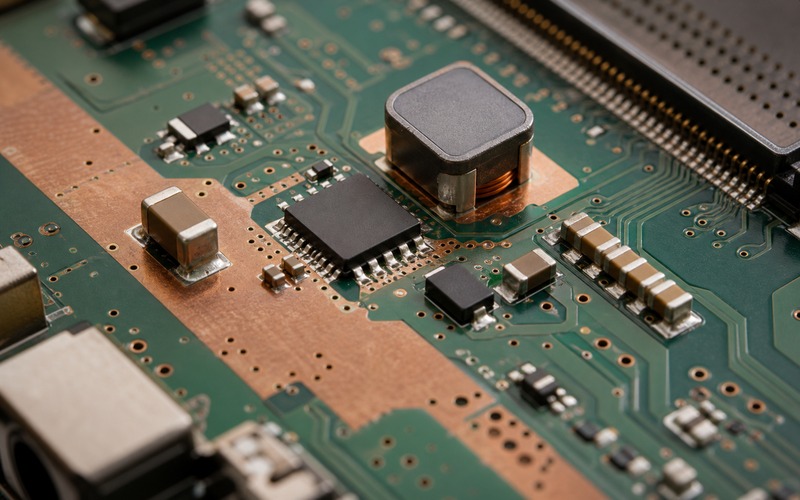
Switching devices get the first review. High-voltage front-end conversion can push designs toward SiC devices or high-voltage silicon MOSFETs. GaN may fit high-frequency conversion stages where voltage class, package, thermal path, and cost make sense. None of these technologies should be treated as a generic efficiency upgrade. Gate drive behavior, package inductance, short-circuit tolerance, thermal impedance, and supplier support all matter.
Protection parts become architecture parts. Fuses, eFuses, solid-state circuit breakers, contactors, relays, isolation monitors, TVS devices, and current sensors have to match real fault energy. DC faults do not behave like ordinary low-voltage board faults. A component that looks fine on voltage rating alone may be wrong if it cannot interrupt the expected DC fault or survive the thermal stress around it.
Passive components carry more responsibility. DC-link capacitors, film capacitors, high-voltage MLCCs, current sense resistors, common-mode chokes, and snubbers need to be checked for voltage, ripple current, lifetime, thermal rise, and physical mounting. A capacitor chosen only by capacitance and voltage rating can fail the real application.
Connectors and busbars also move up the risk list. Contact resistance, temperature rise, touch safety, mechanical retention, creepage, clearance, plating, and service access all become part of the same decision. A connector is no longer just a current rating and a pin count.
Engineering Design Considerations
The best engineering question is not "Can this part handle 800V?" It is "Can this part survive the real electrical, thermal, mechanical, and service conditions of this rack?"
Start by separating voltage conversion, distribution, protection, and service. A design can look efficient on a block diagram and still be hard to shut down safely, hard to repair, or hard to diagnose after a branch fault. Startup, hot-plug behavior, maintenance disconnects, and partial rack failures need to be reviewed before the hardware is locked.
Creepage and clearance should be handled early. At higher DC voltage, insulation planning touches the PCB, connector, busbar, enclosure, coatings, slots, barriers, and service covers. These are not cosmetic details. They affect the mechanical design, manufacturing process, safety review, and test flow.
Thermal design needs a power-path view. Lower current can reduce copper loss, but rack density often rises at the same time. Converter modules, busbars, terminals, and protection devices need defined cooling assumptions. Liquid cooling can help in some systems, but it adds questions around sealing, service, leak detection, materials, and supplier qualification.
Sensing and control should not be treated as add-ons. Higher-voltage power paths need current measurement, temperature monitoring, isolation feedback, and fault reporting that the service team can trust. If a failing branch cannot be located quickly, the system may lose the operational benefit of a more efficient power architecture.
Sourcing Impact
The sourcing risk is that many parts look standard until the actual application is described. A connector may meet the current target but fail temperature rise in a dense rack. A relay may meet voltage rating but not DC interruption. A power module may have strong efficiency on paper but require an isolated driver, thermal interface, or control IC with a long lead time.
Buyers should qualify component families rather than single orderable numbers where possible. For a DC-link capacitor, that means looking at voltage, capacitance, ripple current, lifetime, terminal style, and case size. For connectors and busbars, it means validating the full mechanical and thermal path instead of matching a similar catalog item.
Second sourcing is harder in the power path than it looks. A replacement must fit the electrical rating, safety spacing, mechanical geometry, thermal rise, and assembly process. A near match can still create a requalification project.
Lifecycle also matters. AI accelerator boards may change quickly, but the rack power hardware around them needs stable documentation and long availability. The power path is not the right place for casual substitutions.
Buyer Checklist
- Confirm nominal bus voltage, transient voltage, and expected fault energy.
- Ask whether the part is rated for DC interruption, hot-plug, or continuous high-current operation where relevant.
- Check creepage, clearance, insulation system, pollution degree, and enclosure assumptions.
- Request thermal data under realistic mounting and airflow conditions.
- Review lead time for SiC, GaN, isolated drivers, current sensors, DC-link capacitors, connectors, and busbars.
- Confirm whether alternates have been tested in the real mechanical and thermal stack.
- Avoid single-sourcing custom power-path hardware unless the project has a validated recovery plan.
Common Mistakes to Avoid
- Choosing connectors from current rating alone.
- Treating GaN and SiC as interchangeable efficiency upgrades.
- Leaving creepage, clearance, and touch safety until the enclosure phase.
- Approving a cheaper busbar or connector alternate without thermal testing.
- Assuming protection parts behave the same in high-voltage DC as they do in low-voltage board power.
Related Reading
- Power conversion choices for connected hardware
- Power-integrity passives on an AI board
- Surge and ESD protection for connected hardware
What to Watch Next
The next useful signals will be practical rather than dramatic: more qualified high-voltage connectors, more protection parts with DC-specific data, clearer thermal models, and more reference designs that pair sensing and fault handling with conversion efficiency.
Teams should also watch how fast standards, safety practices, and service procedures catch up. High-voltage rack power can reduce current, but it only becomes production-friendly when the parts, test process, and field service model are boring enough to repeat.