Free Shipping Over$200

- Products
- Marking
- Alternative

Letting a Device Read Ambient Light and Color
A light sensor that reports lux looks like it has done the whole job, until the reading climbs under an incandescent bulb that looks no brighter to the eye. The trouble is that bare silicon sees far into the infrared, where the eye sees nothing at all, so a sensor that does not correct for its own spectral response measures a different light than the one a person experiences. Reading ambient light well is largely a matter of making the sensor see the way the application needs, rather than the way the silicon naturally does. A photodiode and an eye both turn light into a signal, but they answer to different bands, and bridging that difference is the quiet work behind every light reading.
That gap between what the silicon sees and what the eye sees runs through every choice here. Some parts bury the correction inside, applying a filter that mimics the eye's response and reporting a lux value a designer can trust. Others hand back raw counts across one or more wavelength bands and leave the interpretation to the host. Color is the same problem turned up a notch, since reading color means measuring several bands at once and keeping infrared from leaking into all of them.
Parts that report lux directly
The convenient parts do the spectral correction and the conversion inside and hand back a number already in lux. They suit anything that adjusts to ambient brightness, a phone dimming its screen or a thermostat reading the room, where the host wants an answer instead of a measurement to process. The differences among them come down to accuracy, dynamic range, and how closely each one follows the eye. A part that nails all three costs more and is rarely needed, so the choice is usually about how much correction the job warrants.
The BH1750 gives a digital lux reading straight over I²C, a cheap and popular part that needs no calibration to be useful and nothing external beyond decoupling. It resolves from a fraction of a lux up to tens of thousands, enough to span a dim room and a bright window, and its selectable modes trade resolution against speed. An address pin lets two share a bus, and a full conversion runs in tens of milliseconds, fast enough that a screen tracking the room never feels laggy. Its spectral response approximates the eye rather than matching it tightly, so it is the part for knowing roughly how bright a space is, which is what many ambient-adjust jobs need and no more.
The VEML7700 measures ambient light at higher accuracy and with a closer match to the eye's response, carrying a wide dynamic range and a configurable integration time and gain. At the low end it can stretch the integration time to pull a reading out of near darkness, and at the bright end it drops gain so direct sun does not pin the output, the two adjustments that let one part cover an interior and a sunlit window. It is the step up for when the lux number has to be right, in a light meter or a display calibrating its brightness against a target, where tracking the room loosely will not satisfy the requirement.
The OPT3001 measures brightness the way the eye responds, built specifically to match the human photopic curve and to reject the infrared that would otherwise inflate a reading under incandescent light or sun. That matters wherever a device has to agree with how a person perceives brightness, since a sensor that counts infrared a person cannot see will dim a screen wrongly under a warm lamp. It reports lux over I²C with the correction already applied, and it raises an interrupt when the level crosses a window the host sets, so a device can sleep and let the part watch for a change in lighting in place of polling, which matters in a battery device where waking to read the light all day would drain the cell.
All three end at a lux number, and the choice among them is how tightly that number has to mean what the eye means, set against cost.
Bare light, read as a current
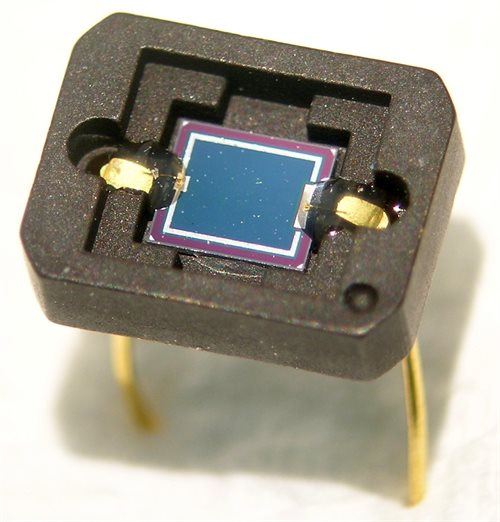
Before any of that integration, light is a current. A photodiode produces a current proportional to the light striking it, and the BPW34 is a common photodiode for exactly that, the part a designer reaches for to get the raw optical signal and build the amplifier and the response shaping around it. It is fast and broadband, and it sees well into the infrared, which makes it flexible and also means the surrounding circuit supplies the spectral shaping a packaged lux sensor would have done internally. Its speed suits an encoder or a light barrier counting interruptions, and its bare junction hands the designer every part of turning a current into a number, in pulse oximetry and any optical job that does not fit a finished sensor.
The TEMT6000 reads ambient light as an analog output, a phototransistor with a response shaped roughly toward the visible, giving a voltage that climbs with brightness straight into an ADC pin. It sits between the bare photodiode and the digital lux part, simpler than a full sensor and more finished than a raw diode, and its narrow field of view suits reading the light falling on one spot. It is the choice for a cheap brightness reading where a rough analog level is enough and a bus would be more than the job needs.
Why a light sensor has to see like the eye
The thread under all of these is spectral response, the plain fact that a sensor and an eye do not see the same light. Silicon peaks in the near infrared, a band the human eye cannot detect at all, so a photodiode pointed at a scene reports a heavy dose of infrared the person standing there never perceives. An incandescent bulb and the sun both pour out infrared, while a fluorescent tube or a white LED put out almost none, so an uncorrected sensor reads the same visible brightness as two different levels depending on the source, and a screen set to dim by it would behave one way indoors and another by a window. The fix is to bend the sensor's response toward the eye's, the photopic curve that peaks in the green and falls to nothing at the edges of the visible, done either with an optical filter over the die or by measuring several bands and computing the visible part. Dynamic range is the second hard part, since useful light runs from well under one lux in a dim room to tens of thousands in direct sun, a span no fixed gain covers, which is why these parts carry adjustable integration time and gain and step them automatically. The integration time also sets how much the reading is smoothed and whether it picks up the flicker of mains-driven lighting, which beats against a short integration window and makes a reading wander unless the timing is chosen to average over whole mains cycles, and PWM-dimmed LED lighting raises the same problem at a higher rate. None of this shows in a single lux figure on the front page, and all of it decides whether the number means what a person would call brightness. The honest move is to read the spectral response curve in the datasheet, not only the lux range on the front page, since that curve is where a part either agrees with the eye or quietly does not.
Reading color, not only brightness
Color is brightness split into bands. In place of one number for how much light there is, a color sensor reports how much falls in red, green and blue, and from those a host works out a color or a color temperature. The infrared problem returns sharper here, since infrared leaking into any channel pushes the reported color away from the one a person sees, and the channels themselves are filtered dyes over photodiodes whose match to true red, green and blue is approximate, so a color part lives or dies on its infrared rejection and its calibration.
The APDS-9960 does proximity, gesture and RGB sensing in one part, pairing a color sensor with an infrared emitter and detector so it can also notice a hand approaching or sweeping past. It is the part behind a phone that wakes when a hand waves over it and blanks the screen against a cheek on a call, folding several optical jobs into one small package. Its gesture engine reads the direction of a sweep from the order in which its photodiodes brighten, enough for a wave-to-next or a hand-to-snooze without a camera. The proximity reading comes from timing the reflection of its own infrared LED, so it works in the dark where a camera would need light of its own, while its RGB channels give a coarse color read short of a calibrated measurement.
The TCS34725 senses color with an infrared-blocking filter over the die, the detail that lets it report a color close to what the eye sees instead of one skewed by infrared. It gives red, green, blue and clear channels over I²C, and from their ratios a host computes a correlated color temperature, the warm-to-cool number a camera or a smart bulb uses to set white balance. The common breakout carries its own illumination LED, so the color read does not depend on whatever ambient light happens to land on the target.
Light at one particular wavelength
Sometimes the point is not overall brightness but light in one specific band, and the sensor is chosen for what it ignores as much as for what it reads. Filtering the response down to a narrow range turns a light sensor into a measure of a single thing, which is how one optical part does a job that a broadband sensor would only muddy.
The VEML6070 measures ultraviolet intensity, responding to the UV-A band and reporting a level that maps toward a UV index, the part for a wearable or a weather node that warns about sun exposure. It reads the band the eye cannot and ignores the visible light that floods every outdoor scene, and its integration time sets the balance between speed and sensitivity, with the raw count mapping to a UV index through a documented table in place of a single scale factor. That is the whole reason a dedicated UV part exists, rather than a guess derived from a visible-light sensor.
The SFH5711-2/3-Z is built for display backlight control, a light sensor whose response is shaped to the eye and whose output is logarithmic, compressing the enormous range from a dark room to bright sun into a manageable signal. The logarithmic shape is the right one for backlight control, since perceived brightness is itself logarithmic, so a linear step in the output matches a perceived step in brightness. Each decade of light shifts the output by a fixed amount, which means a few millivolts of change always stand for the same ratio of brightness, in a dark room or under noon sun, and a screen dimmed by it tracks what the eye expects across the full range without separate handling for the dim and bright ends. That single logarithmic channel does the work of the gain-switching a linear sensor needs, which is part of why it became a standard answer for phone and laptop backlights.
Letting the question decide the sensor
Across the whole group the recurring lesson is that a light sensor is only as good as the match between its spectral response and the eye or the application it serves. A part with the wrong response hands back a confident lux number that disagrees with every person who looks at the same scene, and no amount of resolution rescues a reading that is measuring the wrong light to begin with.
So the first question is rarely how many lux a part can resolve. It is what light the job cares about, and how closely the sensor can be made to see only that, which is what divides a brightness reading a person would agree with from a number that merely looks precise.