Free Shipping Over$200

- Products
- Marking
- Alternative

Measuring Current and Magnetic Field Without Opening the Circuit
Measuring a current without cutting into the wire means measuring one of two things it leaves behind: the small voltage it drops across a known resistance, or the magnetic field it throws around the conductor. Every current-sensing part is one of those two ideas built out, and the choice between them sets the accuracy and the isolation, and how far the measurement intrudes into the circuit, before any part number is picked. The current level and the rail voltage, more than anything else on a datasheet, steer that first split.
The two ideas are the same physics seen twice, since a current and the magnetic field around it are inseparable. A shunt turns the current into a voltage to amplify and digitize, while a Hall or magnetic sensor reads the field directly and never touches the conductor. The same magnetic parts that sense current also sense position and proximity, since a magnet on a moving part throws a field a sensor can read, so one family ends up covering current and field together, and an engineer who learns the magnetic side for one job often reuses it for the other.
Reading the voltage across a shunt
The direct way puts a small, precise resistor in the current path and measures the millivolts across it. Sensing current without breaking the circuit open this way is cheap and accurate, yet the shunt drops a little voltage and dissipates a little heat, and the amplifier reading it has to cope with whatever voltage the whole rail sits at. That last point, the common-mode voltage the sense pins float at, is what splits shunt parts into low-side and high-side designs, and it decides much of what follows.
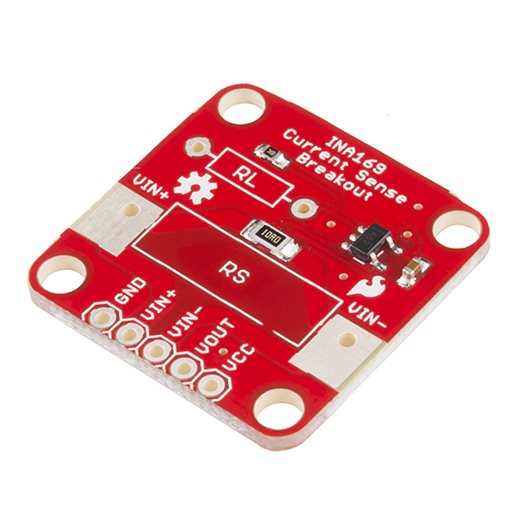
The INA226 measures high-side current and power, sitting on the supply side of the load where the common-mode voltage is the full rail. It carries a precise internal amplifier and an ADC, multiplies the current by the bus voltage it also measures, and reports power directly over I²C, which spares the host the arithmetic. High-side sensing catches a short to ground that a low-side shunt would never see, and the part handles bus voltages up to a few tens of volts, enough for many battery and intermediate rails. Its accuracy leans on a clean Kelvin connection to the shunt, the two sense traces tapping the resistor right at its pads so the trace resistance never adds itself into the reading, a layout detail that quietly decides whether the rated accuracy survives onto the board. It also lets the host set warning and alert limits on current or power, so an overcurrent raises a flag without the processor watching the bus the whole time.
The INA219 reads current and voltage on a power rail in much the same shape, an earlier and widely used part that also returns power over I²C. It covers a slightly lower bus range and is the one many power-monitoring projects reach for first, with breakout boards on every shelf. Both parts expose calibration and alert registers, so a host can set a current threshold and let the part raise a pin rather than poll, the kind of detail that shapes a design as much as the headline accuracy. Between the two, the choice comes down to the bus voltage and the resolution needed, with sourcing often the tiebreaker.
Reading the field instead
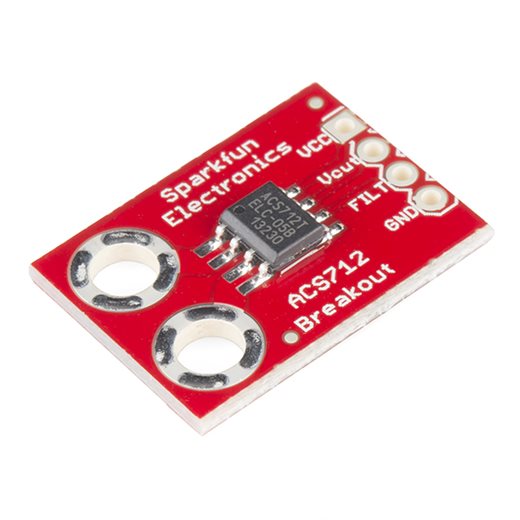
The other way puts no resistor in the path at all. The ACS712 senses current with an internal Hall element, running the current through a low-resistance copper path inside the package and reading the field it produces, which keeps the measurement galvanically isolated from the rail. That isolation is the whole appeal, since the sensing side can sit at logic level while the current path swings hundreds of volts, with no common-mode problem and almost no insertion loss. The price is paid in accuracy and drift, a Hall reading being noisier than a good shunt and wandering more with temperature, plus a zero-current offset the firmware has to null out and a bandwidth that limits how fast a current edge it can follow. For a clean reading the package wants a little distance from other current-carrying copper, since it reads any field around it, not only the one in its own path.
The ACS758 carries the same idea to higher currents, with a heavier internal conductor rated for tens of amperes. It is the part that goes into motor drives and battery packs, where a shunt big enough to carry the load would waste real power as heat and need cooling of its own. Its bandwidth is wide enough to catch the fast current edges of a switching stage, and a fault-flag variant can trip a protection circuit before an overcurrent does damage. It accepts the same accuracy penalty for the same isolation, and it earns its place wherever the current is large enough that a shunt's dissipation turns into a design problem in itself.
Shunt or field, and where to tap
Choosing between the two routes is the real decision, and it turns on isolation and on how much accuracy the job needs, with power loss close behind. A shunt with a good amplifier is the accurate, inexpensive answer when the rail voltage is modest and a small series resistance can be tolerated, and it stays linear across a wide range. It pays in three coins: the resistor burns current squared times resistance as heat, which wastes power and warms the resistor enough to shift its value unless its temperature coefficient is low; it gives no isolation, so the amplifier has to survive the full common-mode voltage of the rail; and it sits in the current path, so a fault current runs straight through it. Low-side and high-side each swap one risk for another, a low-side shunt being simpler but leaving the load floating above true ground, a high-side shunt seeing the full rail but catching the ground faults a low-side part hides. A Hall or fluxgate part removes the insertion loss and the isolation worry in a single move, which is why it dominates at high current and high voltage, but it gives back accuracy, adds temperature drift, and reads any stray field nearby, so a busbar carrying a neighbouring current can corrupt it unless the layout keeps that field at a distance. None of these appear in one accuracy figure, and the route is usually plain once the rail voltage and the current level sit on the table, a shunt taking the low-voltage precision jobs and a Hall part the high-voltage isolated ones, with a fluxgate held in reserve for the cases that demand both isolation and real accuracy and can carry the higher cost.
The same sensors, reading position
A Hall sensor does not care whether the field it reads comes from a current or from a magnet, so the technology that measures current also measures where something is. Put a small magnet on a moving part and a nearby Hall sensor reports its passage, its angle, or its distance, which is how countless throttles and lids know where they are without a contact to wear out. This is the larger half of the magnetic-sensor business, position sensing rather than current, and it explains why the same catalogue page can sit between a motor-drive current sensor and a joystick.
The DRV5053 is an analog-output Hall sensor that gives a voltage proportional to the field strength, the simplest building block for sensing proximity or speed. It reads straight into an ADC pin with no bus to manage, and suits a tachometer picking up a magnet on a spinning shaft or an end-stop that closes when a lid shuts. It comes in unipolar and bipolar variants and a few sensitivity grades, so a design matches the part to how strong a magnet it can mount and how close that magnet can sit, and its low cost lets a board scatter several around a mechanism without weighing each one. Its response is fast enough to count the teeth of a passing gear for a speed reading, a common job once a magnet rides on a rotating part.
The SS49E does linear magnetic field sensing in the same analog style, a long-running part whose output voltage tracks the field through both polarities around a centre point. Its output is ratiometric to the supply, so a clean rail and an ADC referenced to the same voltage keep the reading honest, and like any analog Hall part it drifts with temperature enough that a precise job has to correct for it. It turns up in joysticks and position sensors, and in the current-clamp probes that read a wire's field from outside its insulation.
These analog parts hand back a number that still needs scaling and offset work on the host, and each reads a single axis. When a design needs the field as a vector, or wants the part itself to do more of the work, it moves to a digital three-axis sensor.
Field as a vector in space
A three-axis magnetic sensor reports the field along all three directions at once, which lets a host work out not only how strong a field is but where a magnet sits in space relative to the sensor. That turns a magnet into a contactless joystick or a rotary knob, and it underlies fine position sensing that needs neither optics nor a contact to wear out. Three numbers also let the host cancel a uniform background field by subtracting it across all axes, something a single-axis part cannot do on its own.
The MLX90393 measures the field on three axes with selectable range and resolution over I²C or SPI, a flexible part for tracking a magnet's position in two or three dimensions. It can sit in a low-power mode and wake on a field threshold, raising an interrupt so the host stays asleep until a magnet moves at all, and its configurable balance between range, speed and noise lets a single part cover jobs that would otherwise call for several different sensors.
The TLV493D does three-dimensional magnetic position at low power, a tiny part that sips current and suits a battery device tracking a magnet, a thumbstick on a controller or a detented knob that reports its angle. It speaks I²C and offers a low-power cycle where it wakes, takes a reading, and sleeps on its own, so the average current stays down in the microamps across a slow position read, which is the reason it lands in handheld and wearable controls.
The TMAG5273 is a configurable three-axis Hall sensor, a newer part with low drift, an onboard temperature sensor for compensation, and an angle-calculation engine that returns a computed angle in place of three raw field values. Several I²C address options let a few of them share one bus reading different parts of a mechanism, and its configurability lets one device serve a spread of position jobs that older parts needed a drawer of variants to cover. It is the choice when a design wants accurate angle sensing with the trigonometry done inside the part.
Across all of the magnetic parts the recurring trap is the stray field. A three-axis sensor reads a nearby motor and the current in an adjacent trace as willingly as the magnet it was meant to track, so calibration and a layout that keeps interfering sources at arm's length matter as much as the part's own resolution. A magnetic design that skips that ends up measuring its own circuit instead of the thing it was pointed at.
Letting the rail and the field decide
Current and field come back to the same fork. To read a current, decide whether a shunt's accuracy or a Hall part's isolation fits the rail, and let the voltage and current levels settle it. To read a field for position, decide whether a single analog axis is enough or the job wants a digital vector, and how much power and accuracy the design can spare for the sensing.
In both halves the sensing element is the easy part to buy. The common-mode voltage, the stray field and the thermal drift wrapped around it are what decide whether the reading can be trusted.