Free Shipping Over$200

- Products
- Marking
- Alternative

Reaching Kilometers at Low Power With a Sub Gigahertz Radio
A sub-gigahertz radio reaches kilometers on the same coin cell a short range radio would drain inside a room, and it gets there by trading data rate for link budget rather than by spending more power. The range is bought with physics and with how the signal is coded.
That trade is the whole character of the band. A sensor on a sub-gigahertz link can sit in a field, a basement, or a flooded pit and still reach a gateway a town away, as long as it has little to say and can wait its turn to say it. The parts that do this are cheap and sip current, and the limits that ride with them are written into the radio rules as much as into the silicon.
Why a lower frequency reaches farther
Two effects stack up to give sub-gigahertz its reach. A lower carrier frequency loses less energy passing through walls and bending around terrain than a 2.4 GHz signal does, so the same transmit power lands more of itself at the far end, and the practical difference across a built-up area or a stand of trees is large rather than marginal. The lower frequency asks for a longer antenna in return, since a quarter wave at 868 MHz runs around eight centimeters against a couple at 2.4 GHz, which is a real constraint on a small node and one of the first things a sub-gigahertz design has to make room for. The antenna efficiency counts as much as its length, since a short or badly matched antenna throws away the link budget the low frequency worked to win, and a node squeezed for space pays for that in range it never sees on the bench, and on a compact node the ground plane and the clearance around the antenna end up dictating the board outline more than the radio chip does. On top of the physics sits the coding, and on a LoRa link the coding is where much of the range is made.
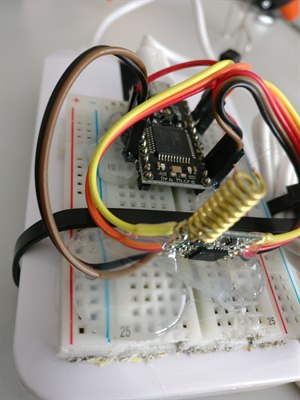
LoRa spreads each bit across a chirp that sweeps the band, and a receiver can pull that chirp out of noise even when the signal sits below the noise floor, which is the trick that buys the distance. The spreading factor, from about 7 up to 12, sets how far the chirp is stretched: a higher factor spends more time on each symbol, which lifts the receiver sensitivity toward the floor near minus 137 dBm that LoRa is known for, and a link budget that deep is what turns a few tens of milliwatts into kilometers. The cost is paid in time and data rate. A higher spreading factor means each symbol takes longer to send, so a message that goes out in tens of milliseconds at a low factor can take the better part of a second at a high one, and the rate falls from tens of kilobits toward a few hundred bits a second. Air time is the currency that matters, for energy and for sharing the band alike. A transmission that holds the radio on for a second at a hundred milliamps spends real energy, so reaching kilometers from a coin cell works only because the device sends a short payload now and then and sleeps at a microamp the rest of the time, never because the radio is thrifty while it transmits. The receive side carries its own weight, since holding a window open to catch a downlink costs current too, so a node that has to listen often gives back part of what the transmit side saved. None of this scales the way a newcomer expects, because pushing the spreading factor up to chase a marginal link can quadruple the air time and the energy per message, and at some point a better antenna or a gateway placed with more care buys more range than another step of spreading does. A network that knows what it is doing leans on adaptive data rate, letting the gateway nudge each node down to the lowest spreading factor its link can hold, so the nodes near the gateway stay fast and cheap and only the far ones pay the high cost. Bandwidth is the other dial, and the common 125 kHz setting trades against wider ones that move data faster but hear less, with a coding rate layered on top for error correction, so a frame's real air time falls out of all of these together and not the spreading factor alone. The range that results is a planning figure rather than a promise, since open country can carry a link like this well past ten kilometers while a dense city might hold the same radio to one or two, and the only honest number comes from a survey of the real site. The way to size one of these links is to fix the payload and the reporting interval first, read the air time off the spreading factor the range demands, and only then check that the battery and the band rules can both carry it.
The band itself is set by region. A device for Europe lives in the 868 MHz ISM band, one for North America in 915 MHz, and the two are not interchangeable, so a product sold in both carries either a switchable radio or two build variants that diverge at the antenna match. Each band fixes its own power ceiling and its own rules on how a device may use the air, and those caps shape a design as firmly as the battery does.
The cost that comes with the range
The transmit limit bites hardest as a duty cycle cap. A device in the EU 868 MHz band may be allowed to transmit only around one percent of the time, which sounds generous until a long frame at a high spreading factor eats the better part of a second and the node then has to stay silent for a minute or more before it may speak again. That turns the reporting interval into a legal constraint as much as a battery one, and it quietly rules out the chatty designs that work fine on a short range link, so a sub-gigahertz product is planned from the start around sending little and sending it rarely.
The LoRa transceivers
The LoRa transceiver that defined the category is the SX1276 and its classic LoRa radio, a part that pairs a sub-gigahertz transceiver with the LoRa modem and talks to a host MCU over SPI. It covers the common bands from 137 to 1020 MHz, reaches the deep sensitivity the technology is known for, and carries enough installed base that a design built on it has a wide pool of reference code, stacks, and ready modules to draw from, which is often reason enough to start there on a first product.
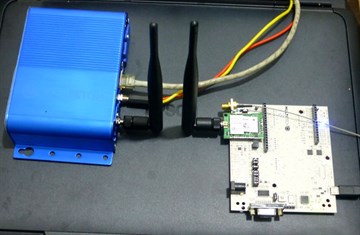
The newer generation trims the power and the size in a way that matters on a battery. The SX1262 lowers the receive and sleep current against the older part while reaching a higher output power, up around 22 dBm, in a smaller package, which is why fresh designs tend to start there and why a long-lived product often plans a move onto it. It keeps the same SPI-attached shape and a close software story, so it drops into a host much the way its predecessor did, and the lower receive current in particular helps any node that has to keep a downlink window open. The gain is real enough that the older part is now chosen mostly for continuity rather than for a fresh design.
Where the full band coverage and the deepest reach are not needed, the cost comes down further. The LLCC68 is a cost optimized LoRa part that gives up some of the spreading factors and the band range of its sibling to hit a lower price, which suits a high volume node that works in one region and never needs the longest link the family can manage.
Within LoRa the parts mostly differ by power draw and price, not by reach.
Sub-gigahertz beyond LoRa, and the integrated parts
Not every sub-gigahertz link is LoRa, and for a lot of jobs it should not be. The CC1101 is a general purpose sub-gigahertz transceiver that runs plain FSK and OOK modulation, which suits a short proprietary protocol over a few hundred meters where a device does not need LoRa's extreme sensitivity and would rather keep the air time, the licensing, and the complexity down. It has been a workhorse in remote controls, alarm sensors, and simple telemetry for years, and its plain modulation keeps the per-message energy low when the range is modest and the link is clear.
For more reach without going all the way to LoRa, the Si4463 pushes a sub-gigahertz link further with a higher output power and a sensitive receiver, landing between a basic transceiver and a full LoRa part. It fits a design that wants a kilometer or so on a conventional modulation and the lower air time that comes with it.
The pattern that played out in BLE and WiFi repeats here, with the radio and the MCU merging into one part. The STM32WLE5 folds a LoRa radio and a Cortex-M4 into one part, which removes the SPI link and the second chip, shrinks the board, and lets the application and the radio share one low power domain and one set of tools. It suits a node built around LoRa from the start, and it brings the radio inside the same STM32 ecosystem a lot of teams already work in, which shortens the path from a familiar MCU to a connected one.
A second integrated option comes from a different supply base. The ASR6601 offers a LoRa SoC alternative that pairs the modem with an MCU core at a competitive price, which carries weight for high volume regional deployments where cost and a nearby supply chain matter alongside the radio itself, and where a design can be qualified against a part that ships in quantity close to the factory.
The last part answers a question the others leave open, which is where the device is. The LR1110 combines LoRa with positioning, adding the ability to scan GNSS and WiFi signals and resolve a location through the network rather than running a full satellite receiver on the node, which trims the power a tracked asset spends finding itself and keeps the heavy computation off the battery. For a logistics tag or a livestock tracker that reports rarely and has to last for years, that pairing of a long range link with a low energy fix is close to the whole product. The tradeoff is accuracy, since a scan-and-solve fix is coarser than a dedicated receiver left running long enough to lock, so the part suits knowing which yard or which building an asset sits in rather than pinning it to the meter.