Free Shipping Over$200

- Products
- Marking
- Alternative

Why a Team Reaches for an FPGA Before the Architecture Settles
Why a Team Reaches for an FPGA Before the Architecture Settles
A team often reaches for an FPGA when the product still has moving boundaries. The interface may change, the sensor timing may remain uncertain, the processor may need help, or the final partition between hardware and firmware may still be open. In that phase, a fixed-function device can force decisions too early. A reconfigurable device gives the team a way to measure real signals, test timing and keep options open while the system shape becomes clear.
The value is not vague flexibility. The useful value is controlled flexibility. An FPGA can bridge interfaces, capture fast data, generate timing, prototype acceleration, test a bus width, emulate glue logic and expose whether a future ASIC, MCU, processor or dedicated accelerator will carry the final job. The board should turn uncertainty into evidence rather than hiding it behind a large programmable part.
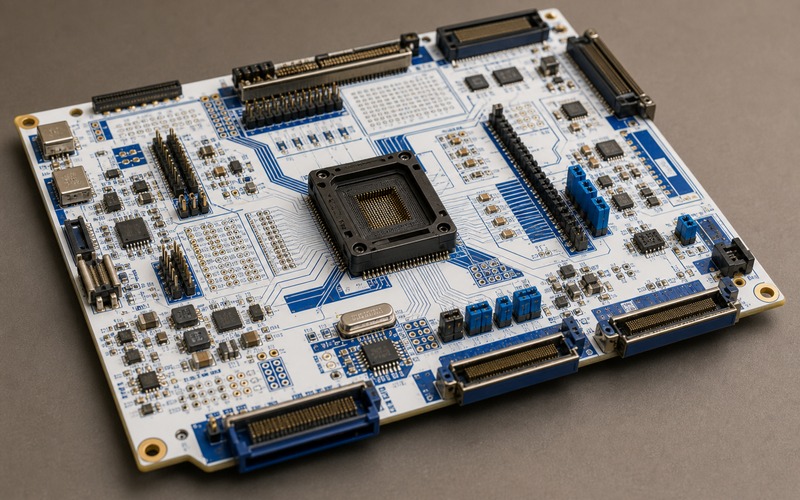
Use FPGA When the Boundary Is Still Moving
An FPGA is useful when the team has questions that a schematic alone cannot answer. Can the image sensor timing be captured with enough margin? Does the host link have enough bandwidth? Can a preprocessing step reduce processor load? Will a motor feedback loop need dedicated timing? Can a custom protocol be handled without adding another controller? These are boundary questions, and they become expensive if answered after the main processor and connector plan are frozen.
The FPGA should have a defined experiment. It may validate timing closure, interface conversion, parallel capture, a small pipeline, a motor control loop or a security boundary. If no one can name the experiment, the part can become a costly escape hatch. The selection review should state which uncertainty the device removes and which later product decision depends on the result.
The board also needs an exit path. A temporary FPGA path may later become firmware, an MCU peripheral, a dedicated bridge, an ASIC block or a smaller programmable device. The first board should record measurements in a form that helps that later decision. Otherwise the team may prove that the FPGA works while failing to learn which architecture should ship.
Check Interface Risk Before Compute Claims
Many early designs reach for programmable logic because an interface is not yet settled. Camera sensors, ADC capture, LVDS links, pulse timing, parallel buses, custom serial protocols and old industrial interfaces can all create edge cases. FPGA fabric can hold the timing close to the connector and let the firmware team work with a cleaner stream.
That does not remove electrical review. Each interface needs voltage range, termination, impedance, reference clock, return path, connector direction and protection review. A board that captures a signal on a lab bench may still fail when cable length, enclosure grounding or nearby switching loads are added. The FPGA gives observability, but the physical layer still has to be engineered.
Keep the external direction honest. High speed connectors, camera sockets, board-to-board headers and service ports should face the real cable or mating board path. A connector that points into the center of the PCB creates assembly stress and makes the validation board less useful as a product reference.
Plan Configuration and Boot Early
An FPGA does not become useful until it is configured. Configuration flash, boot mode pins, programming header, JTAG access, reset supervision and power sequencing are part of the component selection. Treat those supporting parts as part of the FPGA path rather than as small afterthoughts.
Configuration memory should be reviewed for voltage, package, capacity, speed, lifecycle and programming method. A substitute flash part can change boot time or require a different programming flow. If the board will be updated in production, the update path should be tested with the same constraints as the shipped product.
Boot timing also affects the system. The FPGA may need to be ready before a processor starts talking, or it may need a safe state while power rails rise. Outputs that reach relays, converters, sensors or external connectors should have known states during configuration. Undefined startup behavior can turn a flexible prototype into a field risk.
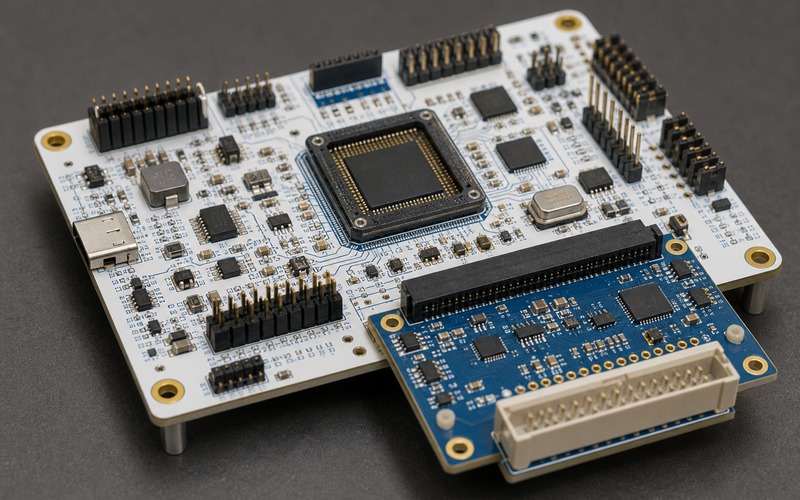
Size Fabric, Memory and I/O Together
FPGA selection fails when logic capacity is reviewed without I/O and memory. A small design can run out of pins before it runs out of lookup tables. A streaming pipeline can meet logic use but fail on memory bandwidth. A bus bridge can fit in fabric yet lose margin because clock domains were not counted.
Start with I/O banks and voltage domains. Check which pins support the required standards, whether each bank has the correct reference voltage, and whether the package can route the signals without creating impossible escape paths. The package decision is often the real selection point, because a smaller package may save area while blocking the interface map.
Memory should be treated as a timing device. External DDR, SRAM, flash or FIFO paths add layout rules, clocking constraints and validation work. Internal block RAM may be enough for a line buffer or a small state table, but it may not hold frame data or long capture windows. The architecture question should include where data waits while the system catches up.
Power Rails and Thermal Budget Are Part of the Experiment
FPGA boards often need several rails: core, auxiliary, I/O banks, memory and sometimes transceiver or PLL supplies. Sequencing, current margin, ripple and measurement access should be part of the first board. If the power design is weak, the team may misread timing faults as logic bugs.
Current is also workload dependent. A lightly loaded design and a full-speed capture path can look like different products. Measure current with the intended clock rates, active I/O, memory traffic and temperature range. Keep the bitstream or design revision with the power record so the measurement can be repeated.
Thermal review should be practical. A large BGA package may need copper area, airflow, a heat spreader or duty cycle limits. A prototype may survive open on the bench and fail inside a sealed enclosure. If the FPGA is only a validation tool, record whether thermal risk belongs to the temporary board or to the final architecture.
Use the FPGA to Learn, Not to Avoid Decisions
A reconfigurable device can make a prototype move quickly, but it should not become a place where every unresolved design question disappears. Each experiment should produce a decision: keep the logic in FPGA, move it into firmware, choose a bridge device, change the sensor, widen a bus, adjust memory or revise the processor choice.
The team should track measured timing margin, resource use, I/O utilization, power, latency and firmware load. Those numbers make the next architecture review concrete. Without them, the design may keep the FPGA because it works, even if a smaller and cheaper solution would be enough once the boundary is known.
Version control matters. Store the HDL, constraints, build tool version, timing reports and test notes together. A timing pass that cannot be reproduced is weak evidence. A build that depends on a local tool setting becomes a maintenance risk.
Constraint quality is part of the learning. Name the real clocks, generated clocks, false paths, input delays and output delays instead of accepting a default report. A clean timing report with missing constraints can be more dangerous than a failing report, because it tells the team that the design is safe without checking the path that matters.
Resource use should be interpreted with the future product in mind. A prototype that uses too much fabric may still be useful if it proves an interface, but it should not be mistaken for the final area target. Record which blocks are temporary test logic and which blocks represent the likely product function.
Make Bring-Up Evidence Portable
The first FPGA board should leave evidence that another engineer can repeat. Record the bitstream version, constraint file, clock plan, configuration image, measured rail current, interface test pattern and the exact condition that produced a timing result. Without that record, the board may appear successful while the project loses the reason it worked.
Bring-up should start with simple known patterns before the full product stream is connected. Loop a counter through the interface, capture a fixed frame, toggle each bank, verify reset states and confirm that configuration survives power cycling. These small tests separate electrical faults from logic faults and save time when the final data path becomes complicated.
Test access should be planned with production in mind. A bench probe can reach almost anything on an open board, but a product fixture needs named signals, stable connectors and a short pass/fail route. If the FPGA is used to validate the future architecture, the same measurements should help the production team decide which paths need test points on the final board.
Substitution and Supply Review
FPGA substitution is rarely a simple part-number swap. Package, pinout, I/O standards, configuration memory, transceiver availability, PLL resources, block RAM, DSP blocks, power rails and tools can all change. Even parts in the same family may require constraint changes or board rerouting.
The purchasing record should name the package, speed grade, temperature grade, configuration memory pairing, power rails, required I/O standards and tool version. If the product can tolerate a smaller or larger FPGA later, state what evidence would allow that change. If the part is a validation device only, say which final options it is meant to compare.
Lifecycle planning matters because FPGA families and package options can stay available or disappear at different rates. If the prototype depends on a niche package, the supply risk may bias the final architecture. A validation board should teach the team which capability is required, not tie the product to the first programmable device that made the demo work.
Final FPGA Selection Checklist
Before approving an FPGA for an unsettled architecture, confirm the exact uncertainty it will resolve, the interfaces it must touch, the memory and I/O budget, the configuration path, the power rails, the clocking plan, thermal behavior and the evidence needed for the next decision. Keep body links out of the article unless the target page has been verified as a working page.
Keep the measurement owner, board revision and test fixture notes beside the selection record.
That habit keeps later comparisons fair and traceable.
The FPGA earns its place when it turns unknowns into measured boundaries. If it proves timing, interface behavior, data movement and power limits, it can guide the final product architecture. If it merely absorbs unclear requirements, the design should pause and define the experiment more tightly before the board moves forward.