Free Shipping Over$200

- Products
- Marking
- Alternative

XC7Z020 as a Zynq Part Pairing Arm Cores with Fabric for Inference
XC7Z020 as a Zynq Part Pairing Arm Cores with Fabric for Inference
XC7Z020 sits in the useful middle ground between a microcontroller, a pure FPGA and an application processor. It pairs Arm processing cores with programmable logic fabric, so a board can run software, manage peripherals and still place time-sensitive or parallel work in hardware. That mix can help an inference product when the sensor path, feature stage, host interface and control loop all need to live close together.
The part should be reviewed as a small processing system, not as a logic device with a processor added on the side. The processing system handles boot, software, drivers, communication and coordination. The programmable logic can capture sensor streams, pre-process data, bridge interfaces, accelerate fixed kernels or keep deterministic timing. The board has to support both halves with memory, clocks, power sequencing, configuration and a practical debug path.
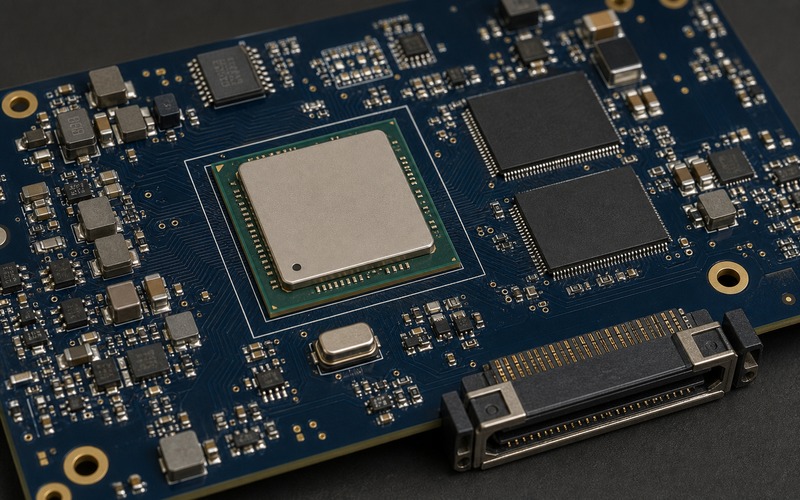
Start with the Partition Between Software and Fabric
The first selection question is where the work belongs. The Arm side is strong for control flow, drivers, application state, communication and update logic. The fabric side is strong for parallel capture, fixed timing, streaming pipelines, custom interfaces and small deterministic accelerators. A good design states which tasks live on each side and why.
Inference work often has three layers: sensor capture, feature preparation and model execution or scoring. The Arm cores may manage the application and data movement, while fabric handles a camera bridge, line buffer, FFT-like preprocessing, pulse classification or a custom interface. The right boundary depends on bandwidth, latency, memory and how often the model changes.
A design that puts every uncertain task in fabric can become hard to maintain. A design that keeps every task in software may miss timing or waste power. The selection note should name the bottleneck that the fabric removes and the software responsibility that remains.
Review the Sensor and Host Interfaces Together
Zynq devices are often chosen when sensor and host interfaces are part of the architecture question. A camera, ADC, LVDS source, encoder, motor feedback path or custom bus may need timing that is awkward for a processor alone. Fabric can bring the signal into a controlled pipeline before software sees a clean buffer or status word.
The host side matters at the same time. Ethernet, USB, parallel memory, display output or a module connector may set the amount of data that can leave the board. If the inference path produces results faster than the host can use them, the bottleneck moves to the next link. Check capture rate, feature rate, memory bandwidth and host transfer together.
Connector direction and routing should match the product. Sensor, host and debug connectors should face the cable or mating board path. Controlled traces need return paths and spacing that can be inspected. A board that works on the bench but forces a cable across the SoC or memory area may be teaching the wrong product layout.
Plan DDR, Configuration and Boot as One Path
XC7Z020 designs usually depend on external memory. DDR routing, termination, power rails, clocking and layout length matching are selection issues, not later details. If the memory path is weak, inference latency, Linux or bare-metal software, buffering and capture stability can all suffer.
Configuration and boot deserve the same early attention. Boot media, configuration storage, mode pins, JTAG, reset supervision and power sequencing determine whether the board can recover from a failed update or manufacturing fault. Keep the programming path reachable after assembly, because a hidden debug path makes production support expensive.
Boot time should be measured with the intended software image and bitstream. A small lab build may start quickly, while a product image with drivers, model data, logs and update logic can behave differently. Record boot mode, image size, memory type and rail timing beside the board revision.
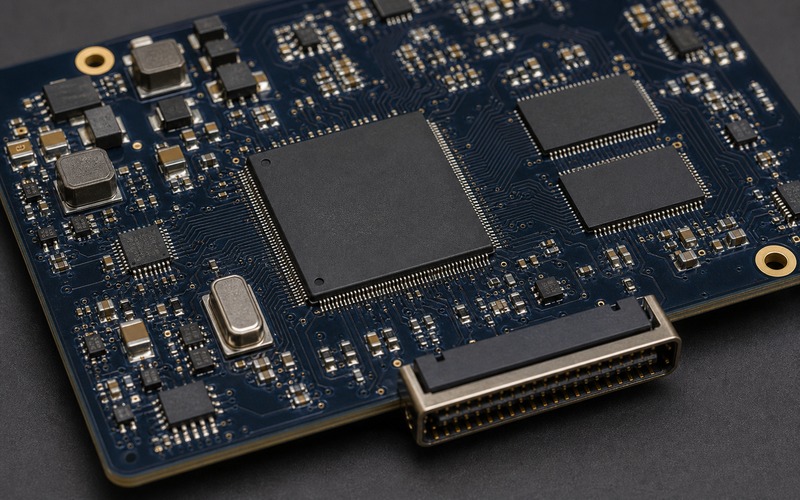
Power Rails Need Measured Margins
A Zynq board has several power concerns: core rails, I/O banks, DDR rails, auxiliary supplies, clock rails and the sensor or host rails around the device. The current profile changes with software load, fabric utilization, memory traffic and interface activity. A simple regulator calculation is not enough evidence.
Measure rails during boot, idle, sensor capture, fabric processing, memory traffic and host transfer. Keep the bitstream, software build and test input with the measurement. A later change in clock rate or fabric resource use can change current and thermal behavior, so the numbers need context.
Thermal review should look at local heat sources. The SoC, DDR memory and regulators may sit close together. A copper area that cools the processor can warm a sensor or connector region. The enclosure, duty cycle and ambient condition decide whether the board has enough margin for the intended product.
Keep the Software and Hardware Builds Reproducible
XC7Z020 selection includes tools. The hardware design, constraints, bitstream, boot image, device tree or bare-metal configuration, firmware version and model pipeline need to be reproducible. If an inference result depends on a local tool state or an undocumented build step, the part choice becomes hard to support.
Timing reports should be reviewed with real constraints. Name clocks, generated clocks, input and output delays, cross-domain paths and false paths deliberately. A passing report with missing constraints can hide a failure that appears only when the sensor or host link runs at product speed.
Software should also expose faults. A driver timeout, DMA error, buffer overrun, model mismatch or fabric status error should be visible in logs or service diagnostics. Without that visibility, a field issue can look like random model behavior even when the root cause is data movement or timing.
Build Evidence Around Data Movement
Many Zynq inference designs fail or succeed because of data movement rather than raw compute. A sensor stream may enter fabric, move through a line buffer, cross into DDR, return to software, and then pass a result back to control logic. Each crossing has latency, bandwidth and ownership rules. The selection review should show where the data waits, who owns the buffer and how a timeout is detected.
DMA setup, cache behavior and buffer alignment deserve attention. A small software mistake can make the fabric look slow or unstable. Keep a test case that moves a known pattern through the same path used by the product model. If the known pattern survives rate, temperature and reset testing, the team has stronger evidence that the architecture is ready for real input data.
Instrumentation should be planned into the firmware. Timestamp capture, buffer counters, fabric status bits, interrupt counters and watchdog events can turn an intermittent failure into a diagnosable fault. Those signals also help compare a pure software path, a fabric-assisted path and a later replacement architecture.
Use the Fabric Where It Has a Clear Payoff
Fabric is valuable when it removes a measurable bottleneck. It may align pixels, threshold a stream, count pulses, generate motor timing, bridge a protocol or prepare features before the Arm side receives the data. The result should be measured in latency, bandwidth, processor load, power or interface reliability.
Some work belongs in software because it changes often, needs complex branching or depends on high-level libraries. Some work belongs in fabric because it is fixed, parallel and timing-sensitive. The team should write that reasoning down so a future product revision does not keep hardware logic that no longer earns its place.
When the model changes, the partition may change. A feature extractor that is fixed for one model may become a limitation for another. Keep the model format, feature stage and fabric interface documented together.
Model update behavior should be part of the board decision. If the product expects field updates, the team needs a safe way to update software, model files and fabric images without leaving the device in a half-programmed state. If the product will ship with a fixed model, the approval record should say which measurements justify freezing the feature path.
Security and recovery also affect the selection. A product that loads images from removable media, a network path or a service connector needs a clear recovery method and a trusted source of build files. The more the inference path depends on fabric, the more important it becomes to keep version checks and rollback behavior visible.
Substitution and Purchasing Review
XC7Z020 alternatives need careful review. A replacement Zynq part may change package, memory interface, I/O banks, fabric resources, speed grade, boot support, tool version or thermal behavior. A plain FPGA plus MCU may look similar at a block diagram level while adding a new interface and a new failure path.
Purchasing should receive the exact package, speed grade, temperature grade, memory pairing, boot device, rail requirements, toolchain condition and approved alternate boundary. If the design depends on a specific DDR layout, I/O standard or fabric resource count, that condition belongs in the component record.
The supporting parts also need approved options. DDR, configuration flash, clocks, regulators, connectors and level translators can block the design even if the SoC is available. Treat the Zynq choice as a board-level supply plan rather than a single line item.
Bring-Up and Production Test Planning
The first board should have a bring-up sequence that another engineer can repeat. Start with power rails, boot mode, JTAG, DDR detection, configuration load, clock checks and a simple fabric loopback before connecting the full sensor stream. This order separates board faults from software and model issues.
Production test needs the same discipline. A fixture may not run the full inference workload, but it can verify rails, boot, DDR access, a fabric pattern, a host interface and a few sensor lines. If those tests are named early, the board can leave useful pads and connectors in reachable places.
Keep the board revision, test image, bitstream hash, software build, fixture version and measured limits with the approval record. A Zynq design is easier to maintain when the hardware and software evidence travel together.
Final XC7Z020 Selection Checklist
Before approving XC7Z020 for inference work, confirm the software versus fabric partition, sensor path, host path, memory budget, boot method, power sequence, timing constraints, thermal margin and debug access. Keep body links out of the article unless the target page has been verified as a working page.
Keep the measured workload, test limits and board revision attached to that approval note.
The part earns its place when Arm cores and fabric each solve a clear part of the product problem. If the board proves interface timing, data movement, power margin and reproducible builds, it can be a strong architecture choice. If those points remain unclear, the design should stay in validation until the evidence is complete.