Free Shipping Over$200

- Products
- Marking
- Alternative

Choosing Between Panasonic VL-2020 and VL-2330 Rechargeable Coin Cells
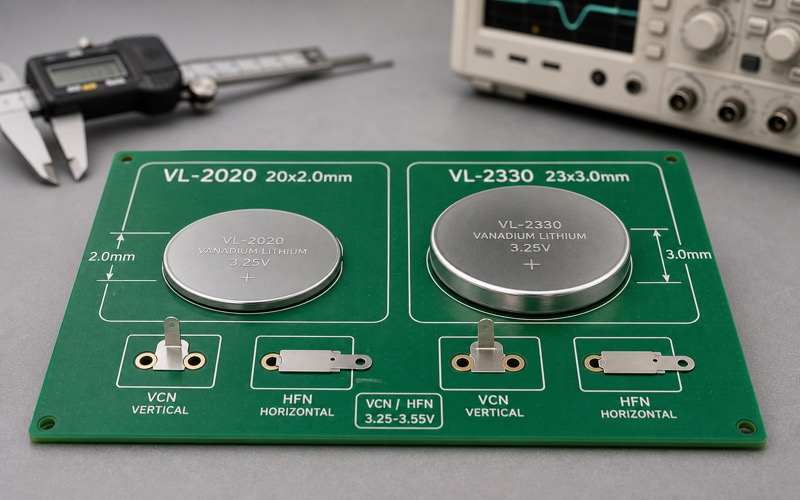
VL-2020 and VL-2330 look like neighboring Panasonic VL-series rechargeable coin cells, but they solve different layout and hold-up problems. The first decision is size and reserve energy. The second decision is terminal direction. A design that treats the suffix as a purchasing detail can end up with a cell that is electrically correct and mechanically wrong.
Compare the electrical base first
Both families are Panasonic Energy VL-series vanadium lithium rechargeable coin cells. They share a 3 V nominal voltage, a 3.25 to 3.55 V charging voltage window and an operating range of -20 to +60°C. Panasonic's VL charging guidance centers the charge circuit around 3.4 V with a 0.15 V tolerance and warns against trickle charging. That common charging discipline is the first thing to preserve when moving between 2020 and 2330 sizes.
| Family | Nominal capacity | Continuous standard drain | Cell size, without tabs | Typical suffixes here |
|---|---|---|---|---|
| VL2020 | 20.0 mAh | 0.07 mA | 20.0 x 2.0 mm | VCN vertical, HFN horizontal |
| VL2330 | 50.0 mAh | 0.10 mA | 23.0 x 3.0 mm | VCN vertical, HFN horizontal |
The capacity difference is large enough to change service assumptions, but it should not hide leakage problems. If a product moves from VL2020 to VL2330 because the backup interval missed its target, measure the backup current before changing the BOM. A leaking divider, unpowered IC pin, status LED, pull-up or ESD path can drain either cell. The larger cell may only mask the fault for longer.
Choose VCN or HFN as a layout decision
VCN points to a vertical PC-pin mounting style. It saves board area and keeps the cell visible, but it needs height and mechanical protection. HFN points to a horizontal PC-pin mounting style. It lowers the vertical envelope, but it takes more flat board area and places the tabs across the PCB surface. Neither suffix is a minor variant after layout. The suffix is part of the footprint, enclosure and assembly plan.
A low-profile handheld controller may reject VCN before the electrical review begins. A crowded board with height available may reject HFN because a flat 23 mm cell blocks routing and component placement. A serviceable unit may prefer a cell that is easier to inspect. A sealed unit may care more about keeping the battery below a cover. These choices belong with mechanical engineering, not only with purchasing.
How the four part numbers map
- VL-2020/VCN rechargeable coin cell
- VL-2020/HFN rechargeable coin cell
- VL-2330/VCN rechargeable coin cell
- VL-2330/HFN rechargeable coin cell
VL-2020/VCN is the compact, vertical choice when the backup job is small and board area is tighter than height. VL-2020/HFN is the compact, low-profile choice when height drives the enclosure. VL-2330/VCN is the larger-capacity vertical option when a longer backup interval is needed and vertical clearance exists. VL-2330/HFN is the larger-capacity, low-profile option when the product needs the 2330 energy reserve but cannot accept an upright cell.
Selection sequence for the BOM
Start with the backup load. Measure the rail after main power is removed, not only while the system is on the bench with supplies connected. Decide the required hold time and temperature range. Choose 2020 or 2330 from that current and time budget. Then choose VCN or HFN from the enclosure and PCB footprint. After that, design the charge path to the VL charging window, check the current limit and verify that no other circuit backfeeds the cell. Only then should the full part number be frozen in the BOM.
Substitution should follow the same sequence. Do not approve an alternate because the base number or diameter looks close. Compare capacity, charge voltage, charge-current guidance, terminal orientation, footprint, operating temperature, certifications and logistics restrictions. Keep the full suffix in drawings, quotes and ERP records. In this family, the last three letters decide whether the cell can be soldered into the board that was designed for it.