Free Shipping Over$200

- Products
- Marking
- Alternative

Fitting the Antenna and RF Front End to a Wireless Design
The antenna and the matching around it are where a wireless design quietly goes wrong more often than anywhere else. The radio can be a good part and the firmware clean, and the product still fails to reach across a room because a few millimeters of copper and a handful of passives were left as an afterthought at the end of the layout, squeezed into whatever space the rest of the board did not want.
This part of a design is unglamorous and easy to underbudget, since on the schematic it is only an antenna and a few components sitting between the radio and the air. It is also where range and the pass or fail of a radio certification are decided, and it follows physical rules that do not bend to a tight schedule or a crowded board. That is the reason the antenna and the front end deserve their own place in the plan rather than the corner that happens to be left over, and the reason a team without RF experience treats this as the part to get help with rather than the part to improvise.
Chip antenna or a trace on the board
The first decision is what the antenna is, and for a 2.4 GHz design it usually comes down to a chip antenna or a trace etched into the board. A trace antenna costs nothing in parts, since it is only copper on a layer the board house prints anyway, but it eats board area, needs a clear ground-free zone beneath it, and has to be tuned for the specific board stackup it sits on, which means iterating real hardware until it resonates where it should. That trade is the heart of choosing a chip antenna against a printed trace antenna, and it usually turns on how much board area a product can spare and how much RF tuning effort the team is willing to take on rather than on any single number.
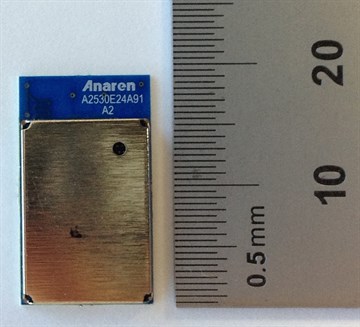
The other path buys a known quantity. The 2450AT18A100 is a 2.4 GHz chip antenna, a small ceramic part with a characterised radiation pattern and a known impedance that drops onto the board in place of a tuned trace, trading a few cents and a little height for a predictable result in a smaller footprint. It still needs its ground clearance and a matching network, and it still has to be checked in the real product, but it removes the slow work of designing and tuning a radiator from scratch, which is why it suits a team that would rather buy the antenna than become antenna engineers for one product.
Neither choice escapes the layout. A chip antenna placed badly, crowded by metal or set over a ground pour, performs worse than a trace antenna laid out with care, so the part is only ever as good as the space the design gives it. The decision is less about which is better in the abstract than about which one fits the board area, the height limit, and the RF experience the project brings, and either can win when it is the one matched to those constraints.
The match in between
Between the radio pin and the antenna sits a matching network, and it is the piece that decides, more than any other, whether the link works, because a radio designed for a 50 ohm load only delivers its power into something close to 50 ohms. A radio that drives a differential output, as many do, first needs that signal turned into the single-ended, unbalanced form an antenna wants, and that is the job of a balun, which converts balanced to unbalanced and shifts the impedance in the same part. The BALF-NRG-01D3 is a balun and match for an nRF radio, an integrated part that replaces a cluster of discrete inductors and capacitors with one tuned block sized for that radio's pins, which both shrinks the board and removes a set of component values that are easy to get wrong. Where the matching is built from discretes instead, it is a pi-network of a few parts whose values transform the antenna's impedance to the 50 ohms the radio expects, and those values depend on the board, the antenna, and everything near it, so they are tuned on real hardware with a network analyzer rather than trusted from a calculation. The reason this matters so much is that a mismatch reflects power back toward the radio instead of radiating it, seen as return loss or VSWR, and a poor match can throw away a large share of the transmit power and desensitize the receiver at the same time, turning a part rated for a long link into one that barely crosses a room. The antenna's own impedance is not even fixed, since it shifts with the ground plane, the enclosure, and a nearby hand or surface, so the match that looked perfect on a bare board drifts once the product is assembled and held in use. A careful design tunes the match with the antenna in its real housing, checks it across the whole band rather than at a single frequency, and leaves footprints for a few spare matching components so the values can be adjusted once the first boards come back, because the match is almost never right on the first attempt and the cost of a second spin is far higher than three unpopulated pads. The same care extends to the cable and the connector when the antenna sits off-board, since a length of mismatched coax or a cheap u.FL joint can undo a good match before the signal even reaches the radiator.
Pushing the range with a front end
When the link has to reach further than the radio alone manages, a front end goes between the radio and the antenna to add power on the way out and sensitivity on the way in. A power amplifier lifts the transmit level, a low noise amplifier lowers the noise the receiver adds to a weak incoming signal, and many front end parts package both together with the switch that hands the single antenna between transmit and receive. It is the standard way to extend a link without changing the radio or the protocol, and it sits in the same signal path the match already occupies.
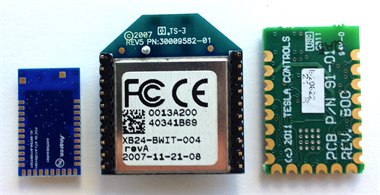
The part that does this for a sub-gigahertz link is one example among many. The SKY66112-11 adds a power amplifier to a sub gigahertz link, raising the output power to push the range out toward the limit the regulations in that band allow, which can turn a link that just barely reached into one with comfortable margin in a noisy environment. It draws real current while transmitting, in the tens of milliamps and up depending on the output level, so it belongs on a mains-powered node or one whose duty cycle keeps the transmit time short enough that the battery can carry the peaks. A bypass path that routes the receive signal around the amplifier when the extra sensitivity is not needed keeps the idle current down, the detail that lets a part like this sit on a device that does not shout all the time.
A front end is not free, and reaching for one carries consequences past the part cost. The extra transmit power has to stay inside the regulatory ceiling for the band, a limit a design can blow straight through by adding gain without counting the antenna's own gain, which then turns a range upgrade into a certification failure. The amplifier also adds current, heat, and a few more components to tune, and it raises the noise budget on receive if the wrong part is chosen. A front end earns its place where the range genuinely falls short after the basics are right, and it is the wrong first answer to a link that is weak because the antenna or the match was done poorly in the first place.
Fix the antenna and the match first; add a front end only if the budget still demands more reach.
The keep-out you cannot skip
Every antenna needs a region of board around it with no copper, no components, and no metal, the keep-out area, and it is the rule that gets broken first whenever a board grows crowded. The antenna radiates into the space around it, and copper, a battery, or a shield sitting in that space absorbs and detunes it, pulling its resonance off frequency and stealing the energy that should have left the board as a signal. The cost does not show on the schematic, which is why it survives review and surfaces only when the range comes in low.
The reason the antenna keep out area cannot be skipped is that no amount of matching or amplification recovers an antenna smothered by its surroundings. The keep-out is part of the antenna's design, specified in its datasheet as a shape and a clearance for a reason, and shrinking it to fit one more component is the change that turns up later as a range complaint nobody can trace from the schematic, since the schematic looks the same whether the keep-out was honored or not.
The ground plane underneath is the other half of the same rule. Many small antennas use the board's ground plane as part of the radiator or as a counterpoise, so its size and its shape change the antenna's behaviour directly, and a ground plane that is too small or cut in the wrong place shifts the tuning as surely as a misplaced component does. The antenna, its keep-out, and the ground plane are one system rather than three things to lay out independently, and a change to any of them is a change to the antenna.
The enclosure closes the loop. Plastic near an antenna loads it and shifts its tuning, metal near it can stop it entirely, and a hand wrapped around a handheld product detunes and absorbs in a way no bare-board measurement predicts, which is why a wireless product has to be tested fully assembled and, where people hold it, held in a hand during the test. A design that tunes only the bare board has tuned a different device than the one the customer will use. The teams that have shipped a few wireless products build the assembled-and-held test into the schedule rather than meeting the need for it in a field return.
None of this is exotic, and all of it is unforgiving: the antenna, the match, and the space around them settle the link long before the radio's datasheet numbers ever come into play. A product that reaches its rated range in the field is almost always one where this layer got its budget and its attention early, not one where a strong radio was asked to make up at the end for an antenna squeezed into a leftover corner.