Free Shipping Over$200

- Products
- Marking
- Alternative

Choosing the Accelerometer, Gyroscope and IMU for Motion and Orientation
An accelerometer and a gyroscope each lie in their own way, and the useful reading from an IMU comes from combining them so the lies cancel. A gyroscope tracks rotation cleanly for a second or two and then drifts, while an accelerometer holds a long-term reference through gravity but jumps at every bump and motor vibration. Neither carries an honest orientation by itself. Orientation is a relative thing to begin with, an angle measured against gravity or against magnetic north, and the work of motion sensing lives in the fusion that turns two flawed signals into one a system can trust across both the next millisecond and the next hour. The split runs deep: the gyro owns the short term and the accelerometer owns the long term, and nearly every motion part and every fusion filter is built around handing the reading between the two at the right moment.
That framing decides what to buy before a datasheet is opened. A design that only counts steps or detects a knock needs a bare accelerometer and nothing more. One that has to know which way it points faces a different question: how much of the fusion to run on its own processor, and how much to buy already finished inside the part. The axis count, three or six or nine, and where the fusion happens are the two decisions sitting under almost every motion part on the market.
The six-axis middle ground
The part many designs start from is a six-axis device: a three-axis accelerometer and a three-axis gyroscope sharing one package, reporting six raw numbers and leaving the fusion to whatever reads them. It carries everything needed to recover a full orientation, as long as the host or a software library does the blending. Six axes is the default a design holds to unless a clear reason pushes it down to a bare accelerometer or up to a nine-axis part with a magnetometer, so it is the sensible place to open a search. Going to nine axes buys a drift-free heading and the calibration burden that comes with it. A bare accelerometer saves power and parts but cannot give a true orientation. A design that needs full attitude usually settles on six.
The MPU-6050 is the part many engineers meet first. It is inexpensive, documented everywhere, and has a long history in hobby drones and gesture controllers. It carries a small digital motion processor on board that can run some fusion and gesture detection without troubling the host, and its register map has been copied so widely that example code exists for nearly every microcontroller. Its age does show against newer silicon, in noise and in how far its bias drifts with temperature, so a precision design tends to look past it. For learning, for prototypes, and for applications that forgive a degree or two, it stays the obvious first reach, and its low price makes a spare in the drawer cheap insurance.
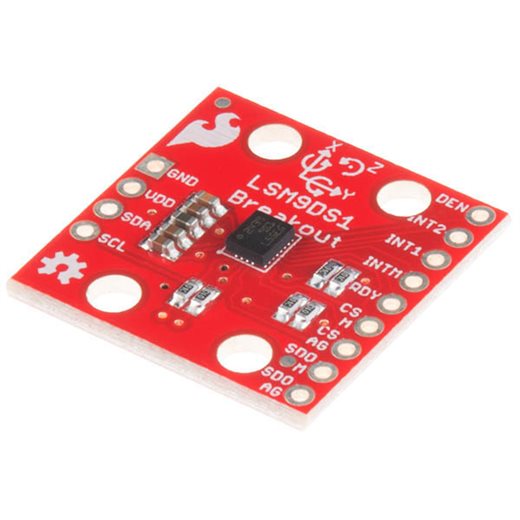
For a product that has to run for years on a battery while staying alert to motion, current draw outweighs raw performance. The LSM6DSO answers that with low always-on consumption and a configurable FIFO that buffers samples so the host can sleep, waking only when a programmed event fires. It also carries a small machine-learning core and a set of finite state machines that recognize patterns like steps or a wrist turn inside the part itself, while the main processor stays dark. That on-sensor intelligence is the gap between days and months of life on the same cell, which is why it shows up across fitness bands and asset trackers.
When the motion is the product
When the motion itself is the product, a camera gimbal or a tracked surgical tool, noise and bias stability matter more than cost. The ICM-42688-P sits at the high-performance end, with a low noise density measured in micro-g per root hertz and a tight bias stability that keep a fused orientation from creeping while the device is held still. That still-state drift, how fast the heading wanders when nothing is moving, is the figure that separates a horizon line that stays level from one that tilts away over a minute of use, and it seldom shares the front page with the headline ranges. Parts at this end also tend to carry tighter factory calibration and a higher sample rate, both of which a gimbal or a stabilization loop leans on to react without visible lag.
When an accelerometer is enough
A large share of motion jobs never need a gyroscope at all. Step counting, tap sensing and motion wake are an accelerometer's work, with no rotation to integrate and no drift to chase. The choice among these comes down to power and to which events a part can recognize on its own, since taking that load off the host is half the reason they exist.
The ADXL345 is the classic digital accelerometer, in service for years, with built-in tap and free-fall detection that raise an interrupt so the host never has to poll the stream. It reads over I²C or SPI, offers selectable ranges out to sixteen g, and has gone into so many products that its quirks are all documented and worked around. Its appeal now is being a known quantity ahead of the last word in performance, the part a design reaches for when it wants something that will still be orderable, and still behave the same way, five years out.
The LIS3DH covers the low-power three-axis case that fills wearables and handhelds, with selectable ranges, a built-in ADC for a couple of auxiliary analog channels, and a current low enough not to dent a tight power budget. It is the steady workhorse of the group, dependable more than remarkable, and it lands wherever a design wants tilt, activity or a shake gesture without much ceremony around it.
Where the entire point is to stay asleep until something moves, the ADXL362 draws so little, in the hundreds of nanoamps while watching for motion, that it can serve as the wake gate for a whole battery device. It holds the processor and the radio in deep sleep, watching on its own, and rouses the system only when real movement crosses a programmed threshold. That role, one tiny part keeping a far hungrier system asleep, is how a remote sensor node lasts years on a single small cell rather than weeks, and it is a pattern to copy wherever a device spends nearly all of its life waiting.
Why orientation is the hard part
The reason orientation is harder than the parts make it look is that each sensor in an IMU fails in a way the others have to cover. A gyroscope reports a rotation rate, and recovering an angle from it means integrating that rate over time, which sums every small bias and noise sample along with the real motion, so a gyro-only angle walks away within seconds and a fraction of a degree per second grows into tens of degrees across a minute. An accelerometer gives an absolute tilt reference by sensing gravity, but it cannot tell gravity apart from the acceleration of the device itself, so a sharp move or a nearby motor throws the reading until the disturbance settles. In a nine-axis part the magnetometer pins the heading the other two cannot hold around the vertical axis, by sensing magnetic north, yet it reads the field of a speaker magnet or a steel chassis as readily as the earth's. Fusion is the math that blends the three, a complementary or a Kalman filter that leans on the gyro over the short term and on the accelerometer and magnetometer over the long term, and the quality of that blend decides whether the output is steady or useless. Beneath it sit the steps no marketing page opens with: calibrating each sensor's offset and scale, aligning all three to one set of axes, and compensating for temperature, since a bias that shifts with warmth feeds the integrator a steady error that looks exactly like a slow rotation. There are tricks that help, like a zero-velocity update that resets the accumulated drift whenever the device is sensed to be still, but they are software wrapped around the part, not something a better sensor delivers on its own. A part can be excellent and the orientation still poor when those are skipped.
Carrying the magnetometer
Adding a magnetometer makes a nine-axis part, which a design reaches for when it needs a heading that holds without drift, a compass that does not slowly wander off true. The ICM-20948 brings all nine axes into one package, with a digital motion processor that can run fusion on board, though many teams still do the blending on the host or in a library for the control it gives. Either way the part asks the team to handle the hard-iron and soft-iron magnetometer calibration a clean heading demands, the work of mapping the steel and the magnets in the device itself so their fields can be subtracted back out. That calibration is the step teams underestimate, and a nine-axis design that skips it ends up no better than six.
Buying the fusion already done
The other path hands the fusion to the sensor itself, so the host reads a finished orientation and never touches a filter. It gives up some flexibility and a little cost, and it buys back the weeks of tuning that fusion done well otherwise demands. For a team without a signal-processing specialist on hand, that single trade is frequently the whole reason a part gets chosen.
The BNO055 runs sensor fusion on an internal microcontroller and outputs orientation directly, as a quaternion or as Euler angles, so a host asks for a heading and gets one without implementing any filtering. It folds the three sensors and the fusion into a single part, which collapses a hard firmware problem into a part-selection decision. That is the appeal that put it into a great many robotics and AR projects, where a team would rather spend its time on the application than on a filter, and it even runs its calibration in the background, reporting how well calibrated each sensor currently is so the firmware knows when to trust the heading.
The BNO085 takes that idea further, with more capable fusion and higher orientation accuracy, plus a rotation-vector output tuned for AR and headsets and a step into gesture recognition. It is the pick when orientation quality is itself the requirement and the board-level effort is the thing to save, the case where a slightly higher part cost pays for itself in firmware that never has to be written or debugged.
Between fully raw and fully fused sits the BMI270, a low-power six-axis part with on-chip gesture, step and activity recognition tuned for wearables. It does some of the interpretation itself, enough to spare the host from waking for every sample, without claiming to deliver a finished nine-axis heading. It fits the watch and fitness-band designs where power is the hard limit and the set of motion features needed is a known, fixed list, so paying for on-chip intelligence that matches that list is money well spent.
So the same physical signals reach the system in states that range widely, from six raw streams to a clean quaternion, and the right level depends on what a team can build and afford. Buying the fusion is not a shortcut to be ashamed of; it is a real trade of flexibility and cost against engineering time, and on a tight schedule it is often the right call.
Letting the use decide the part
The part question follows the fusion question, not the reverse. Decide whether the design feeds its own filter from raw axes or takes a finished orientation off the shelf, decide whether it lives on a coin cell or on mains power, and the candidates fall away quickly. Each of the three sensor types is easy to buy and easy to misread, which is the trap a parts-first search keeps walking into, picking the lowest-noise part on the page and then finding the orientation still drifts because nothing downstream of it was tuned.
What turns those raw sensors into a heading that holds is the fusion and the calibration wrapped around them, well beyond the headline specification on any single part among the three.