Free Shipping Over$200

- Products
- Marking
- Alternative

Murata GCJ21BD72A225KE02 2.2uF 100V Soft-Termination MLCC for Automotive Rails
Murata GCJ21BD72A225KE02 2.2uF 100V Soft-Termination MLCC for Automotive Rails
Murata has introduced the GCJ21BD72A225KE02, a soft-termination multilayer ceramic capacitor for automotive powertrain and safety equipment. The part combines 2.2uF capacitance, a 100Vdc rating, and an 0805-inch package size, which makes it relevant for compact vehicle electronics that need higher capacitance without moving to a larger footprint.
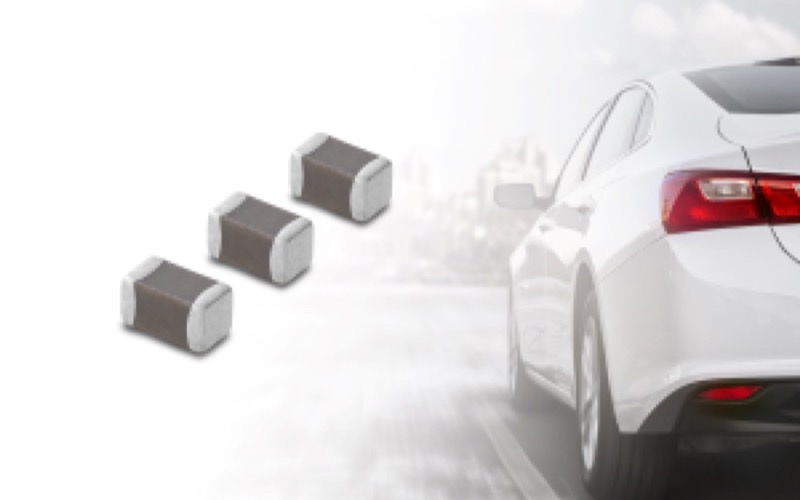
The important point is not only the capacitance number. In an automotive rail, the capacitor has to survive voltage derating, DC bias, vibration, board flex, temperature cycling, and long program life. A smaller high-voltage MLCC can free board area, but it still has to be checked as a reliability component rather than a simple capacitance replacement.
What Murata announced
Murata positions GCJ21BD72A225KE02 as a 2.2uF, 100Vdc soft-termination chip MLCC in 0805 size, also described as 2.0 x 1.25 mm. The company says this rating was previously associated with a larger 1206 size in its own lineup, and that the new part reduces mounting area compared with the prior 2.2uF / 100Vdc option.
The device targets automotive powertrain and safety equipment. Murata also states an operating temperature range from -55 C to +125 C and X7T temperature characteristics under EIA standards. The soft-termination structure is meant to absorb board flexure stress and reduce cracking risk after mounting.
Why this matters in a vehicle BOM
Automotive electronics are moving more functions into tighter module areas. 48V systems, electrified powertrains, ADAS controllers, and safety-related boards all create pressure for higher capacitance and higher voltage margin in less PCB space. A capacitor that keeps 100Vdc rating while moving into an 0805 footprint can help when the board is crowded around DC-DC converters, pre-regulators, local rails, sensor interfaces, and protection networks.
The tradeoff is that MLCC selection is rarely solved by nominal capacitance. Engineers still have to review effective capacitance under bias, temperature behavior, ripple current, acoustic risk, aging, mechanical stress, and the way capacitors are distributed across the rail. Buyers also need the exact orderable part number because one character in an automotive MLCC code can change dielectric, tolerance, packaging, or qualification assumptions.
Design checks before using GCJ21BD72A225KE02
| Check area | What to verify | Why it matters |
|---|---|---|
| Voltage derating | Compare the 100Vdc rating with the real rail voltage, transient margin, and OEM derating rule. | Automotive programs often apply conservative voltage stress limits, especially on long-life powertrain boards. |
| Effective capacitance | Check DC bias curves for the exact part number, not only the 2.2uF nominal value. | High-capacitance MLCCs can lose meaningful capacitance under bias, changing rail impedance and hold-up margin. |
| Temperature behavior | Review X7T behavior against the module's cold start, hot soak, and nearby heat-source profile. | The useful capacitance window changes across temperature, and the rail must stay stable at the corners. |
| Board flex | Confirm placement, orientation, keep-out, and mounting process around the soft-termination structure. | Soft termination helps absorb stress, but poor placement near board edges, screws, connectors, or depanelization paths can still create risk. |
| Footprint migration | Compare the 0805 layout with any existing 1206 capacitor position. | Area savings are only useful if the land pattern, inspection, rework, and spacing rules remain acceptable. |
Where it can earn its place
The part is most interesting where the design needs more capacitance on a rail that cannot afford a larger capacitor body. That can include compact DC-DC output filtering, local decoupling near powertrain controllers, ADAS safety boards, 48V-derived low-voltage rails, and high-density automotive control modules where board area has already been negotiated tightly.
It should not be treated as an automatic replacement for every 2.2uF / 100V MLCC. If the existing design relies on a larger package for thermal spacing, mechanical robustness, capacitance under bias, or a specific impedance profile, the smaller package still needs electrical and mechanical validation. The safer first pass is to compare the whole capacitor bank, not only the single part line.
Procurement checks
- Confirm the exact orderable code GCJ21BD72A225KE02 and the latest Murata datasheet revision.
- Check automotive grade documentation, packaging format, termination structure, and lifecycle status.
- Ask for DC bias, temperature, aging, impedance, and reliability data before freezing the BOM.
- Review whether the design needs a second source, a larger-package fallback, or a parallel capacitor-bank option.
- Do not substitute a standard MLCC for a soft-termination part without reviewing board flex and crack-risk requirements.
Related In-Fortune reading
- TDK E13 EM SMD gate-drive transformers for xEV isolation and DC-DC rails
- Doing solid power conversion for a connected device
- Powering an AI board so it rides through sudden load
Source and procurement note
The manufacturer announcement is here: Murata GCJ21BD72A225KE02 2.2uF / 100Vdc soft-termination MLCC release. Before design-in, confirm the latest datasheet, simulation data, qualification details, orderable suffix, packaging, and long-term supply path with Murata or an authorized channel.