Free Shipping Over$200

- Products
- Marking
- Alternative

The Ways to Measure Pressure and Force Accurately
Pressure is not one measurement. A barometer and a load cell both report a reading called pressure, yet they answer different questions, so the first split in choosing a part is which question the design is asking. Absolute, gauge or differential names the reference the reading is taken against, and a part built for one of them reads nonsense wired for another. Get that reference wrong and no amount of resolution rescues the number, since the error sits in what the part compares to, ahead of how well it measures anything at all. The span of interest runs huge as well, from a few pascals of airflow to hundreds of bar in hydraulics, and no one sensing method spans that, which is the second thing an application has to pin down before a part.
Underneath the label, the sensor is almost always reading a small mechanical deflection. A thin diaphragm bends under pressure, and a piezoresistive bridge or a capacitive structure turns that bend into an electrical signal that is rarely large. A piezoresistive bridge gives a strong signal that drifts with temperature, while a capacitive cell draws almost no power yet wants more circuitry around it, and that readout choice ripples through the rest of the design. From there the familiar low-level chain problems follow, the ones any small signal meets on its way to a converter, and a couple more belong to pressure alone: what the diaphragm is exposed to on its front face, and what its reading is referenced against on the back.
Pressure read as altitude
The pressure part on a small board is frequently there to infer height. Air pressure drops in a known, roughly exponential way with altitude, so a barometric sensor doubles as an altimeter, and a part like the BMP280 covers the everyday case. It is a small, low-power device on I²C or SPI, cheap enough to drop into a phone or a weather node without much thought, and it hands back an absolute pressure the host turns into meters. Its noise floor suits weather trends and coarse height; what it does not promise is the steadiness to separate one stair tread from the next, and that finer job is a different part.
That finer job is the reason the BMP388 raises the resolution and tightens the noise, far enough to resolve a single floor of a building. It adds a configurable filter that buys a quieter reading at the cost of response speed, a knob the designer sets to match how fast the height itself moves.
A drone leans on the barometer harder than usual, since an altitude hold in a hover is only as steady as the pressure reading beneath it, and a few tens of centimeters of false drift sends the aircraft hunting up and down. The MS5611 serves as an altimeter with the low noise and tight repeatability that job needs, and it carries factory calibration coefficients the host applies to linearize and temperature-correct every sample. That correction is what separates a height that holds from one that walks with the board temperature across a long flight.
Because every barometric reading wanders with temperature, the MPL3115A2 builds the compensation in and will output altitude in meters directly, sparing the host the math. It is the quiet pick when a design wants height off the bus with the least firmware wrapped around it.
The four read one quantity and part ways on how finely and how stably they manage it. That, more than price, is the axis a barometric design moves along.
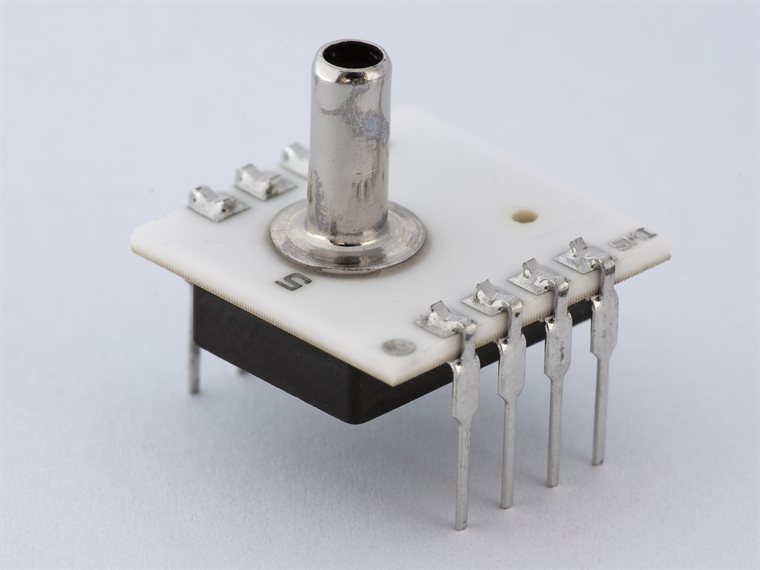
Reading a real pressure outright
Not every job splits hairs over altitude. Plenty need a real pressure across a broad span, read for itself, and a part like the MPX5700AP reads mid-range absolute pressure and gives back a simple analog voltage. That output is ratiometric to its supply, which means the reading is a fraction of the rail, so the part leans on a clean, stable supply and an ADC referenced to that same voltage, or the supply noise rides straight into the result. It is the kind of part that watches a pump or a tank, where a fraction of a bar is precision enough and an analog line into a spare ADC channel saves adding another device to the bus. A series like this usually spans several ranges, so a design takes the variant whose full scale sits just above the highest pressure it will meet, because headroom past that point is resolution thrown away.
What the reading is taken against
The decision that shapes a pressure design more than the part number is what the reading is taken against. An absolute sensor measures relative to a sealed vacuum behind its diaphragm, so it reports true pressure and, as a side effect, reports the weather passing through. A gauge sensor vents its back face to the local air and reports how far above ambient the front sits, which is what a tire, a pump or a cuff cares about. A differential sensor brings out two ports and reports only the drop between them, across a filter or an orifice. They do not substitute for one another: wire a gauge part where the design assumed absolute and every reading carries the day's barometric pressure as a standing error; read a differential part single-ended and the large pressure both ports share drowns the small difference that was the whole point. The reference even sets what overpressure means, since a differential part rated for a small delta can meet the full line pressure on one port during a transient, a destructive event the datasheet bounds with a number kept separate from its measuring range. The vent on a gauge part is a small liability of its own, since it opens the back of the diaphragm to outside air and the moisture and dust riding in it, which is why a gauge sensor in a damp spot often hides a protective membrane over that vent. None of this is exotic, and all of it is settled before accuracy or interface enters the conversation.
What the diaphragm has to survive
What the diaphragm touches on its front face decides whether the part lives at all. A bare silicon diaphragm is fine in clean dry air and unhappy in nearly anything else, so a part built for a wet or corrosive medium puts a stainless steel diaphragm and a gel or oil fill between the process and the silicon, carrying the pressure across without letting the medium reach the die. That isolation costs some sensitivity and adds temperature effects of its own, and it is the price of surviving the medium at all. Leaving it out is a tidy way for a sensor to pass every test on a bench of dry air and then corrode shut, or silt up, a month into a real process line.
Range and survival are two different numbers on the page, and the second is the one that gets skipped. A diaphragm thin enough to resolve small changes can be torn by a pressure spike the plumbing delivers without effort, so the proof rating, how far past full scale the part recovers unharmed, and the burst rating, where it ruptures outright, deserve as much weight as the span itself. A water-hammer pulse when a solenoid valve slams shut routinely reaches several times the working pressure, and it has quietly ended a long line of sensors chosen on their nominal range alone. A rough rule puts the proof pressure around two to three times full scale and the burst point higher again, but the only safe move is to weigh the part's own ratings against the worst spike the system can deliver.
Even the mounting leaves a mark. Stress from soldering the package down, or from over-torquing a threaded fitting, couples mechanically into the diaphragm and surfaces as an offset that calibrating the chip alone never removes, since it arrives after the calibration does. The cure lives in the footprint and the mechanical design, nowhere near the firmware.
Force read as a few microvolts
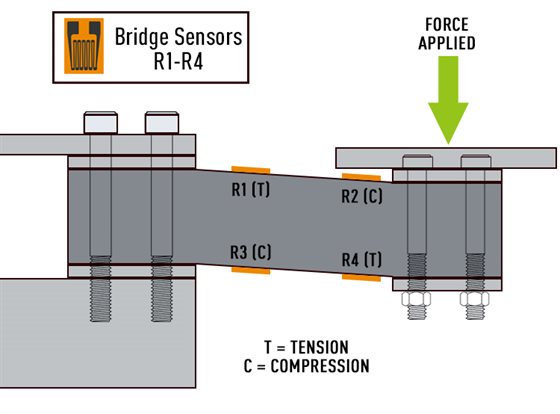
Force and weight are pressure's close relatives, and they bring the hardest front end in the group. A load cell is a strain-gauge bridge whose output shifts by only a couple of millivolts for each volt of excitation at full load, sometimes less, so a cell run at five volts might swing ten millivolts from empty to capacity. A signal that small means an ordinary microcontroller ADC reads more of its own noise than the load when wired straight across the bridge. The excitation itself has to be clean, and it is usually arranged to be ratiometric with the conversion, so a wobble in the supply cancels in the ratio and never shows up as apparent weight.
The HX711 exists for exactly this, a 24-bit converter with a low-noise programmable amplifier sized to a bridge and almost nothing else on the die. It is cheap and purpose-built, drives the excitation itself, and asks little of the host beyond clocking out a serial word at ten or eighty samples a second. Its amplifier offers a couple of fixed gains, up to about 128, set so a full-scale bridge swing fills nearly all of the converter's range, and it can switch between two channels so one chip reads two cells. That single focus is why it sits under a large share of hobby and trade scales.
The NAU7802 does the same work with a different balance of resolution, supply range and sample rate, and a clean I²C interface that puts the bridge front end on the same bus as the rest of the board. It also brings an onboard regulator for the bridge excitation, which tightens the ratiometric loop and saves an external part. Either way the gain stays hard against the cell, because lifting a microvolt signal after it has crossed a noisy board is too late to do cleanly.
A scale is rarely limited by its converter in the end. Creep, the slow give of a loaded cell over the minutes after weight lands, together with the cell's temperature coefficient, usually sets the accuracy a user feels; the hysteresis between loading and unloading adds to it. That is why a careful scale tares often and waits a moment for the reading to settle, compensates against an onboard temperature sensor, and treats the way the cell is bolted and supported as seriously as the silicon reading it. The mechanics and the electronics share one error budget here, and the larger term usually lives in the steel. A scale also averages several conversions for a steadier number, set against how fast a user expects the display to settle.
The small difference
Some readings are the small difference between two nearly equal pressures, a sliver riding on a large shared level. A part like the MPRLS targets low differential pressure, the regime of airflow sensing and medical breathing circuits, where the sensor has to pull a small delta out cleanly while the static pressure both ports hold in common tries to drown it. Zero stability matters more than absolute accuracy here, since the reading often sits near zero, and a slow wander there reads as a flow that is not happening. Even mounting orientation can register, because the weight of the fill fluid on the diaphragm nudges the zero with angle. Calibrating that zero in the field, with both ports opened to the same pressure, is a routine step a differential design has to leave room for.
The thread through all of these is that the reference and the environment decide more than the sensing element does. A barometric part and a differential gauge can each be excellent on their own terms and still be the wrong choice, if the reference is mismatched or the medium attacks the diaphragm. Those failures have nothing to do with the accuracy printed on the front page.
So the first question to ask is rarely which part reads to the tightest accuracy. It is what the reading is taken against, and what the diaphragm has to survive, and those two answers usually cut the catalog to a short list before a single specification gets compared.