Free Shipping Over$200

- Products
- Marking
- Alternative

Doing Passive Identification and Interaction With NFC and RFID
NFC and RFID move an identity or a small block of data with no battery on the tag, which is what sets them apart from every other radio on a connected device. The tag wakes from the reader's own field, answers, and goes dark again, so it can sit unpowered for years and still work the moment a reader comes close.
That single trait, a tag that runs on borrowed power, decides nearly everything else about these parts. The range is short, a few centimeters for NFC and not much more for typical RFID, the tag is cheap and effectively immortal because there is no cell to die, and the reader carries the cost, the current, and the complexity. A design that uses them splits cleanly into the side that is read and the side that does the reading, and the two get chosen against concerns that have almost nothing in common.
How a tag runs on the reader's field
The trick that makes a passive tag work is inductive coupling, the same principle as a transformer with a large air gap between its windings. The reader drives an antenna coil at the carrier frequency, the tag carries its own coil tuned to that frequency, and when the tag enters the field a voltage is induced across its coil that the chip rectifies into a supply. The coupling is loose, far looser than a real transformer, so only a fraction of the reader's energy reaches the tag, and the antenna geometry on both sides ends up mattering as much as the chip does. Everything the tag does has to come out of that induced power, which is the constraint that shapes the rest.
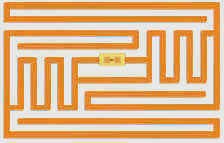
From there the tag has to both run and reply on borrowed power, and the way it does is the part to follow because it explains the limits. The tag's coil and a capacitor form an LC tank tuned to the carrier, and the closer that tuning sits to the reader's frequency the more energy crosses the gap, which is why a tag detuned by a metal surface behind it or a careless antenna layout just stops working. The rectified field has to power the chip's logic and its memory through the whole exchange, so a tag that only holds a serial number needs little and reads at arm's length, while one that runs a small processor or writes to memory needs more and works over a shorter range as the price. To send data back, the tag does not transmit in the usual sense, since it has no power to spare for a transmitter; instead it varies the load on its own coil in a pattern, and the reader sees that as a tiny change in what its own antenna draws, a scheme called load modulation that lets the tag answer without a radio of its own. This back-channel is faint, which is the deepest reason the range stays in centimeters: the reader can push its field a fair distance, but it then has to hear a whisper the tag makes by flickering its load, and that whisper fades far faster than the field that powers it. The exchange behind how an NFC tag works with no battery of its own falls straight out of that asymmetry, a reader that can shout and a tag that can only murmur back on the reader's own energy. It also explains why these links never grew into long-range radios, since the physics that makes a tag cheap to make and immortal on the shelf is the same physics that keeps it close to the reader. The reader's side of this is a real RF design rather than a given: the antenna coil has to be tuned and matched, its quality factor weighed against the data bandwidth while its size is weighed against the range, since a bigger coil reaches further but couples less tightly to a small tag. Power and tuning pull against each other, and a reader that drives hard to reach a distant tag can detune itself against one held flat against its face, so the front end and its matching network are sized for the span of distances the product will meet in use. That is the work the reader ICs further down take off a team, each handling the carrier and the protocol so the host sees only decoded data.
The consequences set where these parts belong. A passive tag has no shelf life to speak of, survives being laminated into a card or sealed into a product, and costs little enough to throw away, but it exists only while a reader energizes it, so the system is built around the reader being present at the moment of the read. That fits access cards, transit fares, product authentication, and a phone tapped against a label, and it rules out anything that has to report on its own when no reader is near.
Low frequency or high frequency
Two bands carry it: 125 kHz holds little more than a serial number, while 13.56 MHz NFC carries real data and reaches phones.
Tags that are memory, and tags that do more
The simplest tag is a block of memory with a radio interface, and on the NFC side that often means a dual-interface part the product reads over a wired bus while a phone reads the same memory over the air. The M24LR04E-RMC6T/2 is a dual interface NFC memory that pairs an I2C side for the host with an RF side for a reader, so a device can write its own status into the tag and a phone can read it out with the device unpowered and disconnected. That makes the tag a window into a product that is sitting on a shelf or boxed for shipment, readable without opening anything or pressing a button.
The same part comes in a larger size when the payload grows past an identifier. The M24LR16E-RMC6T/2 carries more memory in an NFC product tag, room for a longer record, a configuration block, or a short log a reader can pull on contact, which suits a product that wants to hold real content behind the tap rather than a number that points elsewhere. It trades a little cost for the capacity and otherwise behaves like its smaller sibling on both interfaces.
Where the host wants a clean wired path into the tag, the NT3H2111 is an NFC tag memory with I2C built for that, with a pass-through mode that lets a phone and the host hand data back and forth through the tag as a mailbox rather than only reading static memory. That turns the tag from a label into a low-effort channel to commission or update a device with a tap, no screen or keypad required, which is why it shows up on products that ship sealed and get their first setup from a phone held against the case. The field from the phone can even carry enough to do that handshake before the product's own power is on.
A tag can also harvest the reader's field as usable power for the rest of the board. The ST25DV04K is a dynamic NFC tag with energy harvesting, able to pull a little current out of the RF field to wake or feed a low power circuit alongside the same dual-interface memory, so a product still on the shelf can be roused or configured by a phone before its battery is ever connected. The harvested power is small and the range short, but for a one-time wake or a configuration write it removes a connector and a step from the line.
The reader side
The reader is where the cost and the design effort sit, and the part starts with the band. For the low frequency world, the EM4095HMSO16B+ drives a 125 kHz RFID reader as an analog front end that handles the carrier and the coupling so a host MCU only deals with the decoded data, which is the common way to add a simple LF reader to a product without designing the RF from nothing. It pairs with a coil and a handful of passives, and it suits the access fobs and animal tags that live in that band, where a serial number read at a few centimeters is the whole job. The decoded output it hands the host is simple enough for a small 8-bit MCU to take directly, which is part of why low frequency readers stay so cheap to build and turn up in the highest volume, lowest cost access products.
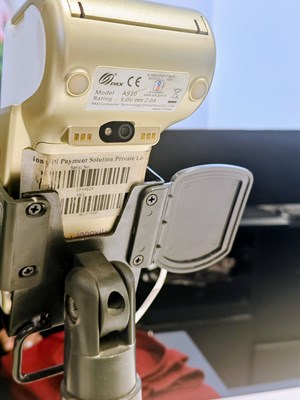
On the high frequency side the front ends do more of the protocol work. The ST25R95-VMD5T serves as the reader front end in an NFC design, managing the 13.56 MHz carrier and the tag protocols and talking to a host over SPI, which keeps the RF in one part while the application stays on the MCU the team already chose for the product. It handles the card detection and anticollision steps that let a reader pick one tag out of several in the field, the fiddly part of an NFC stack a team would rather inherit in silicon than write from scratch.
For a reader that has to speak several tag standards at once, the TRF7970ARHBT runs a multiprotocol NFC reader, covering the common NFC and ISO 14443 and 15693 standards so one design reads the mix of tags it meets rather than committing to a single type. It is a frequent pick where the reader cannot control which tags will be presented to it, such as a public kiosk or a payment-adjacent terminal that has to accept whatever a user taps.
Cost pulls the other way for high volume and a known tag. The MFRC522 does low cost 13.56 MHz card reading, the part behind a great many access readers and hobby builds, cheap and well documented and good enough for the common card types, which is why it turns up wherever the task is reading a known card at a known distance for the least money. It gives up the protocol breadth of the pricier front ends, and for a fixed-credential door or cabinet that breadth was never needed.
For read and write across the widest set of modes, the PN532 handles multiprotocol NFC read and write, including the peer-to-peer and card-emulation modes that let a reader act as a tag or talk to a phone as if it were one. That flexibility makes it the choice when a design has to do more than read a fixed credential, and it costs more than a bare card reader and earns the difference back in the range of things it can be made to do. It is the part reached for when a product has to both read a badge and be read like one from the same antenna, and exchange data with a phone besides, a shape that turns up across payment-adjacent terminals and interactive displays where the reader is also a participant.