Free Shipping Over$200

- Products
- Marking
- Alternative

WHAT IS THE DIFFERENCE BETWEEN AN IGBT AND A MOSFET?
Choosing between an IGBT and a MOSFET isn't just a matter of preference - it's about matching the right technology to your circuit's demands. Both are fundamental building blocks in power electronics, yet their operational characteristics and performance profiles differ enough that using the wrong one can hurt efficiency, reliability, and cost-effectiveness. This article explains these differences in a clear and actionable way so you can make smarter design decisions.
Key Difference at a Glance
At the highest level, MOSFETs offer faster switching and greater efficiency at low-to-medium voltages, while IGBTs shine at high voltages and high-current applications, albeit at slower speeds.
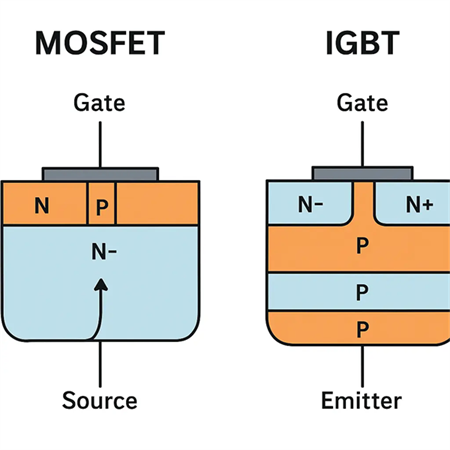
This stems from their design: MOSFETs operate as purely unipolar field-effect devices, optimized for speed and minimal losses at lower voltages. In contrast, IGBTs combine MOS gate control with a bipolar current path, enabling them to withstand and conduct much higher voltages and currents - but at the cost of slower switching due to charge storage effects.
Guideline:
For voltages above ~400V and moderate frequencies → IGBT
For voltages below ~300V and high frequencies → MOSFET
How IGBTs and MOSFETs Work
Both devices are gate-controlled semiconductor switches, but the way they move charge carriers explains their different behaviors.
MOSFETs rely entirely on an electric field to control conduction between the source and drain terminals. This purely electronic mechanism allows them to switch very quickly with little delay or loss, especially at lower voltages.
IGBTs, on the other hand, integrate a bipolar conduction layer into a MOS-controlled structure. The MOS gate voltage still controls turn-on and turn-off, but the presence of minority carriers in the conduction path boosts current capacity and allows for much higher breakdown voltages. However, these carriers linger after switching, slowing down turn-off times.
Why it matters: MOSFETs are best when speed and efficiency at low voltages matter. IGBTs are better suited when robustness and high-voltage endurance are required.
Performance Comparison: IGBT vs MOSFET
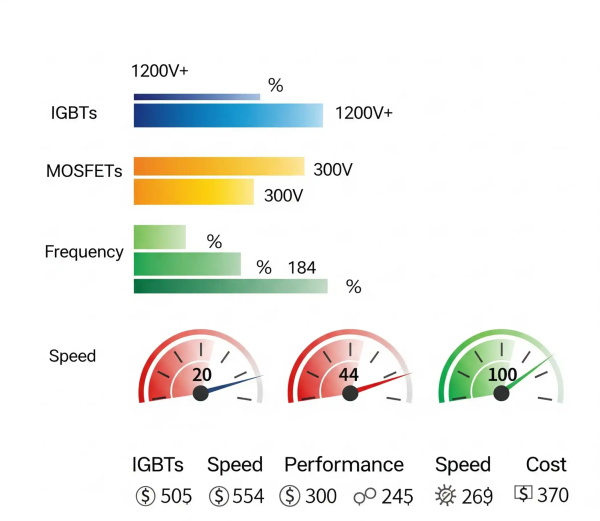
To illustrate how these characteristics play out, here is a direct comparison of their typical performance attributes:
From the comparison, it's clear that neither IGBT nor MOSFET is universally superior - each excels in specific conditions aligned with its design. If your system demands high-voltage endurance and can tolerate moderate switching speeds, an IGBT is often the optimal choice due to its robustness and efficiency at high power levels.
Conversely, if fast switching and high efficiency at lower voltages are critical, a MOSFET becomes the obvious solution. Ultimately, the right decision depends on carefully balancing voltage, frequency, thermal constraints, and cost - there is no one-size-fits-all answer.
Strengths and Limitations of Each Device
IGBT Advantages
- Robust performance at very high voltages and heavy currents
- Cost-effective in high-power applications
- Simpler gate drive requirements compared to BJTs
IGBT Limitations
- Slower switching makes it unsuitable for very high-frequency designs
- Higher switching losses compared to MOSFETs in fast applications
MOSFET Advantages
- Extremely fast switching, perfect for high-frequency circuits
- Low conduction and switching losses at low-to-medium voltages
- Very efficient thermal performance at low power
- MOSFET Limitations
- Not practical or efficient above ~400V due to rising on-resistance
- Less suited to very high current levels
Application Examples: Where Each Excels
IGBTs dominate in environments where high voltages and significant power levels are unavoidable. You'll find them in industrial motor drives, induction heating equipment, high-power inverters, and electric railway traction systems - all of which prioritize robustness over switching speed.
MOSFETs are the go-to for electronics that need rapid switching and efficiency at lower voltages, such as power supplies, DC-DC converters, voltage regulators, and class-D amplifiers. Their ability to operate cleanly at high frequencies makes them indispensable in fast-switching circuits.
Conclusion
Neither technology is universally better - it all comes down to application needs. MOSFETs excel where speed and efficiency rule at lower voltages, while IGBTs dominate high-voltage, high-current environments. Understanding their trade-offs ensures your power electronics are not just functional, but optimized for performance and cost.
When in doubt, consult datasheets, compare specifications, and prototype under real-world conditions to validate your choice.