Free Shipping Over$200

- Products
- Marking
- Alternative

A Battery from Chemistry All the Way to an Exact Part Number

Power semiconductor specialist, SiC and GaN · 15+ years in power electronics · adjunct lecturer in Grenoble and technical consultant
The C in CR2032 was decided before the diameter was. It is the IEC code for lithium manganese dioxide, and it carries the heavy half of the name: what the cell is made of, what voltage it sits at, how it behaves in the cold. The 2032 that follows carries the light half, twenty millimeters across and 3.2 high. A battery's designation is written in the order its decisions matter, chemistry first, geometry second.
The first letter does the work.
A selection deserves to run in the same order. Teams that settle the can first, because the enclosure was drawn first, end up shipping the wrong discharge curve inside a perfectly fitting holder; the holder forgives them, the firmware does not.
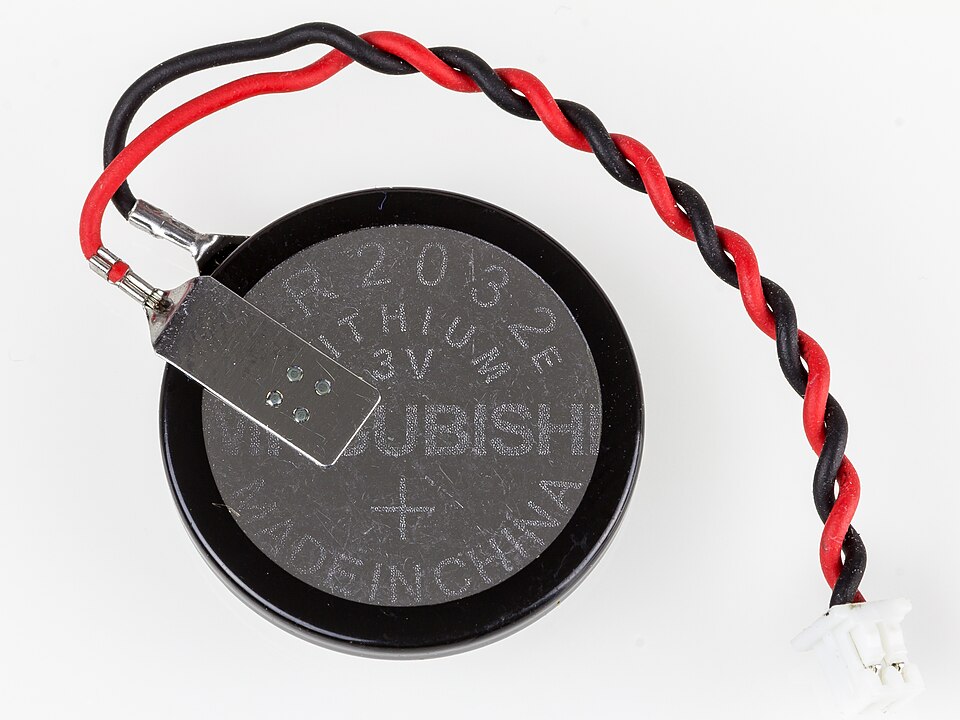
Photo: Raimond Spekking, CC BY-SA 4.0, via Wikimedia Commons
What a battery is to the circuit
No load, no truth. Test cells the way they work.
Before the names, one working model, because every decision below leans on it. To the circuit, a battery is an ideal voltage source in series with a resistance, and both halves of that model are chemistry. The source voltage comes from the electrode pair and never from the size; the internal resistance comes from construction, and it rises as the cell empties, in the cold, and with age. Every familiar symptom lives in that second term: the flashlight that dims under load and recovers at rest, the remote that revives after a day in a warm pocket, the multimeter that reads a dead alkaline at a healthy 1.4 V because an unloaded measurement asks the resistance no questions.
Why the letter owns the voltage
A cell's voltage is set by which two electrode materials face each other across the electrolyte, full stop. Zinc against manganese dioxide gives the 1.5 V that carbon zinc and alkaline share; zinc against silver oxide gives 1.55; zinc against the oxygen in the air gives the 1.4 of a hearing-aid cell; lithium against manganese dioxide gives 3.0; lithium against thionyl chloride, 3.6; the nickel hydride couple, 1.2; iron phosphate sits at 3.2 beside the 3.6 and 3.7 of the cobalt and nickel families. Geometry contributes nothing to any of those numbers.
That is why no catalog has a 2 V coin cell to sell, no matter how politely a design asks. Voltages arrive in the steps the periodic table offers, and a rail between steps is bought with a regulator or a second cell, never with a part number. Capacity scales with the can; voltage refuses to scale with anything you can machine.
What the letter decides
IEC 60086 spends one character on the entire electrochemical system. No letter at all, just an R, is carbon zinc at a nominal 1.5 V, the oldest entry on the list. L is alkaline, the same 1.5 V with more energy behind it. S is silver oxide at 1.55 V. C is lithium manganese dioxide at 3 V, the coin-cell default; B is its quieter sibling, lithium carbon monofluoride, traded for better behavior at temperature and over decades. F is lithium iron disulfide, a 1.5 V lithium built to drop into alkaline sockets. E is lithium thionyl chloride at 3.6 V. P is zinc air, the hearing-aid chemistry that breathes.
The first thing that letter fixes is the shape of the voltage curve, and curve shape is destiny for whatever sits downstream. Silver oxide holds 1.55 V nearly flat to the end, which is why watches and meters that calibrate against their supply pay extra for the S. Alkaline slopes from the first day, friendly to fuel gauges and unfriendly to devices that quit below 1.2 V with half the energy still inside. The lithium letters buy a high, flat plateau and the cold-weather manners that aqueous cells lose.
The second thing it fixes is time. Self-discharge runs from percent-per-month territory in the cheapest aqueous systems down to roughly a percent a year in lithium primaries, and the thionyl chloride bobbin cells behind utility meters are specified across something like minus 55 to plus 85 degrees C with ten-year design lives. None of that came from the data sheet of a specific brand. It came with the letter.
The letter is load-bearing; everything after it is packaging.
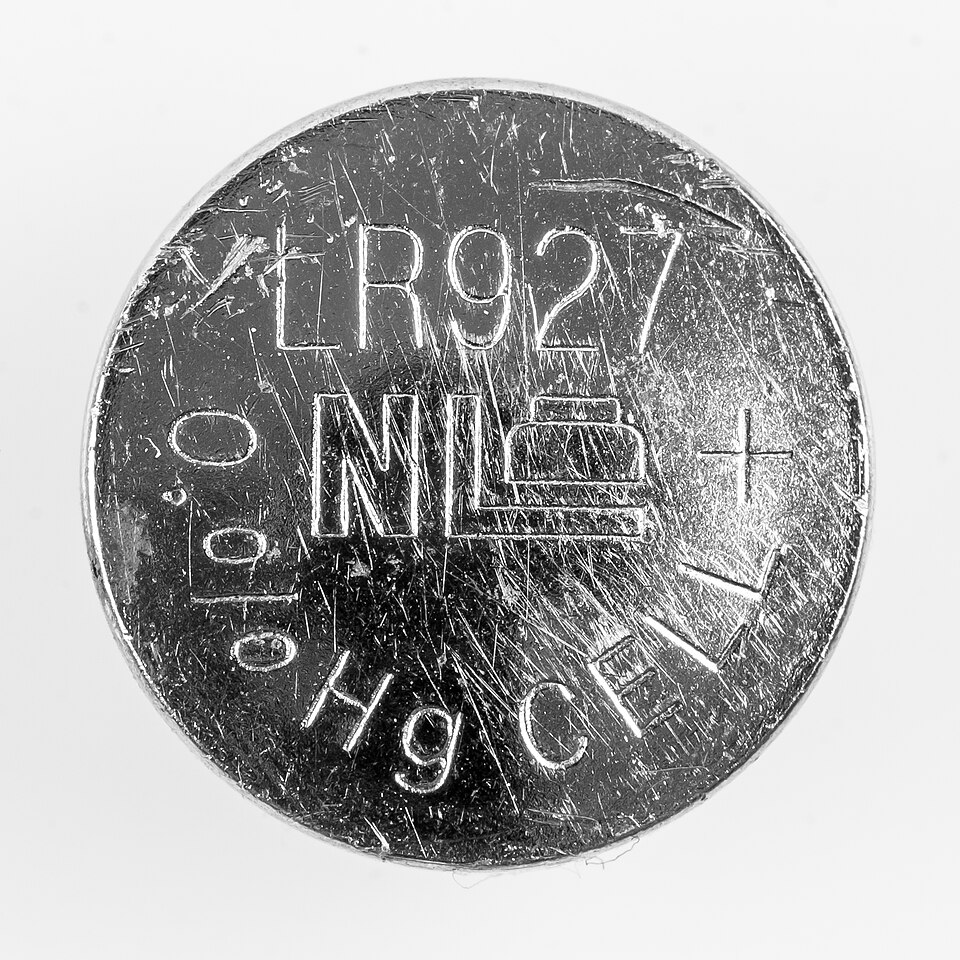
Photo: Raimond Spekking, CC BY-SA 4.0, via Wikimedia Commons
The primary families, one at a time
Carbon zinc, the letterless R, is the floor: cheap, sloping, happiest in clocks and remotes that sip. Alkaline, the L, is the same 1.5 V couple rebuilt for energy and shelf, with several times the capacity of carbon zinc in the same can, and the famous weakness to match: a potassium hydroxide electrolyte that creeps out of an exhausted cell and eats battery contacts, which is why the rule about never letting a device hibernate with alkalines inside was written by warranty departments rather than chemists. Both slope steadily as they drain, which fuel gauges love and which devices that quit at 1.3 V waste.
Silver oxide, the S, pays a precious-metal price for a discharge so flat that a watch keeps rate to the end and a meter can calibrate against its own supply. Zinc air, the P, is the energy-density trick of the primary world: one electrode is the atmosphere itself, so the can is nearly all anode. The tab sealing the air hole is the on switch, and once it is pulled the clock runs whether the hearing aid is worn or not; weeks, not years, and the data sheet says so out loud.
Among the lithium coins, C and B are siblings with different temperaments. The manganese dioxide C is the volume default, strong at room temperature and comfortable with the pulses a key fob asks for. The carbon monofluoride B trades some of that pulse strength for a wider temperature window and slower self-discharge, which is why B turns up soldered to industrial boards that will bake for years while C turns up everywhere else.
F, lithium iron disulfide, is the lithium that impersonates an alkaline: 1.5 V nominal, light, strong in the cold, sold as the premium AA for cameras and winter field gear. E, thionyl chloride, earns the next section to itself; its fine print runs longer than some data sheets.
The fine print inside one letter
Take E, lithium thionyl chloride, and read past its headline. The headline is spectacular: 3.6 V, the flattest long-duration plateau in the primary world, self-discharge low enough that a bobbin cell can sit inside a water meter for a decade and still report. The fine print is what the letter does not say. Bobbin construction buys that shelf life by keeping electrode area small, so the cell is a marathon runner with no sprint in it; ask it for a radio burst and the voltage sags. Worse, the same chloride chemistry that protects the shelf life grows a passivation film on the lithium while the cell rests. A meter that has slept for months wakes up, keys its transmitter, and watches its own supply dip below brownout on the first pulse, a failure that never appears on a bench because bench cells never rest long enough. Designers who know the letter budget for it: a capacitor across the cell to carry the burst, or a scheduled trickle that keeps the film thin. The C coin cells have their own footnote, internal resistance that climbs as capacity drains, so a cell that drove a Bluetooth beacon happily at the start of life delivers the same average current with deeper and deeper voltage notches at the end of it.
Data sheets carry these footnotes. Names do not.
The pulse meets the resistance first
A radio pulse meets the internal resistance long before it ever meets the chemistry.
Run the arithmetic on the second half of the battery model and a familiar field failure explains itself. A fresh lithium coin carries an internal resistance in the low tens of ohms, and the figure climbs as capacity drains and as temperature falls, into the many tens near end of life. Ask such a cell for a 10 milliamp transmit burst across 40 ohms and the terminals sag by 0.4 volts; a cell resting at 3.0 is delivering 2.6 under the pulse, a hair above a typical 2.5 volt brownout threshold, and the next cold morning takes the rest. The log says the battery died at half capacity; the chemistry says the energy was still there and the resistance refused to hand it over fast enough. The fixes belong to the designer: a capacitor sized to carry the burst, a lower transmit power, or a letter with more electrode area behind it.
Loggers that sample voltage only at rest never see this; the cell looks healthy in every reading and dead in the field. Log once a day under load and the slope announces the retirement date months in advance.
Hot and cold pick favorites
Temperature reads the letter and chooses sides. The aqueous chemistries lean on liquid mobility, so an alkaline that delivers its full rating on the bench surrenders a large slice of it near freezing and goes nearly mute well below, which is the dull reason outdoor January gadgets eat batteries. The lithium letters keep working: iron disulfide and thionyl chloride cells are specified down toward minus 40 and past it, and the coin that runs a fob in Phoenix runs the same fob in Fairbanks. Heat flips the table: NiMH self-discharge accelerates sharply in hot storage, alkaline ages faster, and the carbon monofluoride B earns its keep on boards that live beside engines and ovens, at temperatures that retire the C.
Rate the budget at the worst corner of the climate map, never at the bench, and several letters disqualify themselves before price gets a vote.
Geometry, and the digits that carry it
The digits never say what is inside.
Coin cells encode their can in four digits, diameter in millimeters then height in tenths: 2032 is 20.0 by 3.2, 2025 is the same lid over a thinner stack, 2016 thinner again. The temptation to treat them as interchangeable because two of them rattle into the same holder costs real capacity and real contact pressure. Cylindrical primaries use five digits the same way, and the telling one is 14505: 14.5 mm by 50.5, the exact body of an AA. ER14505 is a perfectly legal name for a 3.6 V thionyl chloride cell wearing the costume of a 1.5 V battery, and it will slide into a consumer battery spring with no resistance at all from the mechanical world.
The older codes are history wearing numbers: R6 is the AA, R03 the AAA, R14 the C, R20 the D, kept for continuity, with suffixes like W marking compliance with the watch-battery part of the standard. Line up R6, LR6, FR6 and HR6 and the same can holds carbon zinc, alkaline, lithium iron disulfide and nickel metal hydride: one body, four souls, two different voltages among them.
One more code hides at the front. 6LR61 is the rectangular 9 V block, and the leading 6 is a count: six alkaline cells in series inside one wrapper, just as 6F22 is six carbon zinc cells and 4LR25 is four in a lantern battery. The name confesses the construction before a knife does.
Sizing the can: a budget worked in microamps
Budgets settle arguments that adjectives cannot. Take a sensor node drawing an average of 50 µA and required to live three years on one primary cell. Three years is about 26,000 hours, so the budget lands near 1,300 mAh before any margin. A CR2032 carries on the order of 220 to 240 mAh, which at that drain is roughly six months, not three years; the coin was never a candidate, whatever the enclosure wished for. An ER14505 bobbin cell holds around 2.5 Ah in the same AA-sized can and clears the budget with headroom for the radio bursts, which is the plain arithmetic behind its grip on the metering world. Two alkaline AAs reach a similar number on paper and surrender it in the cold.
The division also runs the other way. A CR2032 that has to last one year hands the whole design an average of about 25 µA, sleep, sensing and radio included, and a firmware team that learns this at the design review learns it late.
Run the division before the mechanical team falls in love with a coin.
An application atlas, read backwards
Run the logic in reverse and the market sorts itself. Utility meters and toll tags sit on E, the only letter that promises a decade. Real-time clocks and key fobs sit on C, with B taking over wherever the board gets baked or reflow-soldered. Watches and instruments that calibrate against their own rail pay for S. Hearing aids belong to P because nothing else packs that many milliamp hours behind an eardrum. Cold-weather field gear reaches for F. High-drain tools and packs live on INR cylinders; stationary storage and anything allergic to thermal drama keeps drifting toward the iron phosphate letter of the rechargeable alphabet. When an application and a letter disagree, the letter is usually reporting a constraint the application forgot.
Rechargeable, where the second letter is the cathode
Lithium-ion cells answer to a different standard, IEC 61960, and spend their letters differently. I opens the code for lithium ion; the second letter names the cathode that sets the cell's personality: C for cobalt, N for the nickel-rich blends, F for iron phosphate, M for manganese. R closes it for a round can. So INR18650 reads as lithium ion, nickel cathode, round, 18 mm across and 65 long; swap the N for an F and the nominal voltage drops from the 3.6 V family to iron phosphate's 3.2, before any brand has said a word.
Inside one can and one prefix, the brand suffix carries the trade. Samsung's INR18650-25R holds 2500 mAh and is rated for 20 A continuous; its sibling INR18650-35E packs 3500 mAh and is happiest under ten. Same geometry, same chemistry letters, opposite answers to the only question that matters in a pack: energy or power. And the suffixes obey no standard at all; LG's HG2 tells you nothing until its data sheet does, which is the manufacturers' quiet way of saying the name stops being public property at the hyphen.
Nickel kept the older alphabet. HR is nickel metal hydride under IEC 61951, so HR6 is the rechargeable AA at a nominal 1.2 V. The missing three tenths of a volt matter less than they read, because an alkaline spends a long stretch of its own discharge near 1.2 anyway; what bites instead is the flat NiMH curve confusing gauges calibrated for a slope, and the self-discharge that the low-self-discharge variants were invented to tame.
And one mechanical footnote with a safety question inside it: a protected 18650 carries a small circuit board under its wrapper and grows a couple of millimetres for it, so a holder sized from the bare-cell drawing rejects the protected part, while the unprotected cell that does fit hands every fault duty to your pack electronics.
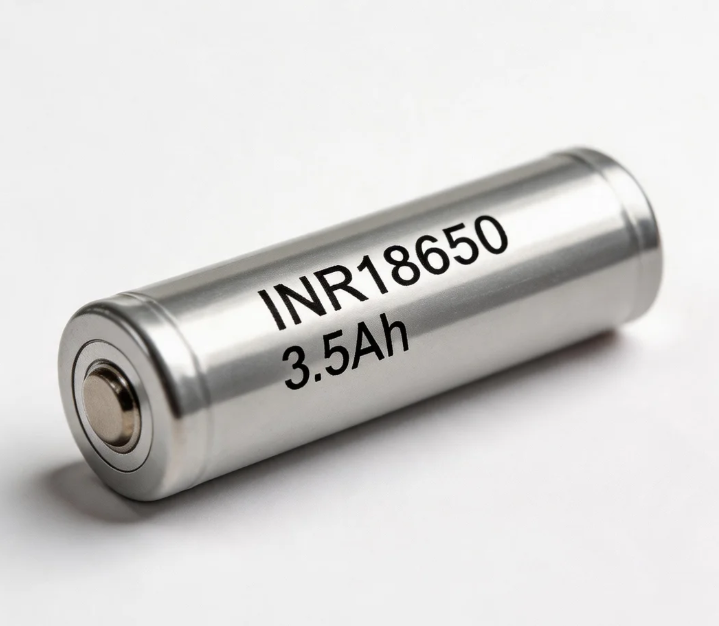
Photo: Sevenethics, CC0, via Wikimedia Commons
The charging window is the letter again
A cell and the charger that feeds it are one chemistry decision wearing two enclosures.
Recharging turns the letter into a safety boundary instead of a preference. The cobalt and nickel families charge to 4.2 V per cell; iron phosphate stops near 3.65; nickel metal hydride wants a charger that watches for the small voltage dip marking full rather than any fixed ceiling at all. Put an iron phosphate cell on a 4.2 V charger and the window is violated by design; leave NiMH on a dumb constant voltage and it cooks slowly. The charge profile is not an accessory chosen afterwards. It is the same second letter, read by the charger instead of the load.
Series, parallel, and why packs hate strangers
Cells multiply by two grammars. Series adds voltage and demands twins: every cell in the string carries the same current, so the weakest one empties first, and its healthy neighbors then drive it below zero into reverse, which is how one tired cell murders a flashlight set, and how the leading digit of 6LR61 quietly raises the stakes six ways. Parallel adds capacity and demands equal voltages at the instant of connection, or the fresher side dumps current into the tireder one before any load is attached.
Pack builders answer both grammars the same way: matched lots, matched ages, matched internal resistance, a balancer wherever lithium is involved, and an absolute ban on mixed chemistries, because a 1.55 V silver cell in series with 1.5 V alkalines is an imbalance on day one. The household rule about never mixing old and new batteries is this engineering, translated for the kitchen drawer.
A series string is exactly as honest as its weakest cell, and given time it always finds that cell.
Receiving and testing without fooling yourself
The multimeter lie comes first. An open-circuit reading asks the internal resistance no questions, so a spent alkaline can show 1.4 V to a meter and 0.9 to a motor. Health is voltage under a representative load, or a direct internal-resistance measurement, and the spread across a batch says as much as the average: a tight lot behaves like one cell, a loose lot behaves like a future warranty claim.
Capacity verification has a standard shape: charge per the data sheet where charging applies, rest, then discharge at the standard rate to the specified cutoff and integrate, the procedure the IEC 61960 family lays out for lithium ion. It is slow, which is the point. Capacity is the one number a label claims for free and a bench extracts at the rate of hours per cell.
Incoming inspection for cells is mundane and decisive: date codes against the order, lot consistency, wrapper print quality, weight, and open-circuit voltage used only as a gross filter for dead-on-arrival, never as a health certificate. A genuine high-capacity 18650 has a stubborn mass; the gram scale is the cheapest fraud detector in the building.
Reading a real string
So far everything has been public language, the part of the name two competitors share. The orderable string keeps going after the standard stops.
A bare coin cell is the same four characters from any maker. The moment it grows metal, it grows private suffix: horizontal solder pins or vertical, through-hole or surface mount, an axial strap, or the full assembly with a spot-welded tab, a twisted pair, and a keyed connector chosen to mate one specific header on one specific board.
Each of those is a code position in the maker's catalog, and none of them transfers between catalogs.
Rechargeables repeat the pattern from the other side. The IEC core sits in the middle of the string, 18650 and its letters, while the working identity lives in the private ends: 25R, 35E, HG2, the tags a pack designer specifies and a counterfeiter copies. Cross-referencing them means laying data sheets side by side, because the names themselves have stopped cooperating.
The standard names the cell; only the catalog names the part.
What ships is also coded
The last characters of a battery's identity are not on the can at all; they ride in its paperwork. Lithium cells move under UN 38.3, a battery-specific test regime of altitude, thermal cycling, shock and short circuit that a shipment must have passed before any carrier will load it, with air transport layering its own packing rules on top. Safety qualification has its own alphabet, UL 1642 and IEC 62133 among the names that appear in a serious cell's specification. Coin lithium added a newer layer when child-safety law in the United States, written after a string of ingestion deaths, began dictating the packaging itself. And the small 0% Hg stamped on the lid is an older round of the same story, the residue of mercury rules that reshaped button cells decades ago. A part number that cannot produce these documents is not a cheaper version of the same part. It is a different part.
Shelf life is part of the chemistry
A date code is data; read it on arrival, not at autopsy.
The letter keeps deciding things after the cell is built, because self-discharge is a property of the system, not of the warehouse. Alkaline packaging is commonly stamped with expiry dates seven to ten years out; the lithium primaries are built around decade-scale storage, which is half their sales pitch; NiMH bleeds charge month by month unless it is one of the low-self-discharge builds, so rechargeable stock wants a top-up before it ships rather than an apology afterwards. The warehouse rules write themselves from there: first in first out by date code, one chemistry and one lot to a bin, nothing stored hot, nothing stored mixed with the half-used returns.
Where the alphabet is heading
The letters are not finished. Sodium ion entered mass production this decade, undercutting lithium on cost and cold-weather behavior while giving up energy density, and it is already forcing the question the iron phosphate letter once forced: which applications need the density, and which only assumed they did. Iron phosphate itself keeps taking share from the cobalt families wherever fire risk and cycle count outrank weight, which is to say in nearly everything that does not fly or ride in a pocket.
Geometry moves too. The 21700 exists because adding a few millimetres to the 18650 bought a meaningful slice more energy per cell at a lower cost per watt hour, and the 46-millimetre class now pushes the same arithmetic further for vehicles. Down at the coin end, child-safety law has been redesigning not the cell but its packaging and its compartment screws, proof that an exact part number now extends to the blister it ships in. The alphabet will keep adding letters every decade or so; the method for reading them has not moved in fifty years.
Questions buyers and boards keep asking
Can a CR2025 stand in for a CR2032?
Same 20 mm lid over a stack 0.7 mm thinner. It will seat in many holders with reduced spring pressure and carries roughly a third less capacity, so the swap trades runtime and contact reliability for availability. Treat it as a roadside repair, not a BOM change.
LR44, SR44, 357, AG13: one battery or four?
One can, two chemistries, several naming habits. LR44 is the alkaline at 1.5 V on a sloping curve; SR44 is silver oxide at 1.55 V and flat, sold to the watch trade as the 357; AG13 is the alkaline again under the AG habit some makers use. A device that calibrates against its supply wants the S.
Why does a rechargeable AA say 1.2 V?
Because it is an HR6, nickel metal hydride, and 1.2 V is its honest nominal. An alkaline spends much of its life near 1.2 V too, so the device rarely notices; simple gauges calibrated to 1.5 V do.
Will an 18650 work where AA cells go?
No, twice over. The voltage is 3.6 V against 1.5, and the can is 18 by 65 mm against 14.5 by 50.5, so chemistry and geometry refuse together.
What is inside a 9 V battery?
The name confesses: 6LR61 is six alkaline cells in series, 6F22 six carbon zinc, one wrapper around a little stack.
How should cells be stored?
Cool, dry, in original packaging, one chemistry and lot per bin, NiMH topped up before long storage, stock rotated by date code. Lithium primaries are the forgiving ones; they were engineered for the shelf.
Is a 9,900 mAh 18650 real?
No. The chemistry inside a genuine 18650 tops out around thirty five hundred milliamp hours; anything printed far above that is the wrapper talking. Ask for the UN 38.3 report instead of believing the label.
Why are some batteries 3 V and others 1.5 V?
Because voltage belongs to the electrode pair, not the package. The lithium couples land near 3 V and above; the zinc and nickel couples land near 1.5 and 1.2. There is no dial inside the can, and no in-between cell to buy.
CR2032 or CR2450?
Same C chemistry, same 3 V, different can: 20 by 3.2 mm against 24.5 by 5.0. The bigger coin carries on the order of three times the capacity, so the choice is the enclosure's to make; the electrical behavior barely changes.
Why does a zinc-air battery ship with a sticker on it?
The sticker seals the air hole, and air is one of the electrodes. Peeling it is the on switch: the cell activates, and from that moment its life is measured in weeks whether the device runs or not.
Can I solder wires straight onto a battery?
Not with an iron on the bare can. The heat needed to wet the shell cooks seals and separators and can vent the cell; cells meant for wiring ship with factory spot-welded tabs, the assembly, ordered by suffix. Buy the tabbed part number instead of improvising one.
Why do airlines care about lithium batteries?
Because the failure mode is fire. Passengers carry cells in the cabin within watt-hour limits with spare terminals protected; freight moves under UN 38.3 paperwork, and lithium ion shipped as cargo travels at a reduced state of charge by rule. The paperwork section above is the ground-level view of the same regime.
Getting the cell
No commodity an electronics buyer touches gets faked as heavily as the battery, and the fraud is usually printed right on the wrapper: 18650 cells advertising six, eight, ten thousand milliamp hours, when the chemistry inside a real 18650 tops out around thirty five hundred. The wrapper costs nothing to print; UN 38.3 reports, qualification files and traceable lot codes cost everything to fake, which is exactly why the paperwork, not the label, is the authentication.
In Fortune Electronics sources cells against the full string, the IEC core plus the maker's suffix, from CR2032 variants with the tab and connector a board needs, through ER14505 bobbin cells for metering, to graded INR18650 stock with documentation that survives an audit, and quotes the transport-compliant packing alongside the cells because with lithium the logistics are part of the specification. Send the string; the chemistry is already in its first letter.
Designation letters and example ratings here follow IEC 60086 and IEC 61960 usage and current maker listings; capacities and discharge ratings for named cells, such as the 2500 mAh / 20 A and 3500 mAh figures above, are from manufacturer specifications and vary by revision. Confirm against the data sheet of the exact cell and revision you buy.