Free Shipping Over$200

- Products
- Marking
- Alternative

The Lithium-Ion and Polymer Cells That Power a Rechargeable Product

Power semiconductor specialist, SiC and GaN · 15+ years in power electronics · adjunct lecturer in Grenoble and technical consultant
Open a power bank beside a phone and the same chemistry greets you in two costumes. The power bank holds a steel cylinder, an 18650 or its larger 21700 sibling, rigid enough to survive a drawer full of keys. The phone holds a flat silver envelope, a pouch of laminated foil that gives a little when pressed. Both run the lithium-ion reactions of the rechargeable alphabet; what separates them is everything wrapped around those reactions, and that wrapping is what the word polymer has come to sell.
The honest selection axis for a rechargeable product runs through three layers: the cathode letter that fixes voltage and temperament, the body that fixes mechanics and failure manners, and the maker's string that fixes everything a buyer can order. The pouch never touched the first layer; it rewrote the other two.
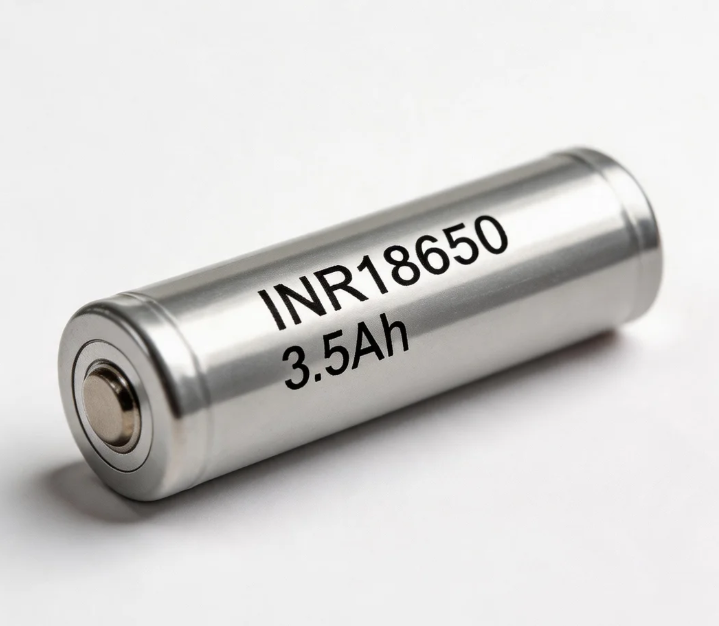
Photo: Sevenethics, CC0, via Wikimedia Commons
What the word polymer is selling
In the laboratory, a lithium polymer cell means a polymer or gel electrolyte standing in for the liquid one, a real distinction with real consequences for leakage and form. In the catalog, the word drifted: nearly everything sold as LiPo today is a lithium-ion cell with a conventional or gelled electrolyte sealed inside a laminated aluminum pouch, and the label is doing the work of a packaging note. The buying mistake this invites is treating ion and polymer as rival chemistries and asking which one is better, when the data sheets describe cousins separated by their wrapping.
The wrapping deserves the attention the word steals. A pouch trades the cylinder's steel for foil and glue: it weighs less, fills rectangular space the way liquid fills a bottle, can be ordered in nearly any footprint a product sketches, and hands every mechanical duty, crush, puncture, swelling room, to the enclosure around it.
So read polymer on a spec sheet as a question rather than an answer: which electrolyte, which pouch, which cathode letter. Three different engineers own those three answers, and the marketing department owns none of them.
Three bodies, one chemistry
Steel keeps secrets; the pouch tells you everything.
The cylinder is the conservative of the three. A wound jelly roll inside a steel can gives it crush strength, a built-in vent, a pressure boundary that holds gas until a designed score line lets go, and a shape that machines have packed by the billion. Its costs are corners: a rectangular product wraps wasted space around every round cell, and the can's weight rides along everywhere it goes. Public naming rides along too, the INR prefix and the size digits printed on the wrap in the photograph above, the open grammar the wider battery alphabet established.
The prismatic cell folds or winds the same electrodes into a rectangular aluminum case, recovering the wasted corners while keeping a hard shell and a vent. Phones lived here before pouches arrived, cars live here now at enormous scale, and the format's quiet advantage is mechanical honesty: a rigid case that mounts like a brick, holds its dimensions, and bulges almost not at all before its own vent speaks for it.
The pouch strips the case down to a laminated foil bag, the lightest and tightest-packing body of the three, made to order in nearly any footprint, with welded tabs in place of terminals. Everything it saved, it owes back: no crush resistance of its own, no vent, no pressure boundary beyond a heat-sealed seam, so the product must supply the skeleton, the swelling headroom, and the restraint that the steel can used to carry for free.
Pick the body for the product's mechanics and for the failure manners it can live with, then let the cathode letter and the maker's string follow. The order matters here as much as it did when the first letter of a primary cell was the chemistry.
The pouch's digits speak millimetres
Cylinders encode diameter and length; pouches encode three dimensions, and they lead with the thinnest one. A designation in the common LP style reads thickness, width, length, with thickness in tenths of a millimetre: LP503450 is a cell 5.0 mm thick, 34 wide and 50 long, and a reputable line in that footprint delivers on the order of a thousand milliamp hours. The same grammar scales from the 401012 slivers inside earbuds to the slabs inside tablets, and a mechanical designer can sketch the battery cavity straight from the name before any data sheet opens.
Thickness first, in tenths of a millimetre; the pouch leads with its waistline.
Two cautions ride along with the convenience. The naming is a convention rather than a standard, so makers write 503450, LP503450 and 053450 for the same body, and the printed thickness is the fresh thickness: the swelling allowance comes out of your cavity, never out of their digits. And capacity for a given footprint varies by maker and by cathode, which is where the letters walk back in.
The cathode letter still governs
Nothing about the pouch repealed the second letter. Cobalt oxide still rules the phone pouch because volumetric energy density is the entire game inside a slab a hand must hold; the nickel blends carry tools and packs; iron phosphate trades energy for thermal calm and cycle count and arrives in pouches and prismatics for stationary and starter duty in growing volume. The nominal voltage follows the letter as it always did, 3.7 and 3.6 for the cobalt and nickel families, 3.2 for iron phosphate, so a pouch marked only 3.7 V has named its family without spelling it.
The Nokia pack in the photograph below says exactly that much and nothing more: 3.7 V, polarity marks, a hologram and a private name. The pouch world prints what the maker chooses; the public core, where one exists at all, lives in the data sheet.
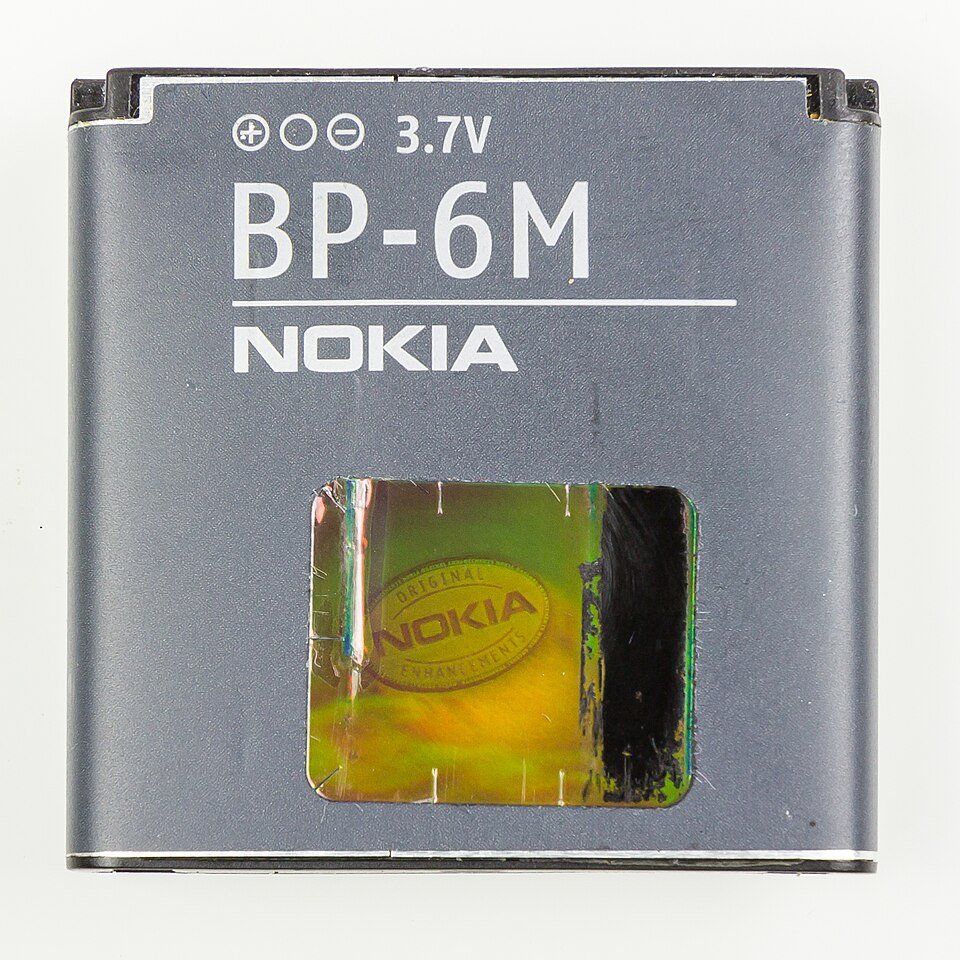
Photo: Raimond Spekking, CC BY-SA 4.0, via Wikimedia Commons
Milliamp hours only spend inside one voltage
Milliamp hours are a currency with an exchange-rate problem. A 1000 mAh iron phosphate pouch at 3.2 nominal volts holds 3.2 watt hours; a 1000 mAh cobalt pouch at 3.7 holds 3.7, fifteen percent more energy behind the same headline number. Comparing packs across chemistries in mAh is comparing wallets by counting their notes, and the airlines understood it first, which is why every carry-on limit is written in watt hours: multiply the nominal volts by the amp hours and the number on the label stops being able to flatter itself.
Inside one chemistry the shortcut comes back, which is why cylinder suffixes still speak mAh among themselves without confusion. Cross a voltage boundary, an iron phosphate swap, a 2S pack set against a large 1S, and watt hours become the one honest column left on the comparison sheet.
C is the current's dialect
Discharge ratings arrive in a unit that scales with the cell: 1C is the current that would drain the rated capacity in one hour, so 1C on a 2500 mAh cylinder is 2.5 amps and 1C on a 200 mAh earbud sliver is 0.2. The dialect lets one number describe cells of any size, and it lets the Samsung 25R's 20 amp rating be read at a glance as 8C while a power-bank cell loafs along below 1. Burst ratings sit above continuous ones and last seconds; the data sheet states which is which, and a careful reader takes both.
The dialect also hosts the loudest lying in the catalog. Hobby pouches wear 25C and higher on the shrink wrap, numbers that would mean 55 sustained amps from a 2200 mAh pack through tabs the width of a fingernail; the realistic continuous figures sit far below the print, and the first components to protest are the connector and the wiring, which obey copper rather than marketing.
Convert every C back to amps before believing it, then walk those amps through the tab, the trace and the connector in turn. The cell is rarely the first thing that melts.
Cycle life is a contract clause
A cycle rating is a sentence with fine print: so many full charge-discharge cycles until capacity falls to 80 percent of new, measured at a stated current and a stated temperature. Move any condition and the number moves with it. Shallower discharge stretches it dramatically, which is why a pack cycled across the middle half of its range outlives one slammed rail to rail; heat shortens it; aggressive charge rates tax it quietly on every plug-in.
The charge ceiling is a clause in the same contract. Standard cobalt and nickel cells terminate at 4.2 volts per cell; the high-voltage cobalt variants sold as LiHV stretch to 4.35 and a little beyond, buying a slice of extra capacity from a chemistry tuned to survive it. The ceiling belongs to the cell, never to the charger's ambitions, and mixing the two directions is one of the few mistakes this page will call dangerous outright.
Specify the cycle clause the way the application will run it, depth and rate and temperature together, or the number on the brochure and the number in the field will be strangers within a year.
Charging has a shape
A lithium cell charges in two phases, and the shape explains half the marketing built around it. Constant current comes first, the charger pushing its rated amps while the cell voltage climbs toward the ceiling; constant voltage follows, the charger holding 4.2 and letting the current taper toward a cutoff the data sheet names. The constant-current leg is the fast one and covers the bulk of the capacity; the taper is slow by nature, because the cell sets the pace there, and no charger wattage shortens it. That is the physics behind every brochure promising 80 percent in half an hour while staying coy about the remainder: the sprint is real, and the last fifth was always going to walk. It is also why topping a pack to 100 before storage buys little and costs cycle life, and why a product that must turn around fast gets its working window sized to live inside the sprint.
The first 80 percent is a sprint; the last is paperwork.
The taper carries a diagnostic nobody invoices for. A healthy cell's current falls along a familiar curve; a cell whose taper stretches longer every month is reporting rising internal resistance, the same aging the pulse arithmetic in the battery article measured from the other side. A charger that logs its tapers owns an early-warning system for the whole fleet.
Swelling is the pouch speaking
Every aging lithium cell generates a little gas as its electrolyte slowly decomposes, and the three bodies answer it in three voices. The steel cylinder holds the pressure silently and, in a fault, releases it through a scored vent in one designed event. The prismatic case bulges almost imperceptibly before its own vent speaks. The pouch has no vent and no rigid wall, so it does the one thing foil can do: it inflates, gently, visibly, over months, and what looks like a defect is closer to a status report. A pouch that has grown a belly is announcing that gas now exists where electrolyte used to be, that internal pressure is pressing electrodes apart and raising resistance, and that the heat-sealed seam keeping oxygen out and electrolyte in is being asked to hold a shape it was never welded for. The design listens in advance: a few percent of cavity headroom above the printed thickness, no rigid component bridging the pouch face, no adhesive that promotes the battery into a structural member, and a service rule with no exceptions, a swollen pouch is retired, never pressed flat, never punctured to deflate, never recharged to see whether it improves. The iPhone in the photograph below is what the message looks like when nobody reads it early enough.
Treat swelling as the pouch's only vocabulary and the policy writes itself. The cylinder's silence is comfort right up until its single sentence; the pouch mumbles for months first, which is a gift to anyone watching.
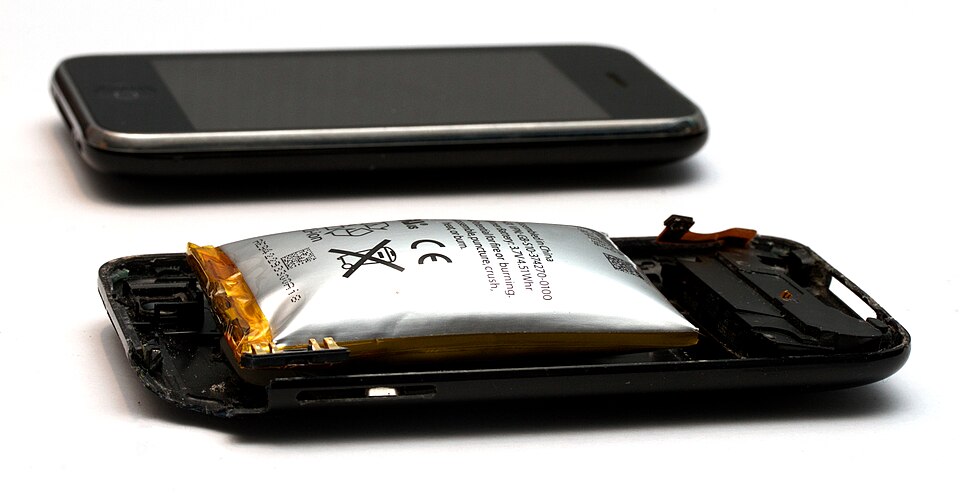
Photo: Mpt-matthew, CC BY-SA 3.0, via Wikimedia Commons
The board under the wrapper
Between a bare cell and a usable battery sits a small circuit, and its name tells you its ambitions. A PCM, the protection circuit module spot-welded to the cell's tabs and tucked under the final wrap, is a bodyguard: it opens the path at overcharge, overdischarge, overcurrent and short circuit, and otherwise stays out of the way. A BMS is a manager: balancing across series cells, watching temperature, often keeping a fuel gauge, the difference between a cell that survives abuse and a pack that reports its own health to the host.
The buying consequence is concrete. A bare tabbed pouch belongs only inside a product whose own electronics already do the protecting; everything else should be ordered as a protected assembly, cell plus PCM plus leads plus connector, which is also exactly where the part number grows its longest suffixes.
One field warning travels with the connector. The small white plug standardizes the shell and the pitch, never the wiring inside it, so red arriving at the wrong pin through a perfectly mating shell has destroyed more hobby electronics than any cell fault; polarity is verified with a meter at incoming, never assumed from the colour.
Counting cells: the S and the P
Multi-cell packs declare their arithmetic in a two-letter code: 2S1P is two cells in series in a single parallel group, 7.4 nominal volts at one cell's capacity; 1S2P doubles capacity at single-cell voltage; 4S2P stacks both moves. Series multiplies voltage and demands balancing, because series cells age apart and the strong one reaches the 4.2 ceiling while the weak one still begs for charge; parallel multiplies capacity and demands matched voltages at the moment of assembly. They are the same two grammars the primary alphabet taught, now with a balancer wired in as referee.
The code belongs on the BOM beside the footprint, because 2S1P and 1S2P can share a silhouette and a connector and still destroy each other's chargers on first contact.
Reading a pouch's full string
Assemble the layers and the orderable string writes itself, longer than anything the primary world ever asked for. The core is the footprint, LP503450 or its maker's spelling of the same digits; everything after the core is configuration.
A complete pouch line item reads like a small bill of materials: typical and minimum capacity, the cathode letter or its voltage tell, the charge ceiling, 4.2 or 4.35, the C ratings continuous and burst, then the hardware, PCM included or bare, NTC thermistor lead or not, wire length and gauge, connector family and pin order, and finally the compliance set, the UN 38.3 summary and the IEC 62133 or UL file numbers that let the assembly board a truck. Two strings differing in any single one of those positions are different parts wearing one footprint, and a quarter of the field failures in this category trace to treating them as the same part.
Cylinders compress the same information differently: the public core, INR18650, does the heavy lifting while the maker's suffix, 25R, 35E, MJ1, carries the personality, so cross-referencing is a data-sheet exercise rather than a name exercise, exactly as it was across the wider battery alphabet.
Either way the standing rule of this series holds: put the full string on the BOM with its approved equals beside it, because a line that says only 503450, 1000 mAh invites a different battery every quarter.
The paperwork is part of the cell
Rechargeable lithium travels on documents. UN 38.3 testing must precede any shipment; by air, packs move under the lithium-battery packing instructions, with cargo cells held to a reduced state of charge by rule; and the safety files behind a serious cell name IEC 62133 for the cell and the UL 2054 territory for the pack around it. None of this is decoration. A freight forwarder asks for the test summary before quoting, a certification body asks for the file numbers before granting a product mark, and a pouch whose supplier can produce neither is a pouch the finished product cannot legally carry across nearly any border. The compliance suffix deserves the same scrutiny as the capacity figure, and deserves it earlier, because a missing document stops a shipment the way a missing milliamp hour never will.
Cold charges are forbidden charges
Temperature splits the rechargeable window in a way the primary letters never showed. Discharge tolerates cold within reason, with many cells specified to minus 20 and surviving it grumpily; charging does not, because below roughly zero degrees the arriving lithium can plate onto the anode as metal instead of slipping between its layers, and plated metal is permanent capacity loss at best and an internal short in the making at worst. Serious chargers and every honest BMS gate charging on a temperature reading for exactly this reason, and outdoor products either warm their packs before charging or refuse politely until the pack warms itself.
Below zero, the charger must wait; the load may work.
Old cells in new wrappers
The rechargeable aftermarket has its own counterfeit flavor: harvested cells. Packs are stripped from retired laptops and scooters, rewrapped, relabeled with optimistic capacities, and sold as new, and the giveaway is rarely the printing. It is the spread. A batch of genuinely new cells matches itself in open-circuit voltage, internal resistance and weight, while a harvested batch scatters across all three, because its members lived different lives before the new wrapper. A receiving bench that measures a sample of every lot, and logs what it measures, turns that scatter into a verdict before the cells reach a single product.
The gram scale keeps its title as the cheapest lie detector in the building.
From prototype to tooling order
Prototype on stock cells.
Stock footprints exist so the first hundred units never wait for a tooling slot: a 503450 or a 603048 from a maker's standing catalog gets firmware running this month, with the PCM and connector configured from the standard menu. The fork arrives at volume, where a custom footprint buys back every cubic millimetre the enclosure wasted, at the price of tooling, a minimum order measured in the thousands, and a re-qualification clock, UN 38.3 included, that restarts whenever the cell, the maker or sometimes the production line changes. Plan that switch as a project with its own calendar rather than a purchase, and keep the stock part qualified as the bridge that ships product while the custom one earns its papers.
Where the pouch is heading
The negative electrode is moving for the first time in a generation: silicon-rich and silicon-carbon anodes reached volume phones in the last few years, buying meaningful capacity inside unchanged footprints, and the spec sheets show it as familiar size digits carrying unfamiliar milliamp hours. Charge ceilings keep creeping upward in the cobalt family, and pouch construction itself is shifting from wound to stacked electrodes, which fills corners better and swells more evenly when the time comes.
Read the brochures with this series' standing rule in hand: a new word on the wrapper is a question about which layer changed, the chemistry, the body or the string, and the data sheet still answers in the old grammar.
Questions that keep coming back
Lithium-ion or lithium-polymer: which is better?
They are cousins separated by wrapping, not rival chemistries. Nearly everything sold as polymer is a lithium-ion cell in a laminated pouch. Choose the body for the product's mechanics and the cathode letter for voltage and temperament; the word on the label decides neither.
Can a swollen battery still be used?
No. Swelling means gas has replaced electrolyte and the seal is holding a shape it was never welded for. A swollen pouch is retired: never pressed flat, never punctured, never recharged to see whether it improves.
Why can't lithium cells be charged below freezing?
Below roughly zero degrees C the arriving lithium can plate onto the anode as metal instead of intercalating. Plated metal is permanent capacity loss at best and an internal short in the making at worst, which is why chargers gate on temperature.
What does 1C mean?
The current that would drain the rated capacity in one hour. 1C on a 2500 mAh cell is 2.5 A; 8C on the same cell is 20 A. Convert every C back to amps before believing a rating, then walk the amps through the tabs, traces and connector.
Can I drop in a higher-capacity cell of the same size?
Sometimes, carefully. Same footprint and same charge ceiling are mandatory; then confirm the C rating still covers the load and the protection board's limits match the new cell. A label promising far more capacity than the footprint's known ceiling is its own warning.
Is the red wire on the small white connector always positive?
No. The connector family standardizes the shell and the pitch, never the wiring. Verify polarity with a meter at incoming inspection; reversed leads through a perfectly mating shell have destroyed more electronics than cell faults have.
At what charge level should lithium cells be stored?
Around half charge, cool and dry. Full cells stress their chemistry on the shelf and empty ones risk drifting below the safe floor; mid-charge is the resting state at which the cells age slowest.
Can a bare pouch be used without a protection board?
Only inside a product whose own electronics already protect it against overcharge, overdischarge, overcurrent and short. Everywhere else, order the protected assembly; the PCM is cheap insurance glued to the tabs.
Will a 4.35 V cell work with a 4.2 V charger?
It charges safely and stops early, surrendering the extra capacity the higher ceiling bought. The reverse is the dangerous direction: a 4.35 V charger on a 4.2 V cell violates the cell's ceiling by design.
Where is the date or lot code on a pouch cell?
Printed or laser-marked on the pouch face or along a seal edge, and repeated on the carton. Match it to the paperwork at receiving; a cell whose lot cannot be traced has a story instead of a pedigree.
Getting the cell, tabbed and papered
Sourcing a rechargeable cell is sourcing an assembly and its file. In Fortune Electronics supplies pouch and cylindrical lithium from stock footprints, 503450-class pouches through INR18650 and 21700 cylinders, configured with the tabs, PCM, leads and connector a product specifies, and ships them with the UN 38.3 summary and the compliance documentation that freight and certification will demand on schedule. Where a design moves from a stock footprint to a custom one, the same channel quotes the tooling, the minimums and the re-qualification calendar before the BOM commits to either.
Send the full string, footprint, letter, ceiling, hardware and papers together, and the quote answers the product being built rather than the cell that happened to get named.
Figures here, capacities, C ratings, charge ceilings and temperature limits, reflect typical maker specifications and shift between cells and revisions; the safety rules, a swollen pouch is retired, no charging below freezing, are floors rather than complete guidance. Confirm every number and every procedure against the data sheet and compliance file of the exact cell and revision you buy.