Free Shipping Over$200

- Products
- Marking
- Alternative

Choosing a Battery and Harvesting Energy for a Field Device
A field device begins as a power argument before it becomes a radio product, a sensor product, or a housing product. The battery decides how often the node can wake, how long the radio may talk, how cold the enclosure may get, and whether a maintenance visit is a nuisance or the whole business model falling apart. The charger, if there is one, decides whether the cell may feed the system while it is being charged. The harvester, if there is one, decides whether the design owns its energy budget or spends every cloudy week apologizing for it.
The trap is to treat the battery as stored energy and the charger as a part number. A field node does not draw a neat current. It sleeps for hours, wakes into a pulse, lets a modem or sensor take a bite, then falls back into a leakage floor that now matters more than the peak. A lithium pouch, a cylindrical primary cell, a coin cell, and a small solar panel all dislike different parts of that story. Choosing among them is less like choosing a tank size and more like choosing which failure you are willing to manage.
The cell is sized against the duty cycle, not the brochure current
Sizing a battery for years in the field starts with the current waveform, not the capacity number printed on the cell. A sensor node may sleep near a few microamps, then pull tens or hundreds of milliamps while the radio joins, transmits, or negotiates a network. The average current is a useful check, but it hides the part that ages cells and causes brownouts: the pulse. A primary lithium cell may carry a long shelf life and good cold behavior, yet it can still sag if the load asks for a sharp burst through a high internal resistance. A lithium-ion pouch may handle bursts better, yet it brings charging, protection, swelling allowance, and transport rules. A coin cell may look attractive because it is thin and cheap, then fail the first time a radio burst asks it to act like a power supply.
The accounting has to include sleep leakage that never appears in a feature list. Regulator quiescent current, pullups, divider ladders, a sleeping sensor, a protection IC, and a fuel gauge all take their share while the product appears idle. A ten microamp leak sounds small until it is multiplied by every hour of every day for several years. In a product that wakes for seconds per day, the idle floor can eat more energy than the work. Capacity also changes with temperature and discharge rate, and the usable end voltage is set by the lowest rail the electronics can tolerate, not by the cell maker's optimistic cutoff. The early spreadsheet should look boring and a little suspicious. If it looks heroic, the field will do the auditing.
Linear charging is simple until the enclosure gets warm
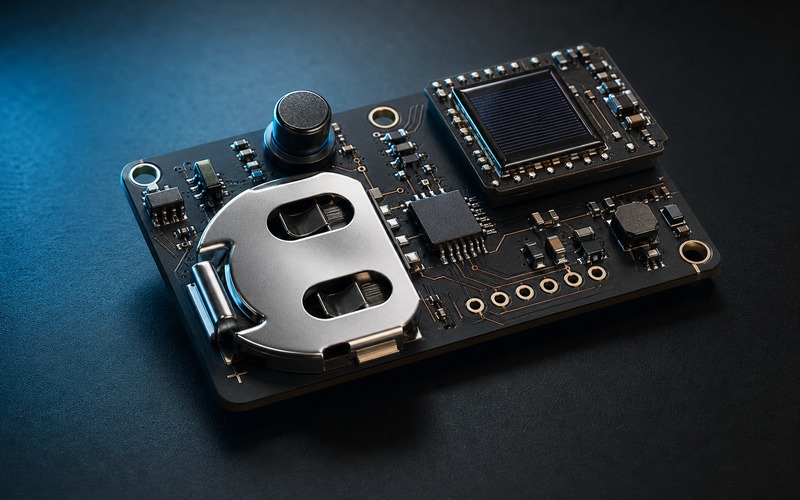
TP4056 for single cell lithium linear charging is popular because it makes a one-cell charger feel almost finished. It accepts a 5 V input, follows the familiar constant-current then constant-voltage charge profile, and needs few external parts. In a bench prototype or a low-cost USB charged gadget, that is a gift. In a sealed field device, the gift has conditions. A linear charger burns the difference between input voltage and battery voltage as heat. At high charge current, that heat has to leave a small board, pass through the enclosure, and stay inside the cell's allowed charge temperature window. If the product charges in sunlight, in a wall box, or next to another hot circuit, that thermal path becomes part of the charger design.
Charge current is also a statement about the cell. A small pouch may not want the current that a module vendor prints on a headline. A colder cell may need charging disabled or reduced. The thermistor pin and status pins are not decoration; they are how the charger tells the product when the battery is in a state that chemistry will tolerate. The TP4056 style of circuit is fine when the system load is separate or modest, but it does not by itself solve power-path behavior. If the product wakes and draws current while the charger is trying to terminate, the charger can misread the situation. It may stay in charge longer than expected, exit early, or let the system load confuse what should have been a clean cell current. That is where the next class of charger enters.
MCP73831 for lithium charging in a small device lives in the same single-cell world but fits tiny products that need a low-parts-count charger with a programmable current. It is the kind of part that disappears into wearables, small handhelds, beacons, and compact instruments where the charge connector and the battery are close together. Its limits are the same family of limits: heat, current, input quality, charge temperature, and what the system is doing while the cell is being charged. A small charger does not remove the need to know the battery's maximum charge current, termination current, and protection arrangement. It only makes the implementation small enough that designers are tempted to stop thinking too early.
A power path separates the product from the cell
BQ24074 for charging with a system power path answers a problem that appears once the product must run and charge at the same time. The system rail should not be forced to behave like the battery terminal. The battery should not be asked to both receive a well-measured charge current and feed unpredictable load pulses through the same undifferentiated node. A power-path charger gives the load a managed rail, supplies the system from the input when input power is present, and charges the battery with the current that remains under the charger's control. That is not cosmetic. It changes how the product boots from a dead battery, how it behaves when a weak adapter is connected, and how cleanly charge termination can be detected.
This is the point where a field device stops being a cell plus electronics and becomes a power system. The input source may be USB, a dock, a service connector, a small panel, or a wall supply. The load may wake into a modem pulse during charge. The battery may be deeply discharged and need precharge before normal operation. The user may plug in a supply that cannot deliver the advertised current. A power-path device arbitrates among those facts. It also forces decisions: minimum system voltage, input current limit, battery regulation voltage, thermal foldback, and what the firmware should infer from status pins. A design that skips this layer can still work, but it often works only on a friendly bench supply. In the field, the charge cable is long, the adapter is weak, and the product wakes at the wrong moment.
Harvesting is not free power
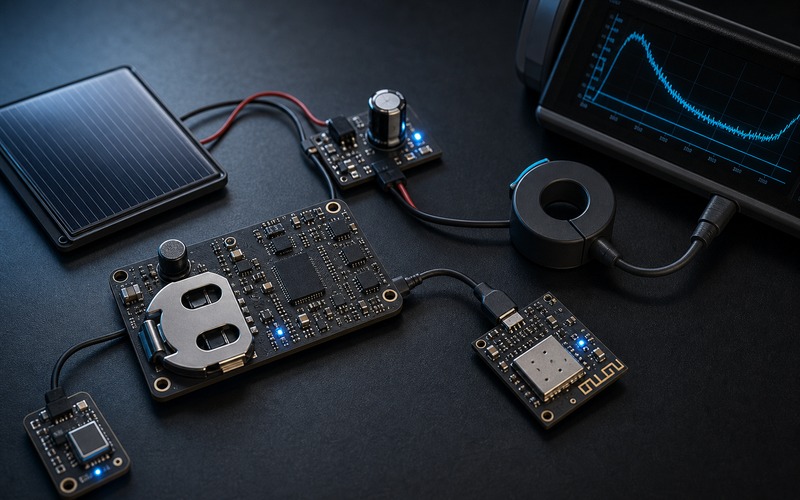
LTC3105 harvesting solar to power a node is the optimistic branch of the battery story, but the optimism has to be measured. A small solar panel on an outdoor device can change maintenance from periodic battery replacement to inspection. It can also hide the fact that winter, shade, dirt, mounting angle, and enclosure decisions now control the energy budget. A harvester has to start from a weak source, hold the panel near a useful operating point, boost or regulate the harvested energy, and decide when enough energy exists to wake the rest of the product. The converter is only one participant. The panel area, storage element, load schedule, and firmware policy decide whether the node survives the bad week, not the sunny day.
Solar harvesting works best when the product can bank energy and postpone work. A meter that can report later, a sensor that can batch readings, or a beacon that can reduce advertising during a dark spell gives the power system room to breathe. A product that promises fixed high-rate reporting regardless of light conditions still needs a battery sized for the worst gap between harvest events. In that case the panel may extend service life but should not be counted as the only source. The honest design question is not how much the panel produces at noon. It is how little the product can live on when the source is poor, and how long the storage element can bridge the gap without abusing the cell.
SPV1050 for ultra low power energy harvesting sits in the same mental space but points to even weaker sources and more careful startup behavior. Ultra-low-power harvesters are chosen when the source is small enough that startup current, leakage, and storage thresholds can decide the whole product. The cold-start path matters because a node shipped empty or drained in storage has to climb from almost nothing. The choice of storage, whether rechargeable cell, supercapacitor, or a small reservoir capacitor, changes the policy. Supercapacitors tolerate many cycles and high pulse currents, but they leak and their voltage moves across a wide range. Rechargeable cells store more energy in a smaller volume, but they need protection and charge limits. A harvester is a contract between the source and the load, with storage as the translator.
The pulse is where small batteries get exposed
The pulse current problem with a coin cell is the part of the design that often waits until the first field trial to announce itself. The open-circuit voltage looks fine. The sleep current looks fine. Then the radio turns on, the cell voltage falls, the brownout detector trips, and the product resets into a loop that drains the battery faster. The cause is not mysterious. A small cell has internal resistance, and that resistance rises with age, low temperature, and discharge depth. A high current pulse turns that resistance into a voltage drop. The cure may be a reservoir capacitor, a lower peak transmit current, a staged wake sequence, a different chemistry, or a product rule that forbids radio work below a certain temperature. The cure is rarely found by quoting nominal capacity.
That last point ties the whole P3.12 branch together. Battery capacity sets the long runway, charging decides how safely the runway is refilled, the power path decides whether the product can operate while refilling, harvesting decides whether the runway can grow between service visits, and pulse behavior decides whether the node can take off at all. None of those choices lives alone. A bigger battery can mask a leaky regulator until shipping costs punish it. A solar panel can hide a poor sleep current until winter. A linear charger can pass lab tests until the enclosure heats. A coin cell can power a demo until the radio pulse turns the demo into a reset counter. The design that survives is the one that treats energy as a timed budget, not a number in amp-hours.
Start with the load waveform. Then choose the cell, charger, harvester, storage element and firmware behavior as one set of compromises. A field device can live for years, but only if the power system is designed around the worst quiet hour and the worst loud second, not around the average day.