Free Shipping Over$200

- Products
- Marking
- Alternative

Sensing Humidity, Gas and Air Quality in a Connected Device
An air-quality sensor rarely measures the thing its label names. A consumer VOC sensor reports a carbon-dioxide number it never measured directly, inferring it instead from the gases a heated film reacts to, and the reading drifts as that film ages. Knowing which sensors measure their target head-on and which hand back a calibrated guess is the first thing to settle, because the two behave nothing alike once they are in the field for a while.
The group splits cleanly. Temperature and humidity are measured directly and honestly by mature parts that need little beyond sensible placement. Real carbon dioxide needs an optical measurement. Particulates need a laser and a fan. The gases that fill the phrase air quality, the volatile organics, are the hard ones, read by a heated metal-oxide film whose resistance shifts with whatever it reacts to, which is cheap and sensitive and never fully selective or stable. The price ladder runs the same direction: a humidity sensor costs little, a metal-oxide film a little more, and a true optical measurement carries the cost of the light source and the airflow it needs.
Temperature and humidity, measured honestly
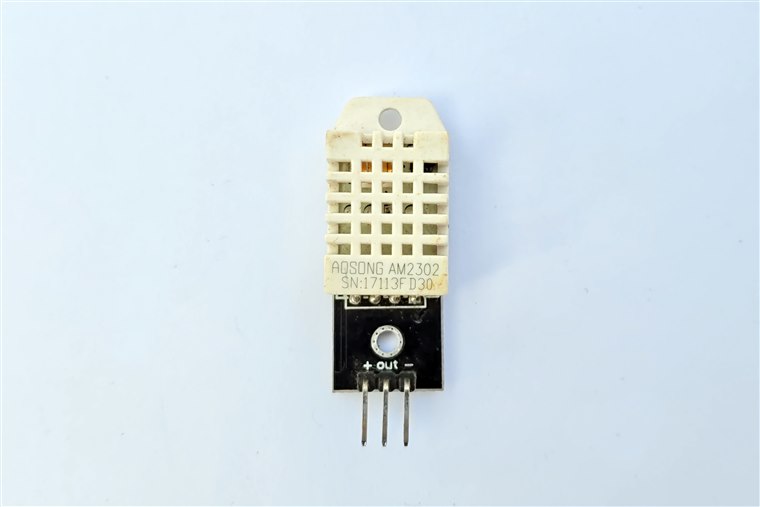
The easiest corner is temperature and humidity, where the parts are mature, accurate and close to plug-and-play. A capacitive humidity element and a temperature sensor share a package and report both over I²C, calibrated at the factory, so a design drops one in and trusts it to within a couple of percent relative humidity. The catches are placement and condensation more than the part itself: self-heating from a nearby chip skews the reading toward warm and dry, and a sensor that gets wet reads at saturation until it dries out again.
The SHT31-DIS measures temperature and humidity at high accuracy, a Sensirion part that has become a reference for the job, good to a few tenths of a degree and a couple of percent humidity with no per-unit calibration. It carries a small heater on board, which sounds odd in a temperature sensor until the use shows itself: pulsing the heater drives off condensation that would otherwise peg the humidity reading at saturation, so the part recovers itself after a damp spell instead of staying blind. It speaks I²C at one of two addresses and guards each reading with a CRC byte, so a corrupted value announces itself instead of passing for sound data, and it answers a measurement command in around fifteen milliseconds rather than holding the bus while it converts. It is the part for a design that wants a number it can trust and can pay a little to get it.
The SHT40 measures temperature and humidity at low power, the same maker's answer for a battery device, trading the onboard heater and some configurability for a smaller, cheaper part that sips current. It suits a wireless sensor node logging conditions for years on a cell, where the occasional condensation event matters less than the average draw across all those years. A single conversion draws on the order of a microamp once it finishes and the part falls idle between readings, which is what lets a coin cell carry it for years where a chattier sensor would flatten the same cell in months. The choice between it and the SHT31 comes down to whether the design needs the heater and the tighter specification, or the lower power and the lower price.
The HDC2080 measures temperature and humidity in a connected device, a Texas Instruments part with low power and a built-in interrupt that wakes the host only when a programmed threshold is crossed, which suits a smart-home node that reports a change instead of streaming constantly. It also carries a heater for the same condensation reason, and its low average current fits a design where the radio, not the sensor, is meant to dominate the power budget, so the sensor has to stay out of the way. The interrupt is the point of the part: the host sleeps through every reading that sits inside the programmed window and wakes only on the one that crosses out of it, which turns a steady polling load into a rare event the firmware can afford. Its measurement modes let resolution trade against conversion time, from nine to fourteen bits on either reading.
The Si7021 measures humidity stably over a long service life, a part valued for holding its calibration where cheaper humidity sensors wander, and available with a protective cover that guards the element from dust and splashes in a dirty spot. It is the choice when the humidity number has to stay honest for years somewhere that would foul a bare element, an HVAC return duct or an outdoor enclosure, where replacing a drifted sensor is more trouble than paying for a stable one up front. The filtered version wraps the sensing layer in a hydrophobic membrane that passes vapour while turning away liquid water and dust, which is what buys the long service in a duct that would coat a bare die within a season.
Why the gas reading is the hard one
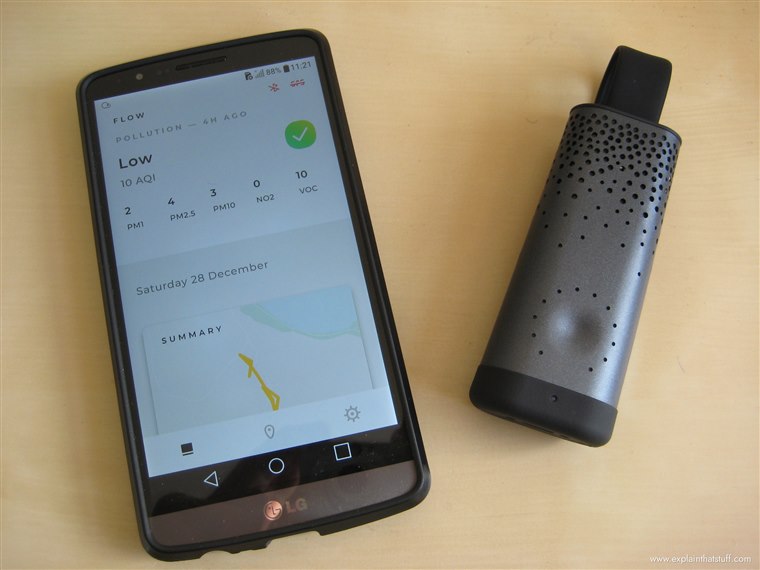
The reason air-quality sensing is harder than it looks is that the interesting gases are measured indirectly, through a proxy that needs constant correction. A metal-oxide gas sensor works by heating a thin film whose electrical resistance changes as gases adsorb on it, which is cheap, small and sensitive, and which brings three problems built in. It is not selective: the film responds to a broad mix of volatile organic compounds and cannot say which gas changed, so its output is a lump sum and not a named concentration. It is relative and not absolute: the reading means something only against a baseline the firmware tracks as clean air, so the part needs a running estimate of what clean looks like and goes wrong when that estimate does. And it ages and can be poisoned, since the film shifts slowly over months and certain compounds, silicones among them, damage it for good. The carbon-dioxide number these parts report deserves particular suspicion, because it is an equivalent value, eCO2, inferred from the VOC level on the assumption that human-occupied air raises both together, and not a measurement of carbon dioxide at all. Measuring carbon dioxide itself takes an optical method instead. None of this makes the parts bad, only that their numbers are estimates wanting warm-up, baselining and a grain of salt, which is the opposite of how the temperature sensor beside them behaves.
All of that sits behind one word on the datasheet, gas.
Sensing the volatile gases
With that caveat in hand, the metal-oxide parts earn their place, since a relative, drifting reading of indoor air is still useful for driving ventilation and raising alerts where an absolute number is not the point. The differences among them lie in how much of the correction each one does on board before the host ever sees a value.
The BME680 is a four-in-one environmental sensor with gas, combining temperature, humidity, pressure and a metal-oxide gas element in one small package, with a vendor library that turns the raw gas resistance into an indoor air-quality index. It is the part for a single device that wants the whole environmental picture, a weather node or a smart thermostat, and the gas reading carries every metal-oxide caveat: it wants a burn-in period and reports a trend more than a calibrated gas figure. The four sensors in one package are its real draw, since splitting them out would mean four parts, four footprints and four supply decisions on a small board. Bosch ships a closed library, BSEC, that takes the raw gas resistance in ohms together with the humidity and temperature beside it and returns the index, which saves a design the work of modelling the film and ties the result to vendor code it cannot see inside.
The CCS811 reports equivalent carbon dioxide and VOC from a metal-oxide element, with an onboard processor that runs the baseline algorithm and hands the host an eCO2 and a VOC number directly. The eCO2 is the inferred value described above, useful for driving ventilation in an occupied room and misleading the moment it is read as true carbon dioxide. It needs a long initial burn-in and ongoing baseline correction, and it stands as the cautionary example of a part whose convenient number hides how indirect the measurement beneath it is, which trips up designs that take the label at face value. It asks for a full forty-eight hours of first run before its output settles and a baseline that assumes the room returns to clean air at some point in each cycle, an assumption that quietly fails in a space which is never left empty.
The SGP40 does VOC sensing for indoor air quality, a newer metal-oxide part that outputs a VOC index through a vendor algorithm built to adapt its own baseline over time, which sidesteps much of the manual baselining the older parts demand. It is built for the honest job a metal-oxide sensor can do, following the trend of indoor air and flagging when it gets worse, without pretending to name a gas or a concentration it has no way to measure. That focus makes it the cleaner modern choice where a VOC trend, not a number, is what the product acts on. Its companion algorithm reports a VOC index from one to five hundred centred on a hundred, a scale built to show whether the air is better or worse than this room's own recent normal rather than to claim a concentration in any unit. It samples once a second and needs an hour of context first.
Measuring the real thing
Where a true carbon-dioxide number is needed, for demand-controlled ventilation or a monitor that has to be right, the metal-oxide proxy will not do and the measurement turns optical. The SCD41 measures true carbon dioxide with NDIR, shining infrared through an air sample and reading how much the CO2 absorbs at its characteristic wavelength, a direct and selective measurement that an eCO2 part can only estimate. It costs more and draws more, since it runs a light source and a sample chamber, and it earns that in a reading that means actual parts per million of carbon dioxide instead of a correlated guess, which is the whole point in a room where ventilation is driven off the number. It reads from four hundred parts per million upward and runs a self-calibration that takes the lowest value it has seen over recent days as fresh outdoor air, a trick that can be switched off for a space kept shut, where that floor would otherwise drag its zero away from true.
At the other end of cost sits the MQ-135 for low-cost air-quality sensing, an analog metal-oxide sensor that outputs a raw resistance the host has to interpret itself, the cheapest way to get a rough air-quality signal at all. It needs calibration against a known reference and a heater supply held steady at the rated voltage, and its reading wants generous interpretation, since the output is the ratio of the film's live resistance to a clean-air baseline that every individual board has to find for itself before its readings mean anything. It is the part for a hobby build or a coarse alarm more than a calibrated instrument, the honest floor of what gas sensing costs before the integrated parts add their processing on top.
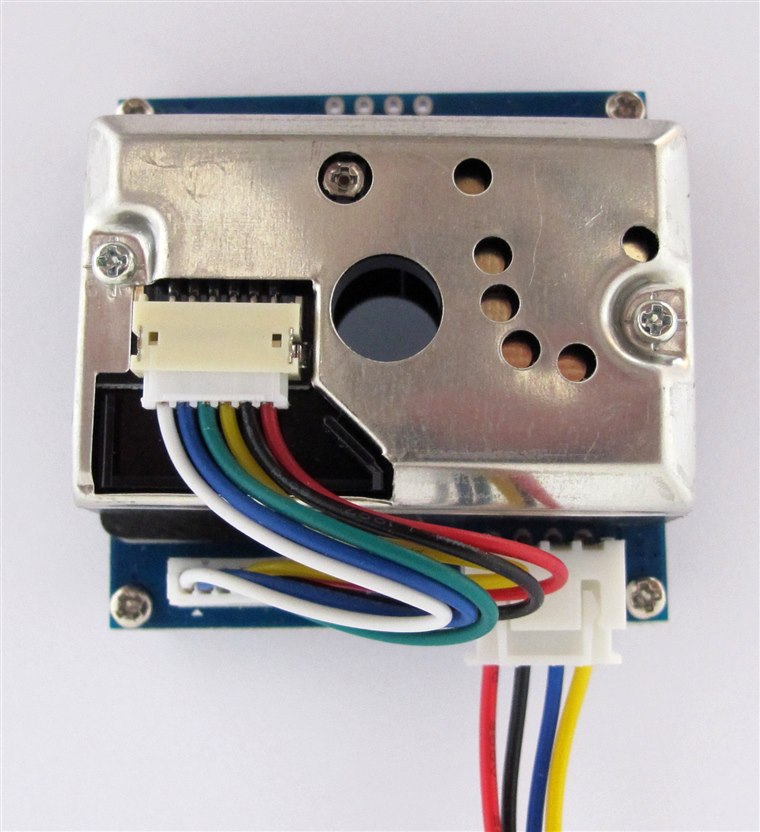
Particulates are a measurement of their own again. The SPS30 does laser-scattering particulate sensing, drawing air past a laser with a small fan and counting the flashes as particles cross the beam, sorting them by size into the PM2.5 and PM10 figures an air-quality index reports. It is a direct optical measurement like the NDIR part, with a wear item the others lack, the fan, and a care item of its own, keeping the optics clean, and it is what a real air-quality monitor uses since a gas proxy cannot speak to dust at all. Sensirion rates the fan and optics for years of continuous running and builds in a cleaning cycle that spins the fan to full speed to clear settled dust, which pushes back the day the chamber fouls and the counts begin to read low without anyone noticing.
Direct or proxy, before the part
The thread through all of these is knowing whether a sensor measures its target or estimates it. Temperature, humidity and particulates are measured directly and can be trusted out of the box, as is true carbon dioxide once the optical part is paid for, while the volatile-organic and eCO2 numbers are proxies that need their baselines minded and a clear head about what they represent. The same datasheet word can hide either kind underneath.
Pick a proxy sensor and the design has to budget for calibration and drift; pick a direct one and it pays in cost or power for a number it can believe. The common mistake is reading an eCO2 figure as carbon dioxide, and the fix is knowing the difference before the part is designed in rather than after a customer questions the readings.