Free Shipping Over$200

- Products
- Marking
- Alternative

TDM22545DXUMA1: Infineon's 140A Dual-Phase Power Stage, With the Inductor Already Inside
People buy the TDM22545DXUMA1 for one reason: it folds two whole buck phases, inductors and all, into a 10 by 9 mm package, so a core rail that would have sprawled across the board collapses to a strip of modules beside the socket. That density is the entire pitch. It is also where the trade starts, because the moment Infineon puts the inductor inside, you stop being the one who picks it. So this part is a decision about how much of your power design you are willing to hand over.
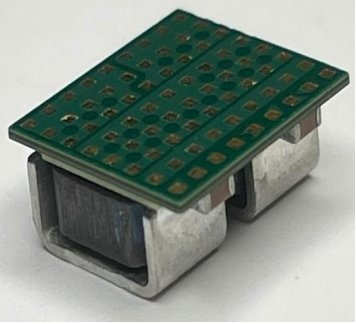
What you are holding
Not a converter. A power stage.
The TDM22545D carries two smart power stages, each one a pair of OptiMOS-6 high- and low-side MOSFETs with their gate driver and on-chip current and temperature sensing, plus the two inductors and the decoupling those phases need. There is no control loop in here. It takes a 3.3 V tri-state PWM input and waits for an external multiphase controller to tell it what to do. DigiKey files it under “PoL DC-DC converter,” which will mislead you into thinking you can drop it down and get a regulated rail. You cannot. Without a controller in front, it does nothing.
That single fact reshapes the bill of materials, because the controller is now a second design problem sitting right next to this one, and the phase count you are about to choose lives over there, not here.
The number that gets misread
Dual-phase 140 A. Read it wrong and you size the rail on a ceiling that does not exist.
Seventy amps. That is the per-phase continuous rating, thermally managed, with a 160 A peak. The 140 is just two of those added up. When you work out how many of these modules a rail needs, you divide your total core current by the per-phase 70 A, derate it for the heat you can pull out of the package, and only then count modules. Treating 140 A as one usable lump is how a design ends up two phases short of what the silicon can do.
Why the integrated inductor cuts both ways
Here is the part that deserves more than a sentence, because the inductor is the whole reason to love this module and the whole reason to walk away from it, and which one it is depends entirely on a rail you have not described yet.
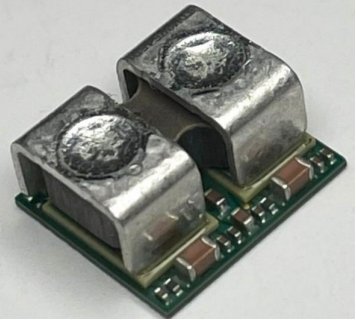
Start with what the integration earns. An inductor is not a neutral component you bolt on at the end. Its winding loss, its core material, the way it dumps heat, and the ringing it forms with the switch node are all tangled together with the MOSFETs feeding it. When you build a phase from a discrete DrMOS and a separate inductor, getting that interaction clean is real work: the switch-node layout, the thermal path under the inductor, the tuning of the loop around it. Infineon does that work once, inside a package built for it, and ships you the result. The inductors here are wound for a switching frequency between 600 kHz and 1.2 MHz, which is the band where this module trades transient response against efficiency the way its designers intended. Stay in that band and you inherit a power stage that someone already made behave.
Now the cost of the same decision. That inductor value is cast in metal. The silicon will switch up to 2 MHz if your controller asks it to, but the inductor was not wound for up there, so push past 1.2 MHz and you are running good MOSFETs through a magnetic part that no longer suits them, paying for it in efficiency and ripple. There is no swapping it for something better. If your rail has a reason to live outside that frequency window, a sharper transient spec, an EMI plan that wants a specific switching point, a different ripple target, this module quietly takes that lever out of your hand. A discrete design keeps it.
So the integrated inductor is not a feature or a limitation. It is the same thing seen from two rails.
Module or discrete DrMOS
This is the real question behind the part number, and a stock page will never answer it for you.
Go with the module when board area and schedule are the things squeezing you. Many phases packed around an AI accelerator or a server CPU, not enough room, not enough time to perfect a discrete high-current layout, a power stage you need to trust on the first spin. That is the case this part was built for, and in that case the density and the pre-solved layout earn their premium.
Go discrete when you need the frequency-and-inductor lever the module took away, or when you are shipping enough volume that the unit-cost gap between a module and bare MOSFETs plus an inductor turns into real money.
The sensing leans toward the module too. The current readout is a MOSFET current-mirror output at 5 µA/A, not a number inferred from inductor DCR or from RDS(on). Those inferred methods ride on parameters that wander with temperature and scatter part to part. A mirror is tighter, and in a multiphase rail tighter sensing is what keeps the phases sharing current evenly instead of letting one phase run hot while its neighbors coast, and it is what makes the cycle-by-cycle overcurrent trip something you can believe.
Designing it in
Two separate things decide whether this design works, and neither one is in the spec table.
The controller is the first. The 3.3 V tri-state PWM interface and the current and temperature telemetry exist to feed a digital multiphase controller, Infineon's own or a compatible third-party one. It sets the phase count, closes the loops, and reads the per-phase sensing. Pick it in the same breath as the module, not after.
The second is heat, and it is the constraint that bites. You are converting up to 140 A inside a footprint the size of a fingernail. Whether the part reaches its rating or derates well below it comes down to the copper you pour, the vias you stitch under it, the air you move, and whatever heatsinking you can fit. This is not a step you do once the layout is otherwise finished. It is the layout.
One honest note about the paperwork. What Infineon publishes openly is a six-page short data sheet, and it stops at features, ordering, and package. The full electrical characteristics, the LG-MLGA-72 pin map, and the application schematic are not in it. Before you commit copper, get the full data sheet and your controller's documentation and check the pin-out, the PWM timing, the sensing scale, and the reference circuit against them. The short sheet helps you choose the part. It will not help you design it.
Near neighbors
The TDM22545T is the same dual-phase 140 A module wearing a TLVR inductor instead of a conventional one, aimed at trans-inductor designs chasing the fastest transient response. If you are not building a TLVR rail, the D is your part.
Drop the integrated inductor and you are back in DrMOS territory, Infineon's TDA21xxx and TDA22xxx single-phase stages among them, which hand you flexibility on inductor and frequency in exchange for doing that integration yourself.
If you go shopping across vendors, the only comparisons that mean anything are phase count, per-phase current, whether there is an inductor inside, whether the part is TLVR, and controller compatibility.
Questions people ask
- Is 140 A per phase or total?
- Total, across two phases. Each phase is 70 A continuous with a 160 A peak.
- Can it regulate a rail by itself?
- No. It is a power stage and needs an external multiphase controller on its PWM input.
- How is it different from a DrMOS?
- A DrMOS integrates the driver and the MOSFETs. This adds the inductors and decoupling for two phases, plus the current and temperature sensing.
- Can I change the inductor or run it well outside 600 kHz to 1.2 MHz?
- The inductor is fixed. The silicon reaches 2 MHz, but the magnetics were wound for that lower band, and you pay in efficiency and ripple above it.
- D or T?
- T for TLVR-based, transient-focused rails. D for a conventional integrated inductor.
Getting it
Parts like this tend to be single-sourced and tight, and Infineon power stages in this class have carried lead times north of twenty weeks, so the schedule risk is usually the supply, not the engineering. In Fortune Electronics stocks the TDM22545DXUMA1 in its LG-MLGA-72 package with the data sheet on the product page, and can quote live stock, confirm a lead time, or source it on request once your design has settled on this module and the controller around it.
Figures here are drawn from Infineon's TDM22545D short data sheet (V1.0, 2024), which omits full electrical characteristics and the pin map. Verify every parameter and the pin-out against the full data sheet and your controller's documentation before committing a design.