Free Shipping Over$200

- Products
- Marking
- Alternative

Planning Supply for a Ten Year AI Product
Planning Supply for a Ten Year AI Product
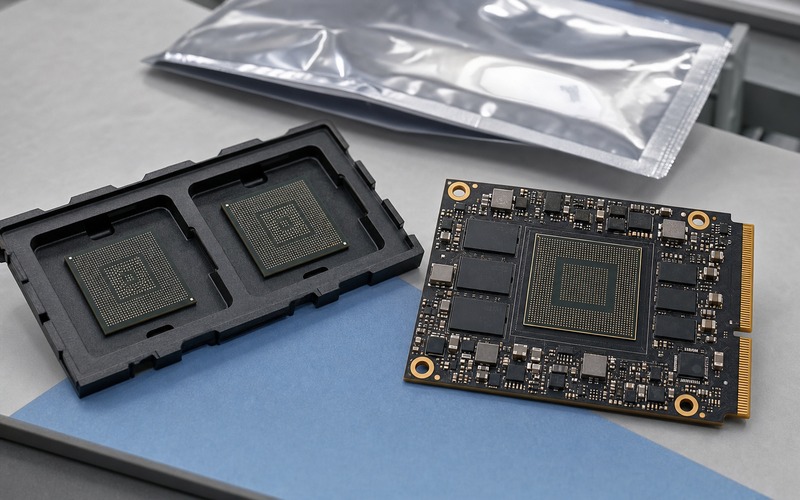
A ten-year AI product needs more than a promise that one processor will remain orderable. The product must be manufactured, repaired, secured and rebuilt through changes in silicon, memory, operating systems, compiler tools, assembly sites and customer requirements. A useful supply plan therefore covers the complete product configuration and the decisions that will be made when its evidence changes.
The planning horizon also needs a precise definition. Ten years may mean ten years of production, ten years from first shipment, or a shorter production period followed by a long field-service obligation. Those interpretations create different demand, qualification and storage needs. Engineering, purchasing, manufacturing, quality and service should work from the same dated volume and support assumptions.
The strongest plan combines architecture, evidence and action thresholds. It limits dependence on components that are hard to replace, preserves the software needed to build the released product, qualifies alternatives before a crisis, and keeps service material traceable. It also accepts that some changes are inevitable. The goal is controlled change with enough time to test it, not an unrealistic attempt to freeze the electronics industry for a decade.
Define the Ten-Year Obligation in Product Terms
Write the timeline as separate phases for development, production, warranty, contractual support and service. Record expected annual volume, installed base, repair rate, regional variants and customer approval rules. A product produced for three years and serviced for seven has a different exposure from one produced continuously for ten. The plan should also identify who owns a redesign after the original development team changes.
Set the acceptable service outcome for each phase. Early production may require identical hardware, while later service may allow a qualified replacement module or a functionally equivalent controller. Regulated or customer-certified products may restrict those choices. Document the boundary now so a future team does not discover during a shortage that a seemingly reasonable change requires months of external approval.
Translate the timeline into a dated evidence set. Identify the released hardware revisions, software branches, compliance reports, customer-specific options and manufacturing locations that must remain supportable. Record which documents can be updated internally and which require an external laboratory, notified body or customer signature. This turns a broad ten-year statement into a finite set of configurations with known change costs and approval paths.
Separate Fast-Changing Compute From the Long-Lived Platform
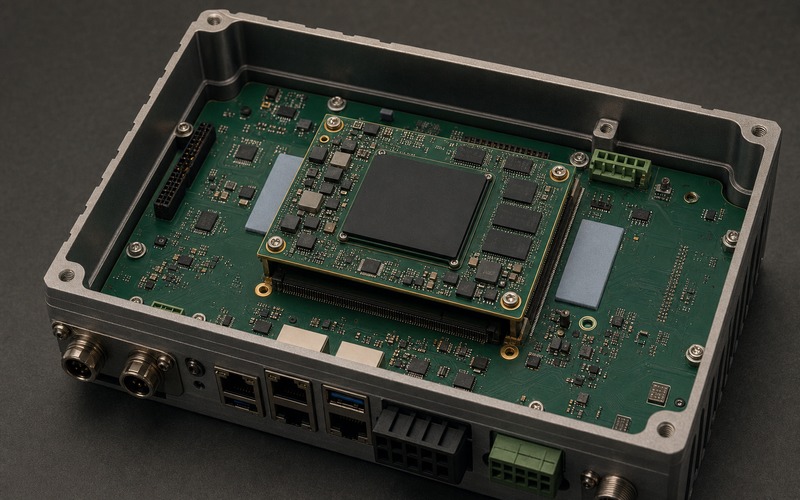
AI processors and their attached memory often change faster than power entry, industrial I/O, enclosure and wiring. A replaceable compute module can isolate that high-change area from the carrier board and mechanical platform. The interface needs defined power limits, reset behavior, clocks, boot ownership, thermal contact, mounting, high-speed lanes and spare pins. A connector alone does not create a durable module standard.
Keep external connectors at the chassis boundary and route field wiring through the carrier. That arrangement reduces the mechanical and compliance work when the compute module changes. Provide access for programming, recovery and diagnosis without dismantling the complete product. Reserve electrical and thermal margin for a future module, but state the limits explicitly so the reserved capacity is real engineering margin rather than an untested assumption.
Build a Component Risk Register From Exact Codes
List every exact orderable code that can stop production or service, including processor, memory, boot flash, PMIC, clock, security device, network controller, storage, connector and custom mechanical part. Record manufacturer status, package, process or assembly notices, software dependency, approved source, known alternatives, qualification time and the date of the evidence. Family names are too broad for this work.
Rank risk by product consequence and replacement difficulty, not by unit price. A low-cost boot device with a unique image format can be more disruptive than an expensive power component with several qualified options. Review dependencies between parts as well. A processor may remain supported while its required memory density, camera bridge or programming tool becomes the real reason the released configuration cannot be rebuilt.
Qualify Alternatives Before the Original Part Is Urgent
A second source earns its place through evidence. Compare pinout, electrical limits, package, thermal behavior, manufacturing process, software support and lifecycle position. For processors and memory, include boot, training, timing, model accuracy, security and recovery behavior. A paper comparison can eliminate weak candidates, but released approval needs tests on the product under its operating corners.
Maintain an alternative at the right readiness level. Some products need a fully approved drop-in option. Others can keep a tested redesign path with schematics, layout, firmware port and qualification estimate ready to resume. Record which state applies. Calling a catalog suggestion an alternate can create a false sense of protection if no board, software or product test has ever used it.
Plan Demand With Scenarios Instead of One Forecast
Use a base case, a high-use case and a service case. Include production yield, field failures, destructive analysis, engineering builds, regulatory samples and customer-held spares. Update assumptions from actual shipments and return data. A forecast should expose uncertainty rather than hide it in a single total, because the decision to redesign or secure service material depends on the range as much as the midpoint.
Separate demand by configuration and code revision. Hardware that looks interchangeable may require a different software image, thermal part or manufacturing test. Count those combinations individually and define whether they can be consolidated later. Include attrition during long storage, rework and qualification. The plan should show when the remaining coverage crosses an action threshold while there is still time to build and approve another path.
Control Source, Traceability and Incoming Evidence
Use manufacturer and authorized-channel evidence as the reference for lifecycle, package and change status. For every receipt, preserve the manufacturer code, lot or trace code, date code, packaging condition, certificate records where applicable and the source path. Inspection should match the risk of the component and route. High-value processors may need package, marking, X-ray, electrical or comparison checks under a documented quality method.
Do not let an urgent purchase erase configuration control. A device with a different suffix, temperature grade, security option or packing code may require a separate review. Samples used for qualification should remain tied to the material later released for production. Retained samples and clear records help investigate a field issue without relying on a distributor page or a purchase email that may no longer be available years later.
Treat Long-Term Storage as an Engineering Process
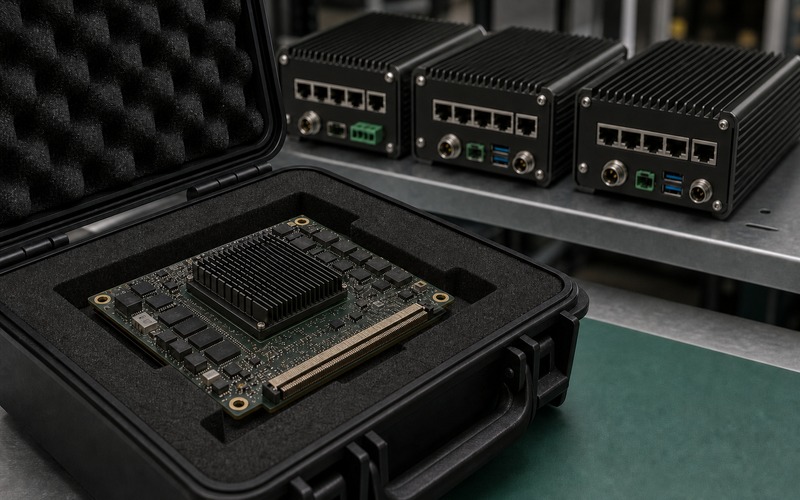
Semiconductors and assemblies held for service still need moisture, temperature, electrostatic and mechanical controls. Record moisture-sensitivity handling, barrier bag condition, desiccant, humidity indication, seal date and any bake or floor-life history. Periodically assess package condition, solderability risk, corrosion and label readability. Storage instructions must come from the exact package and material, not a generic shelf-life rule.
Complete modules require battery, capacitor, fan, thermal interface, connector and storage-media reviews. A stored module can age even when its processor is stable. Define inspection and functional-test intervals that fit the hardware and service obligation. Preserve known-good fixtures and reference units so testing remains meaningful. Rotating material without a recorded configuration can introduce an older hardware or software combination into service.
Preserve the Software, Security and Build Environment
Archive source, dependencies, compiler versions, model-conversion tools, board packages, bootloaders, device settings, signing material procedures and reproducible build instructions for each released configuration. Keep the required host environment and license plan in view. A processor in storage has little service value if the organization can no longer produce a trusted image for it or recover a failed unit.
Security support needs an active plan rather than a frozen image. Track vulnerability handling, certificate life, signing authority, update mechanism, rollback behavior and the last supported operating-system branch. Decide how a future fix will be built, tested and deployed across hardware revisions. Application performance is one check; model accuracy, secure boot, update and recovery also need explicit tests during a module transition.
Keep Manufacturing and Service Capability Alive
Preserve programming adapters, test fixtures, boundary files, calibration tools, golden units, assembly instructions and acceptance limits. Confirm that fixture computers, interfaces and software can still operate after normal IT replacements. Where a fixture depends on a unique instrument or connector, identify a replacement or keep a controlled service unit. Manufacturing continuity can fail even when every bill-of-material item is available.
Train service around hardware identification and configuration matching. The technician needs to know which module, software image, thermal part and test procedure belong together. Returned-unit data should record reset causes, temperature, interface errors and repair action before evidence is cleared. Those records improve demand estimates and can reveal an aging mechanism early enough to change the service plan.
Use Change Notices and Contracts as Inputs, Not Guarantees
Longevity statements, notification agreements and supply contracts are valuable when their scope is exact. Check which orderable codes, sites, package options, notice periods and remedies they cover. Record the governing document and review date. A broad program statement may not cover a specific memory option or module, and a notice period may still be shorter than the time needed for product qualification.
Route each relevant product or process notice through engineering, quality, purchasing and manufacturing. Decide whether it needs documentation only, sample testing, a controlled build or product requalification. Keep the notice history with the released configuration. A series of individually manageable changes can create a larger cumulative validation burden, especially when silicon, package and software move at different times.
Review the Plan Annually and Act on Triggers
Refresh exact lifecycle status, demand scenarios, service returns, storage condition, software support and alternative readiness at a fixed interval. Review sooner after an acquisition, process transfer, discontinuance notice, major tool change or unexpected demand shift. Assign owners and dated actions. A risk register that is updated without funding the next step does not protect the product.
Use clear triggers for alternate qualification, module redesign, service-material purchase, software migration and customer communication. Confirm budget and schedule before the trigger is reached. At each review, make sure the ten-year obligation still matches the commercial product plan. A durable AI product comes from architecture that can change, evidence that remains traceable and decisions made while several workable options still exist.
Run a continuity exercise with one real released configuration. Ask the current team to rebuild its software, program a spare module, run the production test, identify the fitted components and complete a simulated field replacement using only the retained records and tools. The exercise exposes missing credentials, obsolete fixture dependencies, unclear ownership and undocumented manual steps. Correcting those gaps during a routine review is far easier than discovering them after a product has stopped shipping.
Related information
- 2026.07.14 MX25V1006FZUI as a Small Density SPI Flash
- 2026.07.14 W25N01GVZEIG as a 1 Gigabit SPI NAND Flash
- 2026.07.14 W25Q64JVZEIM as a 64 Megabit SPI NOR Flash