 Free Shipping Over$200

- Products
- Marking
- Alternative

Analog Devices Inc. AD8009ARZ-REEL7
- Part No.:
- AD8009ARZ-REEL7
- Manufacturer:
- Analog Devices Inc.
- Category:
- Instrumentation, Op Amps, Buffer Amps
- Package:
- 8-SOIC (0.154", 3.90mm Width)
- Datasheet:
-
 AD8009ARZ-REEL7.pdf
- Description:
- IC OPAMP CFA 1 CIRCUIT 8SOIC
- Quantity:
Unit Price:$0.000000
Ext Price:$0.000000
- Payment:

- Shipping:

Inventory:1,659
Send us your inquiry,we will respond immediately.
In Stock : 1,659 PCS
| Qty. | Unit Price | Ext Price |
| 0+ | $0.000000 | $0.000000 |
*Products eligible for online ordering ship within 1-2 business days,please contact us for exact shipping times.
Also you can RFQ for AD8009ARZ-REEL7 or email to us: Email: [email protected] , we will contact you within 12 hours.
Product Details
AD8009ARZ-REEL7 - ADI AD8009 1 GHz Current-Feedback Amplifier, 5500 V/µs Slew Rate, Low Distortion, 8-Lead SOIC | AD8009
AD8009ARZ-REEL7 is the lead-free, tape-and-reel 8-Lead SOIC option of Analog Devices' AD8009, a 1 GHz current-feedback operational amplifier built for low-distortion high-speed signal paths. Its headline numbers are a 1 GHz -3 dB bandwidth at gain of +1 and an exceptional 5500 V/µs slew rate, settling to 0.1% in 10 ns - the kind of speed that handles fast pulses and wideband IF/RF without slew limiting. Running on ±5 V dual or +5 V single supply at 14 mA quiescent and able to drive 175 mA output, it is a workhorse gain stage for IF/RF, video, high-speed instrumentation, CCD imaging and pulse amplifiers.
Product Introduction
The AD8009 is a current-feedback amplifier (CFA) from Analog Devices aimed at one job: moving a signal fast and cleanly. With a 1 GHz small-signal bandwidth at unity gain and a 5500 V/µs slew rate, it sits at the top end of ADI's high-speed amplifier line. AD8009ARZ-REEL7 is the RoHS-compliant ("Z"), tape-and-reel ("REEL7") version in the 8-Lead SOIC (R-8) package.
The reason a designer reaches for a current-feedback topology here is the relationship between gain and bandwidth. In a conventional voltage-feedback amplifier the gain-bandwidth product is fixed, so raising the gain throws away bandwidth proportionally. A CFA breaks that link: bandwidth is set largely by the feedback resistor R_F, not by the closed-loop gain. The AD8009 holds 1000 MHz at G = +1, still 700 MHz at G = +2 and 320 MHz at G = +10 - far more usable bandwidth at higher gains than a comparable VFA would keep. The trade is that R_F becomes a tuning element (ADI specifies the optimum, around 301 Ω at G = +1), not a free choice.
Around that core the AD8009 delivers a 5500 V/µs slew rate and 10 ns settling to 0.1%, so large fast steps and pulses come through without slew-rate distortion, and the part is characterized for low harmonic distortion in the IF/RF range. It runs from ±5 V (or a single +5 V rail), draws about 14 mA quiescent, and the output stage sources a healthy 175 mA short-circuit current to drive back-terminated cables and low-impedance loads. The 8-Lead SOIC keeps it on any standard board.
Expert Technical Insight
What does the current-feedback topology buy in the AD8009, and what must the designer respect?
- R_F is a design parameter, not free: in a CFA the feedback resistor sets the bandwidth and stability, so follow the datasheet value (about 301 Ω at G = +1) rather than a large or zero R_F as one might in a VFA. Too small an R_F can ring or oscillate; too large gives away bandwidth. This is the single most common mistake when a VFA designer first uses a CFA.
- Bandwidth survives gain - within limits: the headline 1 GHz is at G = +1; it falls to 700 MHz at G = +2 and 320 MHz at G = +10, far better than a fixed gain-bandwidth product would allow, which is exactly why a CFA is chosen for high-gain RF stages.
- Layout is part of the spec at 1 GHz: at these speeds the PCB is a circuit element. Short feedback traces, a solid ground plane, supply decoupling right at the pins and attention to the inverting-input node (which a CFA makes sensitive) are what let the part actually reach its datasheet bandwidth and 5500 V/µs on the bench.
Key Benefits
A 1 GHz -3 dB small-signal bandwidth at G = +1, holding 700 MHz at G = +2 and 320 MHz at G = +10 - the current-feedback topology keeps usable bandwidth at gain.
An exceptional 5500 V/µs slew rate with 10 ns settling to 0.1% passes fast pulses and large steps without slew-rate distortion.
The output sources up to 175 mA, enough to drive back-terminated coax and low-impedance loads directly from a ±5 V or single +5 V supply.
Low harmonic distortion in the IF/RF range at about 14 mA quiescent, in a standard 8-Lead SOIC that drops onto any board.
Specifications
| Parameter | Value | Condition / Note |
|---|---|---|
| Device Type | Current-Feedback Op Amp | High-speed, low distortion |
| Manufacturer | Analog Devices (ADI) | AD8009 |
| -3 dB Bandwidth (G = +1) | 1000 MHz | R_F = 301 Ω, V_O = 0.2 V p-p |
| -3 dB Bandwidth (G = +2) | 700 MHz | Small signal |
| -3 dB Bandwidth (G = +10) | 320 MHz | Small signal |
| Slew Rate | 5500 V/µs | G = +2, 4 V step (typ) |
| Settling Time (0.1%) | 10 ns | G = +2, 2 V step |
| Supply Voltage | ±5 V dual / +5 V single | ±4.5 V to ±5.5 V |
| Quiescent Current | 14 mA (typ) | ±5 V; 16 mA max |
| Output Current | 175 mA (typ) | Short-circuit |
| Output Swing | ±1.7 V (typ) | At ±5 V supply |
| Feedback Resistor | ~301 Ω at G = +1 | Sets bandwidth (CFA) |
| Operating Temperature | -40 to +85 °C | Industrial |
| Package | 8-Lead SOIC (R-8) | Also 5-Lead SOT-23 |
| Orderable Part Number | AD8009ARZ-REEL7 | 8-SOIC, Pb-free, tape and reel |
Note: Values are taken from the Analog Devices AD8009 datasheet. Confirm every parameter against the latest official documentation before committing a design.
Package Information
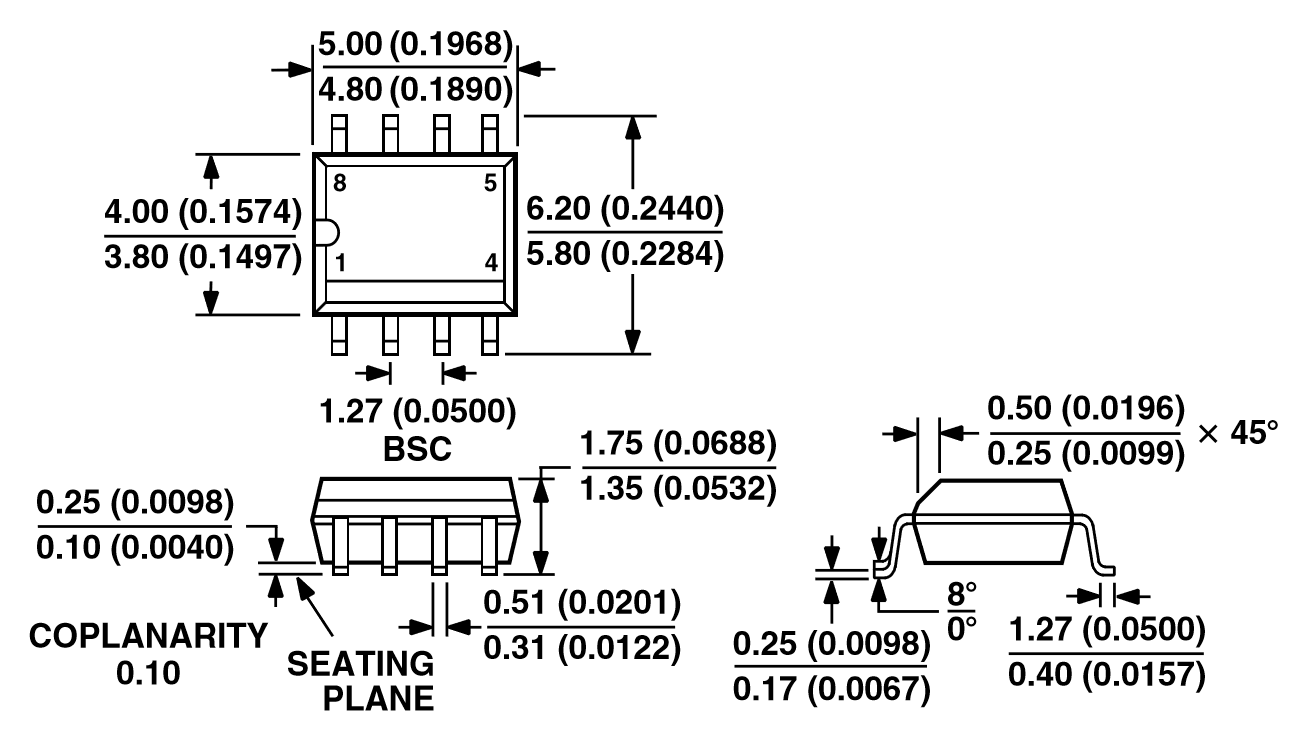
AD8009ARZ-REEL7 is supplied in the 8-Lead SOIC (ADI outline R-8), the standard 3.9 mm-body small-outline IC with 1.27 mm lead pitch. The "Z" in the part number marks the RoHS-compliant lead-free finish and "REEL7" the 7-inch tape-and-reel packing. The same AD8009 die is also offered in a 5-Lead SOT-23 (RT-5) for the smallest footprint. At 1 GHz the package and board matter: keep the SOIC's ground and supply pins tightly decoupled and the feedback loop short, so the layout does not become the bandwidth limit. Package dimensions and pin-1 orientation are shown below.
📄 Full specifications are detailed in the official Analog Devices AD8009 datasheet.
Pin and Signal Definition
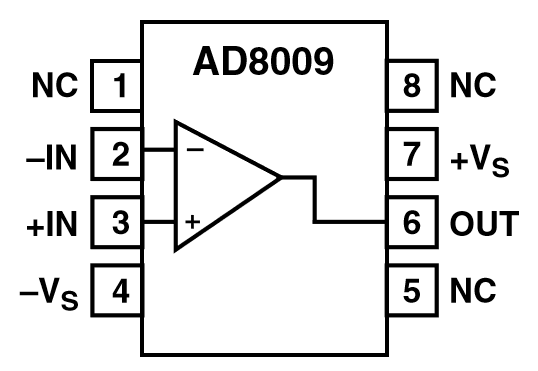
The 8-Lead SOIC uses the classic single-amplifier pinout; the three NC pins around the package edges help isolate the high-speed signal pins:
- Pin 1 - NC: No connect; leave unconnected.
- Pin 2 - -IN: Inverting input. In a CFA this is the low-impedance current-summing node - keep its trace short and clean.
- Pin 3 - +IN: Non-inverting (high-impedance) input.
- Pin 4 - -VS: Negative supply (-5 V, or ground in single-supply use); decouple close to the pin.
- Pin 5 - NC: No connect.
- Pin 6 - OUT: Amplifier output, sourcing up to 175 mA.
- Pin 7 - +VS: Positive supply (+5 V); decouple close to the pin.
- Pin 8 - NC: No connect.
Refer to the package drawing below for the physical pin numbering of the 8-Lead SOIC.
Alternative and Related Parts
The parts below are ADI high-speed amplifiers near the AD8009. They are not drop-in replacements; verify topology, bandwidth, feedback-resistor requirement and pinout before substituting.
| Part Number | Brand | Type / Key Difference | Package | Note |
|---|---|---|---|---|
| AD8001AN | ADI | Single 800 MHz CFA | PDIP-8 | Lower-speed current feedback |
| AD8002AN | ADI | Dual 600 MHz CFA | PDIP-8 | Two channels |
| AD8011AN | ADI | 300 MHz CFA, low power | PDIP-8 | ~1 mA supply class |
| AD8055AN | ADI | Single 300 MHz VFA | PDIP-8 | Voltage feedback |
| AD8056AN | ADI | Dual 300 MHz VFA | PDIP-8 | Two channels, voltage feedback |
Selection Tips: Stay with the AD8009 when you need 1 GHz-class speed with high slew rate and the gain flexibility of a current-feedback amplifier. For two matched channels, step to the dual AD8002 or AD8056; choose AD8011 when supply current must drop to the milliamp class. If the design prefers voltage-feedback behavior with no critical feedback resistor, the AD8055 (single) or AD8056 (dual) is the better fit despite the gain-bandwidth trade.
Manufacturer Information
Analog Devices, Inc. (ADI), headquartered in Wilmington, Massachusetts, USA, is a global leader in high-performance analog, mixed-signal and RF semiconductors, and the long-standing reference name in high-speed amplifiers. The AD8009 sits in ADI's high-speed current-feedback amplifier portfolio, a line developed over decades of leadership in fast signal-chain design.
ADI backs the AD8009 with full datasheet characterization, evaluation boards, SPICE models and application notes on current-feedback layout and stability - support that matters at gigahertz speeds, where the difference between datasheet and bench performance is largely a matter of applying the manufacturer's layout guidance.
Applications



Frequently Asked Questions
What bandwidth and slew rate does AD8009ARZ-REEL7 offer?
The AD8009 has a 1 GHz -3 dB small-signal bandwidth at gain of +1 (R_F = 301 Ω), 700 MHz at +2 and 320 MHz at +10, with a 5500 V/µs slew rate and 10 ns settling to 0.1%.
Why does a current-feedback amplifier need a specific feedback resistor?
In a CFA the feedback resistor R_F sets the loop bandwidth and stability, not just the gain. Use the datasheet value (about 301 Ω at G = +1): too small risks ringing or oscillation, too large gives away bandwidth. This is different from a voltage-feedback amplifier where R_F is a freer choice.
What supply voltage and output current does it support?
It runs from ±5 V dual supply (or a single +5 V rail) at about 14 mA quiescent, and the output sources up to 175 mA short-circuit current - enough to drive back-terminated coaxial lines and low-impedance loads.
What is the pinout of the 8-Lead SOIC?
Pin 1 NC, pin 2 -IN, pin 3 +IN, pin 4 -VS, pin 5 NC, pin 6 OUT, pin 7 +VS, pin 8 NC. The NC pins help isolate the high-speed signal pins; keep the inverting-input trace short as it is the sensitive node in a CFA.
Disclaimer
Information Accuracy: The specifications on this page are based on the official Analog Devices AD8009 datasheet. We work to keep the information accurate and complete, but parameters can change with product revisions, so design engineers should verify all values against the latest official documentation before final design.
Product Authenticity Guarantee: All parts we supply are genuine factory originals with full material traceability.
Technical Support: Pre-sales and post-sales technical consultation is available free of charge.
Application Notice: This page is for reference only. Suitability for a specific application should be confirmed by the design engineer against the actual system requirements.
AD8009ARZ-REEL7 Specifications
- Specifications
- Attributes
- Property Value
- Manufacturer
- Analog Devices Inc.
- Series:
- -
- Package/Case:
- 8-SOIC (0.154", 3.90mm Width)
- Packaging:
- Tape & Reel (TR)
- Part Status:
- Active
- Amplifier Type:
- Current Feedback
- Number of Circuits:
- 1
- SR - Slew Rate:
- 5500V/µs
- Gain Bandwidth Product:
- -
- 3 dB Bandwidth:
- 1 GHz
- Mounting Style:
- Surface Mount
- Current - Input Bias:
- 50 µA
- Vos - Input Offset Voltage:
- 2 mV
- Output Type:
- -
- Current - Supply:
- 16mA
- Current - Output / Channel:
- 175 mA
- Qualification:
- -
- Supply Voltage - Min:
- 5 V
- Supplier Device Package:
- 8-SOIC
- Grade:
- -
- Supply Voltage - Max:
- 12 V
- Operating Temperature:
- -40°C ~ 85°C
AD8009ARZ-REEL7 Relevant information
- AD8009ARZ-REEL7 Tags
- Popular Search
The following parts are popular search parts in Instrumentation, Op Amps, Buffer Amps.
The Posts
-
Exploring the Features of AN431AN - ATRG1 Voltage Reference IC
The AN431AN - ATRG1 is a significant voltage reference integrated circuit (IC) that plays a crucial role in maintaining stable voltage levels within electronic circuits. Engineered with precision, it o…
-
Unveiling the Wonders of XP1002000 - 05R Electronic Component
The XP1002000 - 05R is an electronic component that stands out for its specialized design and functionality, catering to a variety of electronic system requirements.Unique FeaturesOne of the most notab…
-
Unraveling the Wonders of MMBF170LT1 Transistor
The MMBF170LT1 is a remarkable transistor that has carved a niche for itself in the electronic component landscape. This tiny yet powerful device is engineered with precision to deliver outstanding per…
-
Unveiling the Marvels of MMBF170LT3G Transistor
The MMBF170LT3G is a high - performance transistor that stands out in the realm of electronic components. Engineered with precision, it brings a set of features that make it a valuable asset in numerou…
-
Unveiling the Features of RD16E - T1 - AZ Electronic Component
The RD16E - T1 - AZ is an electronic component that brings a set of unique features to the table. Its design showcases precision engineering, catering to specific requirements in various electronic set…
-
Unveiling the Capabilities of RD16ES - T1 - AZ Electronic Component
The RD16ES - T1 - AZ is a remarkable electronic component that combines advanced technology with practical design to meet the demands of diverse electronic projects.Electrical FeaturesOne of the key as…
Related Products
-
LM358DT
STMicroelectronics
-
LM358DR
Texas Instruments
-
LM2904DR
Texas Instruments
-
LM358ADR
Texas Instruments
-
LM2904DGKR
Texas Instruments
-
LM324DR
Texas Instruments
-
MCP6006T-E/OT
Microchip Technology
-
MCP6006UT-E/OT
Microchip Technology
-
LM324PWR
Texas Instruments
-
LM2902PWR
Texas Instruments
-
LM2902DR
Texas Instruments
-
LM358P
Texas Instruments


