Free Shipping Over$200

- Products
- Marking
- Alternative

Choosing a Temperature Sensing Part by Accuracy and Cost
Measuring temperature looks like the easy corner of sensing. Picking the part is rarely where a temperature design goes wrong; a reading drifts or sits high because the sensor reports its own junction temperature, warmed by its own bias current and tied to the board through a thermal path that never made it onto the schematic. The chip on the bench almost always meets its datasheet. What it is touching, and how fast heat reaches it, is the harder half.
Choosing well starts at the measurement and works toward the part. What is the target, what accuracy the job needs, and how a sensor can physically reach it are the questions that settle the sensing method; the part number comes into view only after. Put them in the wrong order and a design ends up with an expensive sensor fighting a thermal problem that a cheaper one, mounted better, would have solved. The same part can be right in one design and wrong in another for reasons that have nothing to do with the silicon inside it.
What accuracy means here
Accuracy on a temperature datasheet is several numbers wearing one word, and a design usually needs only one of them. Reading the part for which one it promises, and over what range, is the first step to take.
Absolute accuracy is how close the reading sits to the true temperature. It is the costliest to guarantee, since it has to be traceable back to a calibration standard, and it earns its place in a thermometer, a reference or a medical device, where the number itself has to be right. For a great many designs it is more than the job calls for, and a part often carries a tighter absolute spec than the application can even use. Tightening it further usually means calibrating each unit at test, which adds cost per part rather than once per design.
Repeatability is whether the same temperature always reads the same, and it is what a control loop quietly leans on. A loop holding a furnace at a setpoint never has to know the true value; it needs each reading to mean the same thing every cycle. Resolution is a third thing again, the smallest step the part reports, often finer than the accuracy, which tempts a designer into trusting digits the accuracy spec will not back up.
Long-term stability is the fourth, and the easiest to forget. A part can be dead-on in week one and wander a few hundredths of a degree a year, which stays invisible on the bench and turns decisive in a sensor meant to run untouched for a decade in the field. A datasheet often quotes its best accuracy only over a narrow window near room temperature, and the error widens once the part works outside that band. Which of the four a part is promising, and over what span, is what separates one that looks good on paper from one that survives the job it is given.
The parts that just hand you a number
The lowest-effort sensor is a chip that runs the whole chain inside itself and hands back degrees over a digital bus. For a board that needs to know its own temperature within a degree, the search often ends here. A small I²C part like the TMP102 for low-cost board temperature is accurate enough for fan control or for compensating another circuit that drifts with heat, and cheap enough to drop in without a second thought.
When the requirement climbs toward instrument grade, a tenth-of-a-degree part like the TMP117 holds that figure over time, near what a platinum sensor gives with none of its wiring. It costs more than a basic part, and in return it stands in for a whole RTD front end, which is the bargain it offers a design that needs the accuracy but not the plumbing.
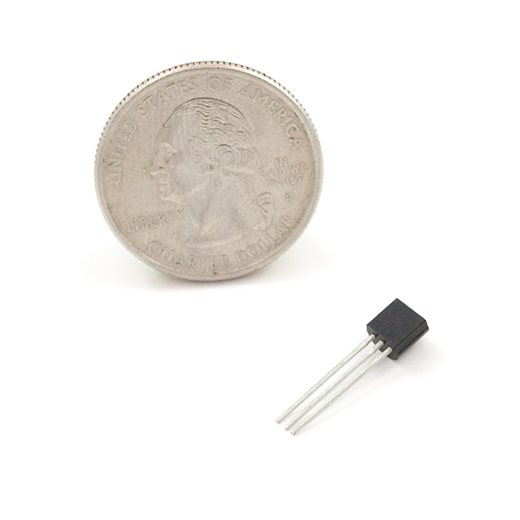
Where temperature has to be read at several points along a run, the DS18B20 on a one-wire bus puts many sensors on a single data line, each with a factory-unique address, and can even draw its power from that line in parasitic mode. The I²C parts above hit a wall here, since each type offers only a handful of selectable addresses, so a job with dozens of points leans on the one-wire scheme. A full twelve-bit conversion on a DS18B20 takes the better part of a second, quick enough for the cold rooms and server cabinets it gets threaded through, where the count of points weighs more than how fast each one refreshes.
The cheap analog ways
Before digital parts took the job, temperature was a voltage or a resistance, and those readings still win on cost and simplicity. An analog part like the LM35 puts out ten millivolts per degree straight into an ADC input, with no bus to drive and no driver to write. Its accuracy then leans on the ADC reference behind it, so the sensor is only as good as the voltage it is measured against. A plain one also cannot read below zero without a negative bias or a second supply, which catches out a design that meets it on a warm bench and later ships it somewhere cold. It stays a sensible pick where an analog path is already in use and a spare ADC input is free, since it adds nothing to drive and nothing to talk to.
A thermistor is cheaper again and reads as a resistance that drops steeply as it warms. An NTC thermistor such as the NTCLE100E3 is the part that sits in a battery pack or a charger, where the point is to flag a cell heating up and the firmware watches for a threshold. The cost shows up in the curve: an NTC is steeply nonlinear, so the code carries a lookup table or works the Beta-value equation, and its tolerance, the spread from one part to the next, sets how well that curve holds without calibrating every unit.
Getting the reading onto the board
The interface is part of the cost. An analog part takes an ADC channel and a clean reference to sit against. A digital part takes a bus address, and on I²C only a few of those exist for each type. A thermocouple or an RTD needs its own front end on an SPI line. On a crowded board running a single microcontroller, the channels and addresses still free can decide which family is practical before accuracy is even weighed.
None of this shows when a part is judged on its accuracy alone, and it is a common way for a tidy shortlist to fall apart late, once the chosen part turns out to want a bus that is already full.
Where the accuracy leaks away
The reason temperature repays more care than its simplicity suggests is that a sensor reports its own temperature, not the temperature of the thing you meant to measure, and the gap between the two holds the real error. Self-heating opens the list. Any part carrying current warms itself; a sensor biased at a milliamp can sit a few tenths of a degree above its surroundings, and a thermistor driven with too much excitation reads its own dissipation as a false rise, which is why low or pulsed bias matters once tenths of a degree are in play. The thermal path comes next. A sensor soldered to a board reads a mix of the air around it and the copper beneath, so a part meant for ambient gets dragged toward a nearby regulator through the ground plane, and a part meant to read a hot device reads low when it sits on a thin trace with poor contact. Heat also takes time to move, so the sensor lags: a bare bead may settle in under a second while a probe inside a thermowell can take many seconds, and a loop that samples faster than that constant is reacting to the sensor warming up while the process has barely moved. Drift closes it, as the calibration that held at shipment walks off over the years while the package takes on moisture and the die ages. None of this appears in the headline accuracy number, and all of it comes down to how the sensor is mounted and driven, with the part itself well down the list.
Probes for high heat
Past a few hundred degrees, no chip survives where the heat is. The sensor becomes a probe.
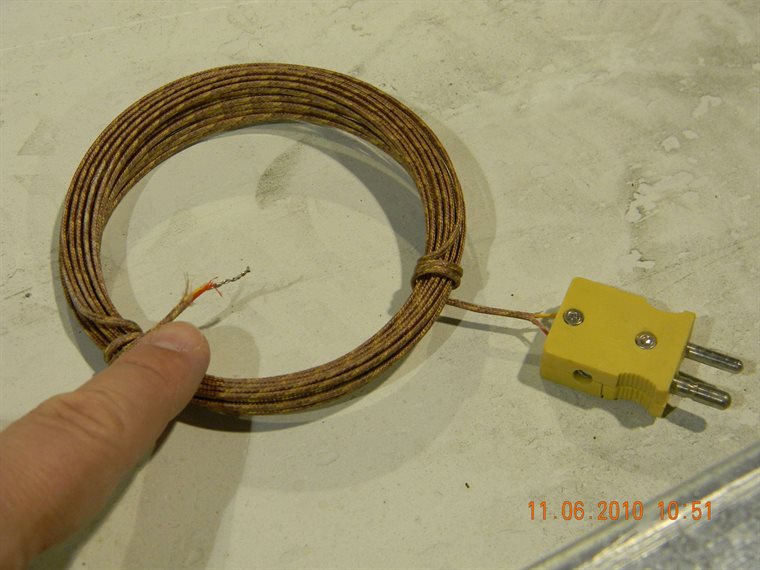
A thermocouple works on the small voltage that forms across a junction of two dissimilar metals, which lets it survive to several hundred or even past a thousand degrees, far beyond where silicon fails. The signal is small and nonlinear, and it means nothing except relative to the temperature of the terminal block where the wires land. The metal pair also fixes the range, so a K type covers the broad industrial span while a J or T type reads a finer signal at lower temperatures over a shorter reach, and the chosen type has to match the front end that linearizes it.
That terminal temperature, the cold junction, has to be measured and added back, and a bare couple cannot do that for itself. A front end like the MAX31855, reading a K-type couple with cold-junction compensation, handles the correction and the linearization together, turning a handful of microvolts into a reading the firmware can act on.
An RTD answers a different need, a narrower range bought back as higher accuracy and better stability. A platinum element changes resistance in a smooth, repeatable way, which makes a PT100 a near-reference choice up to a few hundred degrees and steadier over the years than a couple. A standard PT100 reads a hundred ohms at zero degrees and climbs by a well-defined coefficient, which is why one element from one maker can stand in for another with little fuss.
Reading it well takes a known excitation current and care with the lead wires, since the resistance of the leads adds straight onto the element and shows up as a temperature error. A part like the MAX31865, an RTD front end for a PT100, drives the element and supports the two, three and four wire connections that cancel that lead resistance to the degree a design needs. The excitation current needs care, since too much of it heats the platinum element and reads high, and a probe sheathed for protection answers slowly enough that a fast process can outrun it.
Measuring through the air
Some surfaces cannot be touched, a web moving past on a line or a person's skin, and infrared sensing reads the heat they radiate from a distance. A single-spot infrared part like the MLX90614 works this way, which suits a forehead thermometer or a quick check on a motor, as long as the emissivity of the target is known or close to what the sensor assumes. A field of view comes with it, so the reading is an average over whatever area the optics see at that distance. That spot grows with range at a fixed distance-to-spot ratio, and aiming a close-range part at a small target across a room ends up reading the wall around it as much as the target.
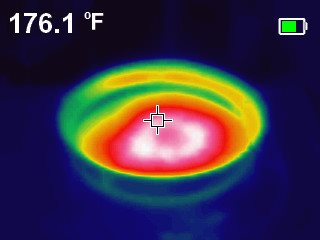
When a design needs a map of where the heat is, an array reads many points at once. A 32-by-24 thermal array like the MLX90640 returns a coarse thermal image, enough to spot a hot cell in a battery pack or a failing bearing without the price of a full thermal camera. Emissivity still governs the result, and a bright metal surface reads colder than its real temperature unless it is painted or taped over. The array also carries its own temperature reference to correct for the sensor heating up, and its frame rate is modest, so it maps slow thermal patterns and misses fast transients.
Across all of these the part is close to the last thing settled. The method gets picked first, out of what is being measured, how accurately, and how the sensor can reach it, and only inside one family does the choice come down to a single number on a datasheet.