Free Shipping Over$200

- Products
- Marking
- Alternative

Cooling AI Silicon That Throttles When It Gets Hot
AI silicon protects itself from heat by slowing down. When the junction crosses the temperature its maker set, the part drops its clock, sheds performance, and keeps doing so until the thermals recover, which means a board that cannot move its heat does not crash; it quietly delivers a fraction of the inference rate the silicon was bought for. Cooling on an AI device is not a mechanical afterthought. It is the part of the design that decides whether the compute that was paid for ever arrives.
The arithmetic is unforgiving. An accelerator that holds a sustained load turns nearly all of its electrical power into heat in a die the size of a fingernail, the heat has to cross a package, an interface, and an enclosure to reach the air, and every kelvin of temperature rise along that path is subtracted from the headroom the silicon has before it throttles. The parts that move the heat, the spreader, the interface material, the heatsink, the fan, are chosen like any other parts on the bill, against numbers.
The junction temperature is the whole story.
What throttling costs
Throttling is a contract written into the silicon: cross the limit and the clock falls, no negotiation. The mechanism is invisible in a demo, because a short benchmark finishes before the die warms, and it is merciless in production, where the camera streams all day and the accelerator runs every frame. The gap between a part's burst performance and what it sustains inside a warm enclosure is set almost entirely by the thermal design, and two products carrying identical silicon can deliver inference rates apart by half because one moves heat and the other stores it.
The honest specification for an AI product is the sustained rate at the worst ambient the enclosure will see, and that number is a thermal result before it is a compute one. Reading a module's data sheet for its throttle threshold, and designing so the junction stays under it at full load on a hot day, is the work this page is about.
From power to junction, by arithmetic
The tool that makes thermal design checkable is a chain of resistances. Heat flows from the junction through the package, the interface, and the cooling hardware to ambient air, each stage adds a temperature rise equal to the power times its thermal resistance, and the junction sits at ambient plus the sum. Working junction temperature from power and thermal resistance walks the calculation, and it is short enough to do on paper before any hardware exists.
The discipline is in using the right numbers. A data sheet's junction-to-ambient figure was measured on a standard test board in still air, conditions a real product never reproduces, so the honest chain is built from junction-to-case, through the interface material's contribution, through the heatsink's rating at the airflow it will see. Each figure carries its conditions with it, and a chain assembled from figures measured under different assumptions produces a junction estimate that is precise, confident, and wrong. The transient side carries its own trap and its own gift: a die and its spreader store heat, so a short burst rides on thermal mass and never reaches the steady-state temperature the chain predicts, which is why a design that infers in bursts can run cooler hardware than its peak power suggests, and why a design that runs sustained cannot borrow that trick. The figures themselves deserve suspicion in proportion to their precision. Junction-to-case assumes all the heat leaves through the lid, which a part that also dumps heat into the board does not honour; a module with several dies shares one spreader and the hottest die is not the average one; and a vendor's case temperature is defined at a point a thermocouple may not reach in the assembled product. None of this breaks the method, it prices the margin. The margin at the end is not decoration. Ambient was estimated, contact pressure varies unit to unit, dust arrives over the product's life, and the heatsink that was machined flat meets a package that is not. Ten kelvins of headroom between the calculated junction and the throttle threshold is the difference between a fleet that holds its rate for years and one that degrades the first summer. The calculation also points backwards: if the chain cannot be made to close at the power the silicon wants to burn, the choice is a bigger cooling system, a lower power limit, or different silicon, and finding that out on paper costs an afternoon where finding it out in an enclosure costs a tooling revision.
Run in reverse, the same chain sizes the cooling. Start from the throttle threshold, subtract the worst ambient, divide by the power, and the result is the total thermal resistance the design is allowed; the parts are then chosen to come in under it, with the margin counted before the shopping starts.
Paper closes the loop only when a measurement confirms it. A thermocouple on the case at full load, compared against the prediction for that point in the chain, validates every term upstream of it for the cost of an hour on the bench, and the first prototype that runs is the right time to spend that hour. A chain that predicted the case within a few kelvins can be trusted at the junction; one that missed by fifteen is hiding a wrong assumption that ships if nobody looks.
It is the cheapest analysis on the whole board, and the one skipped the time it matters.
Where passive cooling runs out
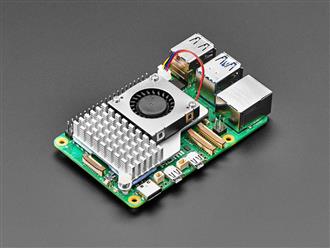
Passive cooling is the right first answer. A heatsink and natural convection have no moving parts, no noise, no bearing to wear out, no dust filter to clog, and for modest power in an open enclosure they carry the job for the life of the product. When passive cooling stops being enough for an accelerator is the boundary question, and the boundary is lower than intuition puts it.
Natural convection moves single-digit watts per reasonable heatsink in free air, and an enclosure cuts that further by trapping the warm air the heatsink just made. An accelerator that burns ten or fifteen watts sustained inside a sealed box has left the passive regime no matter how generous the metal, and the symptoms are a product that performs on the bench with the lid off and throttles in the field with the lid on.
The variables that move the boundary are surface area, orientation, and the path the warm air takes. Fins that line up with gravity so the air can rise through them buy real margin; a heatsink lying flat under a sealed lid buys mass and little else. A vented enclosure with a chimney path can double what the same metal carries sealed.
The decision belongs early because it shapes the mechanical design. A product that will need a fan needs the inlet, the outlet, the duct, and the service access drawn into the enclosure from the first sketch, and a passive product needs the fin volume and the venting budgeted before the industrial designer closes the form. Retrofitting either choice into the other's enclosure is where thermal projects go to fail.
A blower for a part that throttles
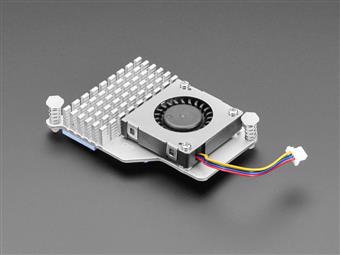
When the power crosses the passive boundary, air has to be driven. Pairing a blower with a part that throttles when hot is a matching problem rather than a catalogue search: a fan delivers flow against pressure along a curve, the enclosure and heatsink present a resistance curve of their own, and the system runs where the two cross. A fan chosen on its free-air number alone delivers a fraction of it through a real duct, which is the polite way of saying the loudest fan on the page can still be the wrong one.
The blower shape earns its place in thin, dense products: it takes air in axially and throws it sideways at higher pressure than an axial fan of the same height, which suits the cramped duct an edge box usually offers. Speed control closes the loop, with the fan driven by the silicon's own temperature so the product is silent at idle and loud only when the work demands it, and the control curve tuned so the fan ramps before the throttle threshold rather than after it.
The fan is also the one moving part on the board, and it ages like one. Bearing life is specified at temperature and falls with it, dust load rises over the years, and a fleet's fans are a consumable to plan for: a tachometer line the firmware watches, a failure response that drops the power limit instead of cooking the silicon, and a mechanical design that lets a fan be replaced without unsoldering anything.
The interface that earns its place
Between the package and the metal sits the layer nobody sees, and it routinely dominates the chain. Two flat surfaces touch on their high spots and trap air everywhere else, and air is an insulator, so the gap has to be filled. Choosing a thermal interface material that earns its place comes down to the resistance of the installed layer rather than the conductivity printed on the tube: a modest paste spread thin beats an exotic compound applied thick, because resistance is thickness divided by conductivity and the thickness is the term the assembly controls. Pastes give the thinnest layers and ask for clamping pressure and a repeatable dispense; pads forgive tolerance stacks and rough assembly at the price of a thicker bond line; phase-change films split the difference and hold their position through service. The choice is set by the mechanical design's gap and pressure, the production line's ability to apply it the same way every time, and the service question of what happens when the unit is opened five years in. An interface that was chosen against those constraints disappears into the chain; one chosen off the conductivity number alone shows up as ten unexplained kelvins between the case and the heatsink, which is the margin the whole design was supposed to keep.
What decides it
The junction decides, and everything is read backwards from it. The throttle threshold minus the worst ambient is the budget; the chain of resistances spends it; the parts are chosen so the sum comes in under the line with margin left for the real world.
Sustained performance is a thermal product. The silicon sets the ceiling, the cooling decides how close the product lives to it, and a competitor with the same chip and better airflow ships a faster box.
Supply has a thermal corner of its own. Fans are life-limited parts with lead-time habits, interface materials are formulations a second source has to match rather than imitate, and the design that names its alternates for both, before the first build, keeps shipping when either one goes on allocation.